Posts in It happened today
It happened today - August 12, 2015

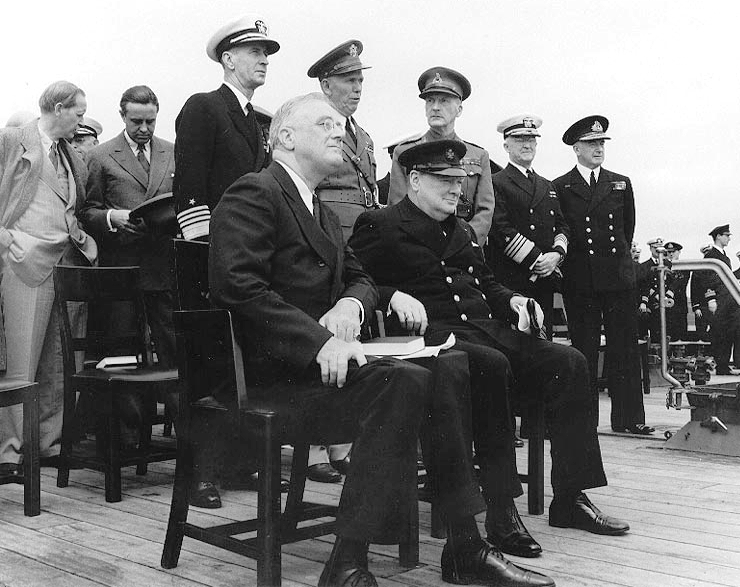
Roosevelt with ChurchillHow’s this for the Anglosphere? On August 12 of 1941, Franklin Roosevelt and Winston Churchill met on a ship in Canada to plan their joint strategy for the Second World War. (You can see a short video clip from that day, here.) They even issued a joint statement of war aims, the “Atlantic Charter”. Which shows astonishing boldness and deviousness at once, since the United States wouldn’t join the war for another four months.

I’m not a big FDR fan. I dislike his domestic policies, of course. And I also find the man off-putting in all sorts of ways from his nebulous political philosophy to his deviousness to his arrogance. It seems to me a highly revealing anecdote that he used to play poker with important Senators regularly (politicians had more time back then, not a bad thing) but if he lost he wrote cheques that, it was understood, would not be cashed. Even though he was richer than almost any of them.

I don’t much like his foreign policy either. It was for the most part characteristically flippant, arrogant and ill-informed. His position on Eastern Europe in 1944 and 1945, and his belief that he could manage Stalin like some rube ward politician from Kansas City, caused untold tragedy. And yet I will say, enthusiastically, that he realized early on that Hitler menaced the entire world and must be stopped.

He understood, when the chips were down, not only what Hitler was like. He knew Britain and America were part of a shared civilization. A copy of Magna Carta on loan from Britain was put safely in Fort Knox when the war broke out. And at the Argentia conference FDR and Churchill attended a church service with the two nations’ flags on the pulpit, after which British and American officers and men sang “Oh God, Our Help in Ages Past” and “Onward, Christian Soldiers.”

Roosevelt’s way of bringing his countrymen on board with his ideas and getting them into the war was characteristically devious, indirect and smug. I think he could have done more, earlier, and more honestly, and should have. (His engineering of incidents involving U-boats and the US Navy and his blatant lies about them were a model for Lyndon Johnson in the Gulf of Tonkin… and I don’t mean that in a good way.) And yet I must concede that he deployed his enormous talents in the dark arts of politics to bring about American entry into the war and though he rarely took a bold step directly in that direction, he never let up from the soft, persistent, indirect steps that led to the desired result and he did succeed.

In this respect curious “might have been” from the spring of 1941 intrigues me. By that the U.S. navy was cooperating with the British in all but name, patrolling the “Western Hemisphere” half-way across the Atlantic, reporting U-boats to the Royal Navy, and shifting battleships and carriers as well as cruisers and destroyers from the Pacific to the Atlantic. And when in May of 1941 the British were desperately hunting the German super-battleship Bismarck, the aging American battleship U.S.S. New York nearly ran into Bismarck on its way to replace U.S.S. Texas on patrol well past the supposed demarcation line of the “Western hemisphere”.

It was probably on purpose. I have no use for conspiracy theories about Pearl Harbor. But I do suspect FDR was hoping Bismarck would clash with New York and, quite possibly, sink her, giving him a casus belli against Germany which, he always understood, was more dangerous than Japan. (Despite Pearl Harbor, the U.S. always devoted more of its military effort to the European than the Pacific theatre until Germany surrendered.)

It might seem cynical to put American sailors in harm’s way in such a fashion. But FDR was a deeply cynical idealist. And much as I dislike the cynicism, I applaud without qualification his idealistic determination to get the United States into the Second World War somehow.

It happened today - August 11, 2015

https://www.youtube.com/watch?v=DPXL3iEVnCM On August 11 of 1965 the Watts riot erupted. In one sense it’s not at all surprising. In another it is. In a third it’s not. And in a fourth it is.

What’s not surprising is that a minor scuffle between two white policemen and a black motorist in the United States should have produced an explosion of black anger over what they regarded with reason as consistently bigoted policing. At any rate it’s not surprising to those of us living through a terribly predictable series of such incidents. No wonder black Americans were fed up.

Then again, it is surprising because the riot erupted eight days after the pivotal Voting Rights Act was passed. Not defeated. Passed. Finally, a century after the Civil War and formal emancipation, and nearly three and a half long and terrible centuries since the first black slaves were sold at Jamestown in 1619, the weight of the American government and of public opinion was solidly behind decent treatment for blacks. You’d think it would be cause for celebration, not for four days of mayhem over 50 square miles that had to be suppressed by the National Guard, leaving 34 dead (all but three of them black), over a thousand injured and millions of dollars in property destroyed.

Here it is important to recall Tocqueville’s comment that “the most dangerous moment for a bad government is when it begins to reform”. Now the United States did not have a bad government as these things go… provided you were white. For those within the charmed circle of American liberty under law, it was a very good government. And it was sort of OK if you were Hispanic. But it was horrible if you were black or aboriginal. And when the state, and the public, finally took off the white hoods, and black Americans could finally vent their rage and frustration without being lynched, and I mean that literally, it is no wonder their anger exploded.

Indeed, just 13 days after Lyndon Johnson’s other pivotal piece of Great Society legislation on race, the Civil Rights Act of 1964, had passed on July 3 1964, a race riot had erupted in Harlem, and there were others in Rochester, Paterson, Philadelphia and the Chicago suburb of Dixmoor that summer. But it was Watts that touched off the “long hot summers” of carnage that lasted into the 1970s, with the worst being the Detroit conflagration of 1967. (Incidentally there is a terrific YouTube video of Gordon Lightfoot’s song about that episode, Black Days in July; whoever did it really did a great job with the visuals on an already powerful piece of music.)

Which brings me to the other way the upheavals were surprising. They were so destructive. After waiting for so long for decent treatment I understand the anger. But in city after city black rioters burned down black businesses and properties and ruined black neighbourhoods. And in the aftermath, as the face of politics and administration began to reflect black majorities, literally, the policies adopted were left-wing folly that drove away jobs.

Detroit, for instance, has never really recovered from 1967, and now features abandoned homes, feral dogs and picturesque but haunting ruined public buildings. And it’s black kids who are trying to get to school in this wasteland.

What’s depressing and weird is that fifty years later, so many people still applaud destructive outbursts of black rage in America. Yes, of course it’s understandable. But it’s ruinous.

Normal people shrink from violent chaos, regardless of their race. At their next opportunity after Watts, Californians chose Ronald Reagan as their governor and Americans generally chose Richard Nixon. And if these were not entirely reasonable or, in Nixon’s case, happy choices, they too are comprehensible. “Burn, baby, burn” is an appalling and nihilistic doctrine and it’s past time it was consigned to the rubbish heap of history. It will elect conservatives, which those on the left don’t want. But it won’t heal wounds, which those on the left presumably do.

Of course there are many voices, black and white and every other shade of humanity, saying stop, enough, channel your frustration into something more constructive. Across America black mayors, police chiefs, councilors and state legislators are trying to build not destroy. But they’re fighting a powerful current of pure destructiveness. And when you read stories about things like the shooting of Michael Brown in Ferguson, by comfortable often white journalists including those in the country next door, be honest. Don’t you detect a weird note of satisfaction in their coverage of these disasters, as though more blatant bigotry triggering more rage, burning black businesses, more bitterness and lawlessness were the right way forward?

Consider that in Baltimore, where the suspicious death of a black man in police custody in April produced a wave of protest and riots and scrutiny of the police, the murder rate has since surged as police stay away from high-crime areas. Scrutiny of the police is always good in a self-governing society provided it is rational. But nothing else is good about that result, least of all the exposure of law-abiding residence of those areas to brutal chaos. It’s so bad the major, who is a black woman, recently fired the police commissioner, who is a black man. But what comes next?

Looking back in sorrow, Watts was at once an entirely reasonable and an entirely unreasonable response to the situation in 1965. But it was a bad response, for America and for American blacks. Fifty years later, surely it’s time that lesson was learned across the ideological spectrum.

It happened today - August 10, 2015

James SmithsonOn August 10 the Smithsonian Institution was authorized. What a characteristically American institution.

Oddly, it had its origins in the eccentric bequest of an English scientist named James Smithson who has a type of zinc carbonate named after him and who died in Italy in 1829 without ever visiting the United States. Should his only nephew die without heirs, Smithson’s will specified, his entire estate would be given to “the United States of America, to found at Washington, under the name of the Smithsonian Institution, an Establishment for the increase and diffusion of knowledge.”

His nephew died in precisely that fashion six years later, and with Congress’s blessing president Andrew Jackson sent a diplomat to England to collect 11 boxes full of Smithson’s money, minerals, books, notes and personal effects. His gold alone was worth over half a million dollars back when that was money (as was gold). And after puzzling over how exactly to fulfill Smithson’s inspiring but vague bequest, Congress passed an act establishing the Smithsonian Institution and on August 10 of 1846 President James K. Polk signed it into law.

The Smithsonian is now exactly the sort of sprawling, vital entity Canada doesn’t specialize in. It comprises 19 museums and galleries, nine research facilities and the national zoo. It boasts of being “the world’s largest museum and research complex”. Those components on the Washington Mall are must-visit sites for visitors to the American capital. (Smithson himself is buried there, by the way.) And while it depends on the federal government for 60% of its more than $1 billion budget, partly appropriations and partly contracts, it energetically pursues both donations and revenue from its shops, restaurants and other operations.

Where, I ask you, is anything remotely comparable in Canada’s capital?

So no offense to Smithson’s nephew. But he did the world a favour by not ending up having a family.

It happened today - August 9, 2015

On August 9, 1969, members of the “Manson Family” butchered five people in director Roman Polanski’s Beverly Hills house, including his pregnant wife, actress Sharon Tate. It was a horrifying incident with a major cultural impact.

Manson himself was the product of a miserably broken home, a lost and troubled soul who turned into a monster and attracted other lost souls and sucked them into his dark fantasies. But it mattered to a lot more people than those directly involved because of what it said about the 1960s project of total human liberation.

There was much that was good about the 1960s. First and foremost its commitment to racial equality. Also its re-examination of how women were often mistreated, its rejection of hostility toward homosexuals and casually demeaning labels. And certainly its awakening environmental awareness. But there was something very troubling built deep into its foundations: the conviction that because some rules and social institutions were unsound or badly distorted, all rules and social institutions were.

This idea, logically, led to the notion that freeing people from social conventions would create heaven on earth. It didn’t work. Instead it became clear that the concept of “original sin” had at least some definite validity, and that human institutions were flawed because humans were flawed.

That being the case, getting rid of all institutions, throwing the baby out with the bath water, was a recipe for disaster. And the very weirdness of Manson’s beliefs, his apocalyptic vision of a coming race war from which he and his followers could emerge as rulers of a black-dominated world, his conviction that the Beatles were sending him coded messages, underlined just how bad things would get if we did indeed let it all hang out.

In the short run, the shock of these murders and other unpleasant events from the fatal stabbing at the Altamont rock concert to the drug overdoses of famous musicians from Janice Joplin to Jimi Hendrix to Jim Morrison led to a conservative reaction. Manson himself was arrested and, in 1971, sentenced to death. When California abolished capital punishment the sentence was automatically reduced to life in prison, where he has amused himself drawing swastikas on his face. But in the longer term, the undermining of institutions from the family to established churches to standards of dress to public manners seems to me to have been impossible to arrest.

In his superb memoir of those years, Walking on the Edge of the World, journalist George Leonard wrote “Now that it’s gone, how can I recreate that time, that spring of 1966? The dazzling light, the ferocious, incandescent release of energy, the renunciation of all the repressions of the past, the crazy sense that each new day might bring something unexpected and wonderful. It was the season of Eros, when the only sin was to say no. And as for the shadows, they only made the light more vivid, more poignant. Sometimes I had a hollow feeling in my stomach. Maybe I was going to far. Maybe there would be retribution and pain; people I loved could be hurt in the pell-mell rush for transcendence. But maybe not. The air was filled with hope, and if we were falling, we were falling forward too fast to stop.” And so it proved.

That Manson himself became a minor cult figure is of limited importance. But the increasingly coarse lewdness of popular culture (by 1988 a band called Niggaz With Attitude could become a huge bourgeois success with “songs” whose names commentators cannot bring themselves to print, opening the door for a huge industry of “Gangsta Rap” that violates every tenet of political correctness with impunity), skyrocketing rates of illegitimacy and divorce, a surge in crime that tapered off recently at levels far above those of the 1950s, collapsing educational and behavioural standards in schools, all these and many more developments indicate something unclean got loose in our public life.

I do not regret the gains of the 1960s. But I very much worry that we proved fundamentally unable to learn from its excesses.

It happened today - August 8, 2015

Rios MonttHere’s a weird one. It’s 22 years since Efrain Rios Montt was ousted as dictator of Guatemala by his own defence minister after just over 17 months in office.
It might seem just one more sordid chapter in the long unhappy story of Latin American politics, even though Rios Montt is the first former head of state to be tried for genocide by his own country’s courts.

He was convicted and given 80 years in jail, 50 for genocide and 30 for crimes against humanity, but promptly appealed and it’s still going on; as he is 89 he will not really face justice in this world now. And he has much to answer for; his rule was brutal, albeit in a troubled time.

Guatemala was embroiled in a bloody civil war at a time when Latin America was threatened by Soviet subversion. It does not excuse war crimes. But it does underline that the situation seemed desperate.

Which is why there is something I find very revealing about Rios Montt’s otherwise grim tale. Very unusually for a Latin American public figure, he was an evangelical Protestant, a Pentecostal in fact. And rather than hiding this polarizing and unpopular fact, he delivered sermons on the radio on Sunday evenings the whole time he was president.

I was much struck by this at the time for a reason that might seem rather dry. But stay with me here.

Much analysis of politics, especially non-democratic politics, is built on the assumption that people like Stalin or Hitler are only interested in power, or rather obsessed with it. Their ostensible beliefs are taken to be merely tools for manipulating the masses or deceiving foreigners in their mad lunge for formless, purposeless power.

I have never agreed with that, or at least not since Richard Gregor’s third-year undergraduate seminar at the University of Toronto persuaded me that the driving force behind Bolshevism was, well, Bolshevism. And I think Rios Montt is a case study because his vocal championing of an unpopular, outsider religion primarily associated with the United States had no possible utility in his “quest for power”.

Quite the reverse, it threatened it by making his people regard him as an unstable weirdo and somehow un-Guatemalan, especially given his already controversial close ties to the Reagan-era U.S. including the CIA, and to Israel. (His own brother is a respected Catholic bishop who headed an investigation into his human rights violations.)

Other factors contributed to his downfall, factors more significant than his sermonizing. But the fact remains that there’s only one possible explanation for this off-putting proselytizing activity: He believed in it. And if that can be true of a weird and peripheral aspect of the beliefs of an otherwise minor dictator, then it can be true of weird but central aspects of the beliefs of more dangerous tyrants.

It happened today - August 7, 2015

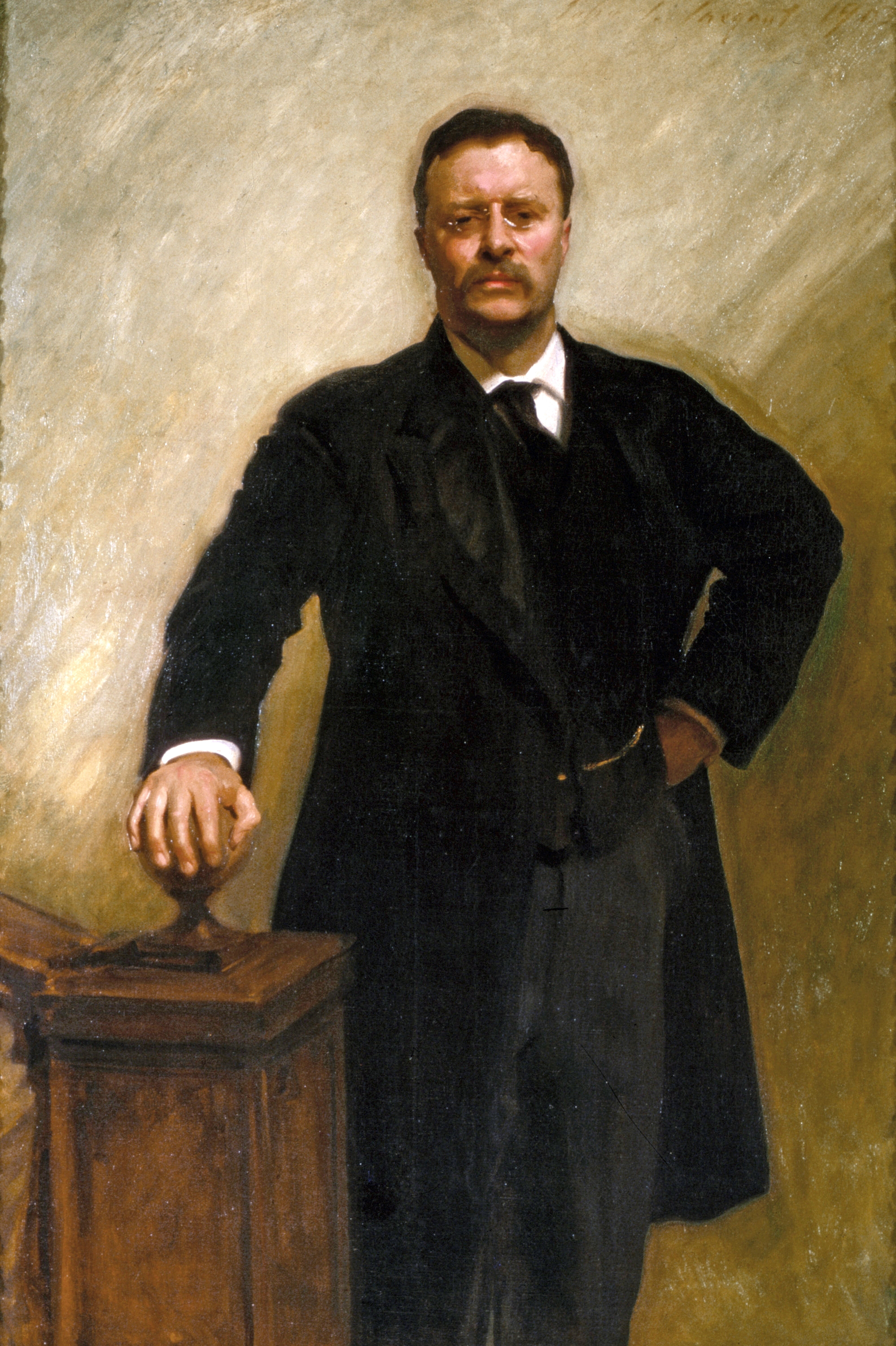
Theodore Roosevelt Teddy Roosevelt is a genuinely admirable, if genuinely weird, figure in American history. But August 7 is not a good day in his life because on that date, in 1912, he was nominated for president by the “Bull Moose” party.
Why is that bad? I mean clearly this is an embarrassing name for a political party. OK, formally it was the “Progressive” party, and it stood for causes like women voting, direct election of the U.S. Senate, tariff reduction and other reforms. But it was pretty universally known as the Bull Moose party thanks to TR’s characteristically colorful description of himself as “fit as a bull moose” and ready to run.

One cringes at a grown man, even “Teddy” Roosevelt (a nickname he hated, BTW), standing next to a running mate (Californian Hiram Johnson) who was holding a sign saying “I want to be a bull moose/ and with the bull moose stand./ With antlers on my forehead/ and a big stick in my hand.” There’s nothing good about that except the reminder when politics today seems unspeakably mindless that it has rarely been an elevated pursuit. But then, if cringe-worthy moments reduce you to jelly you shouldn’t even think of running for office.

No, what’s bad about this renomination is how he got here and where it led.

Roosevelt, you may recall, was a reformist Republican, a progressive and a war hero, who was chosen as a ticket-balancer for the very successful President William McKinley’s reelection campaign in 1900. McKinley’s previous VP Garrett Augustus Hobart having made his one and only mark on history by dying unexpectedly at age 55 in 1899 which brought TR to the White House because McKinley won the 1900 election and then was assassinated by an anarchist in September in the only politically motivated assassination in U.S. presidential politics.

It didn’t work. Whatever assassin Leon Czolgosz disliked about McKinley, he would not have liked TR better (he never got the chance, being executed on October 29, 1901). An aggressive domestic reformer who sought to save capitalism not replace it, Roosevelt was an active, sometimes hyperactive yet prudent nationalist geopolitician abroad, speaking softly while carrying a big stick, driving through the Panama Canal so the U.S. Navy could operate in the Atlantic and Pacific simultaneously, winning the Nobel Peace Prize for mediating the Russo-Japanese War, and warning the Kaiser against excessive pressure on France in the Moroccan crisis of 1906.

So what’s the problem? I’m glad you asked.

In 1908 Roosevelt felt to run again after serving the bulk of McKinley’s term and then being elected in his own right in 1904 would violate the spirit of Washington’s example of refusing to seek a third term. Instead he essentially forced his own choice of successor on the GOP, his friend and trusted subordinate William Howard Taft.

Taft won in 1908. But he hated being president and wasn’t good at it. By 1912 TR had soured on Taft and wanted “his” party back. But Taft resented the way Roosevelt treated him, including over the nomination, and refused to step aside. Roosevelt childishly chose to run on a third party ticket and, by splitting the Republican vote, handed the election to the creepy, haughty, moralistic, bigoted and highly ineffective Democrat Woodrow Wilson, who was therefore president in the critical year and a half leading up to World War I, and utterly failed to rise to the occasion.

Indeed, even once the war started Wilson failed to grasp what was at stake. When a German U-boat sunk the Lusitania and the Germans used poison gas in Ypres, Wilson priggishly declared himself “too proud to fight”. As late as 1916 Wilson dismissed the war as “a drunken brawl in a public house” of no concern to Americans and campaigned on the slogan “He kept us out of the war” before blundering into it without making military preparations. Far better for the world if he’d jumped in in 1914.

Better still, much better, if the U.S. had deterred the war by making clear to Germany that an attack on France, and war with Britain, meant war with the United States. And I am entirely confident that TR would have seen the necessity of such deterrence and acted with characteristic decisiveness. Even Taft would probably have grasped the danger of Germany’s lunge for world domination, especially given suitable advice and backing from his former mentor.

Why, then, is what happened instead mainly Roosevelt’s fault? For starters he should have found himself something useful to do after 1908. I applaud his respecting the spirit of Washington’s self-denying refusal to seek a third term. But as a relatively young and absurdly energetic man he was bound to get in trouble otherwise. For another thing in his deteriorating relationship with Taft he let his childish side get the better of him.

Taft, for his part, should have swallowed Roosevelt’s ill manners and stepped aside from a job he didn’t like and knew he wasn’t good at. But he didn’t, in large part because of the way Roosevelt mistreated his former friend and protégé. I mostly blame TR because he was the dominant figure in their relationship and on the national stage. And this absurd spat had incalculable evil consequences for the world by allowing World War I first to erupt and then go on so long with such a destructive demographic, economic and moral impact on Western civilization.

It happened today - August 6, 2015

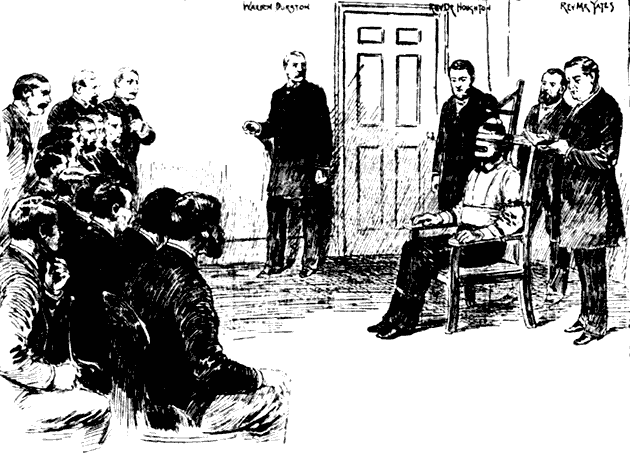
Sketch of Kemmler's executionAugust 6 saw a classic breakthrough in the name of the progress we all seem to worship today when, 55 years before the first atomic bomb was dropped on Hiroshima, William Kemmler was the first man executed in the electric chair.

Now I have no problem with bombing Hiroshima. It was a legitimate act of war and moreover it saved millions of lives, mostly Japanese. And the American nuclear arsenal has kept the world more peaceful since than at any point since the 19th century Pax Britannica began to break down. Si vis pacem, para bellum.

I also have no problem with capital punishment. There are crimes God can forgive that man cannot. Frankly I don’t think Kemmler’s hatchet murder of his common-law wife was in that category. He was a drunken failure with a tough and disorderly life and I think when such people kill in a drunk and disorderly way they should generally get a long prison sentence not a death sentence.

I would reserve the death sentence for crimes of a kind of calculating embrace of great evil: sexually sadistic killings, planned mass murders (including terrorism), treason and so on. But that’s not my issue here.

My concern is with the way the mania for progress led people to hook up this new-fangled electricity to the justice system. There was even a lively debate whether to use alternating or direct current; J.P. Morgan, backing Thomas Edison’s direct current for general use, wanted the electric chair to be on alternating current partly to prove AC was dangerous. But why use electricity at all?

Was there any suggestion that hanging, beheading or a firing squad didn’t work? Were they somehow cruel or unusual? I know some people think the death penalty is inherently so. But if you grant that it is not for purposes of argument, did traditional methods inflict a demeaning amount of pain over an unreasonable amount of time in a disgusting way?

The electric chair certainly did. Kemmler’s death was evidently gruesome, though not everything the yellow press printed in its effort to sell papers through lurid sensationalism should be believed. But it took a couple of tries and did certainly create the stench of charred flesh. As George Westinghouse, the main entrepreneur behind alternating current, said afterward, “They would have done better using an axe.”

Indeed. Kemmler’s attorney’s unsuccessfully appealed on the basis that electrocution was cruel and unusual. It seems to have been then, and sometimes is to this day. But even if it could be designed so as not to be, it’s certainly weird and unnecessary.

I get the superficial appeal of “new and improved” for a breakfast cereal. But we ought to be immune to such claims, and to fads, when it comes to serious things like taking a human life after due deliberation. Especially when the claim is clearly false in this case.

An ax was good enough for Charles I and a rope for Adolph Eichmann. And they’re good enough for me.

It happened today - August 5, 2015

Cyrus West FieldSomebody send a congratulatory telegraph please. Today is the anniversary of the first cable laid across the Atlantic back in 1858. Much windy political self-congratulation followed before it failed the next month. But it was fairly quickly replaced, proving that globalization is old news.

The cable was largely the work of an American businessman named Cyrus West Field. And it would be, the United States being in the vanguard of progress by the 19th century (as well as being the world’s most conservative nation, a paradox that confounds its critics and sometimes its admirers). And the idea also appealed to Samuel Morse, who had thought up the telegraph in 1832, and invented Morse Code so you could use it once it got built, and was of course also American. In May 1844 Morse inaugurated the world’s first commercial telegraph line by tapping out “What hath God wrought” from the U.S. Capitol, where a plaque commemorates the feat, to a train station in Baltimore.

Which is appropriate given how the telegraph and railway shrank time and space so dramatically; within a decade there were over 20,000 miles of telegraph cable in the United States, much of it running along the rapidly spreading railway lines, especially in the North, whose dramatic economic “modernization” gave it crucial advantages over the South in the Civil War. By 1860 there were 50,000 miles of telegraph wires and 30,000 miles of railroad track, most in the North.

On the other hand, I think “What hath God wrought” was a singularly inappropriate message for a medium that man had wrought in his project of overcoming the limitations of nature including, as we got on into the 20th century, human nature. And the Victorian enthusiasm for this electronically linked world ought to give us at least some pause as we type rubbish with our thumbs about how cool we are surfing a wave of mid-19th-century hysteria.

Completion of the cable was greeted by hundred-gun salutes in Boston and New York (where torch-waving celebrants accidentally set City Hall on fire). As Tom Standage notes in his fascinating The Victorian Internet, “‘Our whole country,’ declared Scientific American, ‘has been electrified by the successful laying of the Atlantic Telegraph.’” Meanwhile the London Times enthused that “Since the discovery of Columbus, nothing has been done in any degree comparable to the vast enlargement which has thus been given to the sphere of human activity.” Moreover, it added with some justice, “The Atlantic is dried up, and we become in reality as well as in wish one country. The Atlantic Telegraph has half undone the Declaration of 1776, and has gone far to make us once again, in spite of ourselves, one people.’” And by 1880 there were nearly 100,000 miles of cable across various oceans from Britain to India, Africa, Australia and of course Canada. Email, here we come.

And the global village. One early advocate for an Atlantic telegraph wrote in 1846 “All the inhabitants of the earth would be brought into one intellectual neighbourhood.” And when the U.S. Senate moved into its new chamber on January 4, 1859, U.S. Vice President John C. Breckinridge burbled that “the strifes and uncertainties of the past are finished. We see around us on every side the proofs of stability and improvement…. Future generations will not be disturbed with questions concerning the center of population or of territory, since the steamboat, the railroad and the telegraph have made communication almost instantaneous….”

Regrettably we experienced less improvement in what we communicated than how, from the firing on Ft. Sumter to Hitler’s radio propaganda to Kim Kardashian trying to break the Internet with her surgically enhanced backside.

By the way, Queen Victoria’s telegraph to the hapless President James Buchanan, which took 16 hours to transmit, included this banal passage: “The Queen desires to congratulate the President upon the successful completion of this great international work, in which the Queen has taken the deepest interest”. And Buchanan’s reply called the telegraph “an instrument destined by Divine Providence to diffuse religion, civilization, liberty and law throughout the world.”

If not, doubtless TV or Facebook will get it done. Or holographs and fibre optics. Or something.