Posts in It happened today
It happened today - August 20, 2015

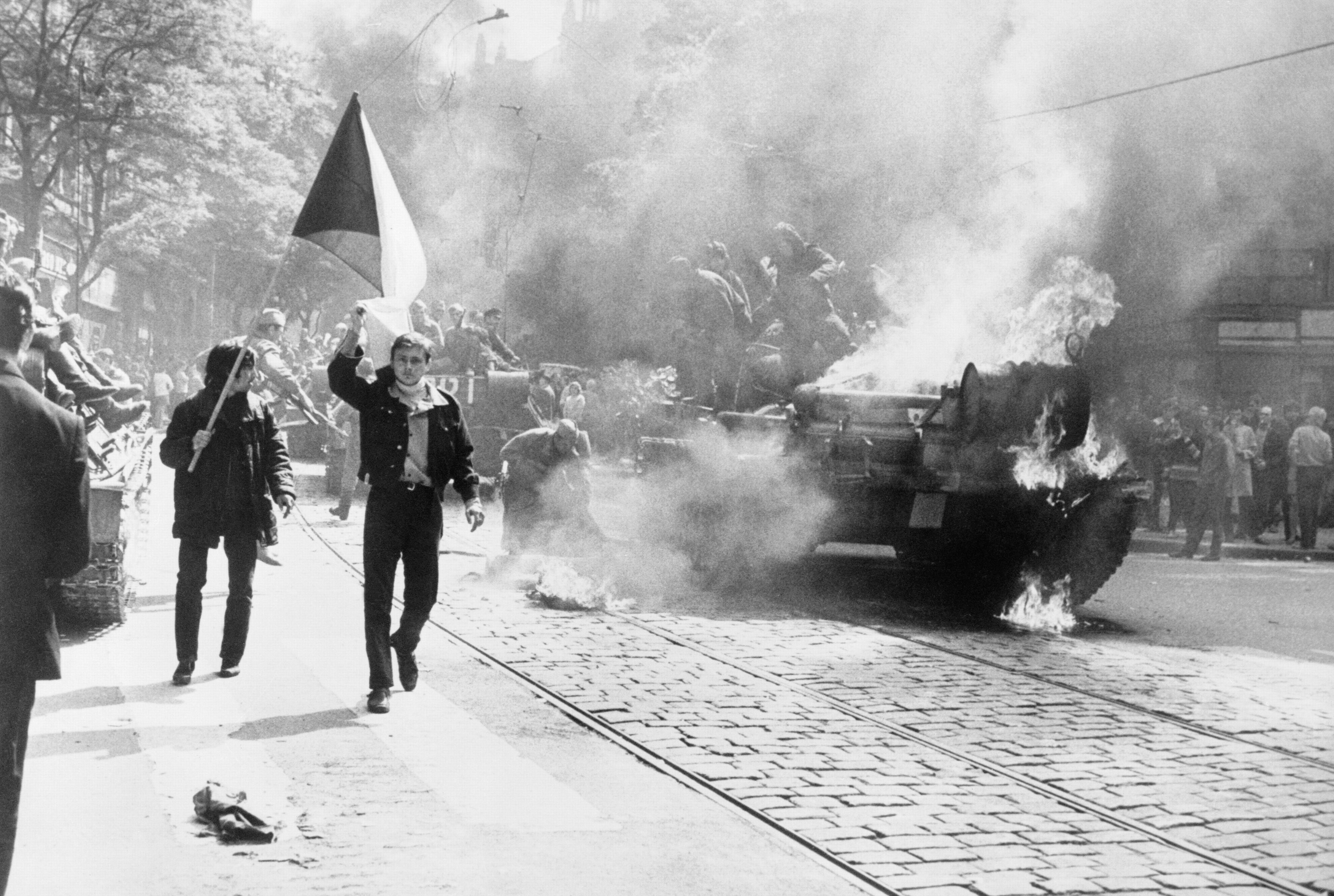
nullWhile I’m on the subject of coups, and bad actions by the Soviet Union, it’s worth noting that this is the anniversary of the Red Army rolling over the Prague Spring back in 1968 and showing that what Czech Communist Party secretary-general Alexander Dubcek called “socialism with a human face” had a tank tread mark on that face. It was a salutary shock at the high water mark of 1960s radicalism in the West.

In 1968 the American hippie movement was in full swing, or stagger, toward Woodstock the next year. Haight-Ashbury was still cool. Yippies and yappies and whoknowswhatskis were disrupting the Democratic Nationjal Convention in Chicago shouting things like “Down the tube with Hube the cube” (a slogan I admire without sharing its sentiments entirely). And in France the slogan “sous le pavé, la plage” was helping oust Charles de Gaulle.

When the squares tried to argue that such disruption was dangerous to the West, including being disruptive of national security, or as a fall-back that it was only possible in the West, the burst of reform behind the Iron Curtain beginning in January 1968 appeared to prove that “flower power” really was superior, that Mao had been wrong about political power growing from the barrel of a gun, and that in the Age of Aquarius peace would guide the planets and love would steer the stars.

The Soviet intervention put a fairly complete stop to all that chatter. It was tyrannical, brutal and brazenly deceitful. And as events continued to unfold in the West, including ousting Nixon over Watergate, it became clear to most sensible people that the two systems were not equivalent, the United States was not Amerika, and that protests only worked in societies that made a determined effort to respect them.

Radicals did not abandon the dream of revolutions in race relations, the economy, Western foreign policy, gender relations and elsewhere. Some of these ideas were better than others. But the debate over all of them was pulled back in a more sober and reasonable direction by the extraordinary contrast between the crushing of the Prague Spring and the continuing and widening debate over flaws in Western societies.

I am sorry Czechs and Slovaks had to pay such a high price. I wish peaceful transformation could have swept the East Bloc. But all too often the world is not like that and when it is not you need to notice it and act accordingly.

It happened today - August 19, 2015

Men in Teheran celebrating the coupSpeaking of coups, this is the anniversary of one of the world’s most infamous, the CIA-backed 1953 overthrow of Iran’s Mohammed Mosaddeq that restored the Shah to power. It seems to have been a very bad idea.

With respect to Iran particularly, the Shah’s regime was eventually toppled by the modern world’s first Islamist revolution, the 1979 seizure of power by Khomeini, with further frequently ominous consequences.

The revolution that sent the Shah packing had helped elect Ronald Reagan (which was good) and emboldened radicals in Afghanistan (which was bad) leading to the Soviet invasion (which was worse) whose failure helped undermine the decrepit Soviet regime (which was good) and brought the Taliban to power and led to 9/11 (again bad) which inspired further generations of death-loving jihadis (worse).

Of course these are indirect effects and you can’t hold the architects of the 1953 coup directly responsible for what happened 26 years later. It’s a tangled web as human events typically are. But they’re not totally unrelated to the events of 1953 and the impact they had on Iran’s political processes and culture. And it gets more tangled as we look beyond Iran and its neighbours, because the overthrow of Mossaddeq was important for another reason as well.

It was the archetypal sinister CIA coup on behalf of resource-extraction multinationals who supposedly dictate American foreign policy. To be sure, this conspiratorial vision was always a left-wing fringe view. But it exerted considerable pressure on the more moderate left, especially in radical periods like the 1970s, and what happened in Iran in 1953 was one of their key pieces of evidence. As G.K. Chesterton rightly noted, “most arguments are not about what is true, but about what is important if it is true.”

The more radical critics of American policy in the Vietnam, and Reagan, eras, argued that the fact that the CIA was behind the overthrow of a “reformist” and a “democrat” and the installation of a pro-Western strong-man in an oil-rich Middle Eastern country was important. And many people found it hard to argue that it was disquieting.

One wonders what Washington gained that made these losses worth risking.

There might be a good answer, namely decades of stability in the world’s most chronically volatile region. The Shah was a disappointment as a modernizing strongman but it was not possible to foresee that result back in 1953; he was what trendy liberal development theory said was needed. He favoured land reform, women’s rights and a dynamic middle class, and he opposed full democracy because his people were not yet “ready” for it (obviously his rule didn’t get them readier but, as I say, most enlightened people back then thought it would).

Possibly it was better for Iran to collapse into radicalism in 1979 than in 1953, especially if you lived in the former. Iran as a militarily strong and pro-western power on the eastern edge of the Middle East and the southern border of the then-vigorous Soviet Union was certainly a force for stability in a place that needed it during the more threatening period of Soviet expansion.

Still, I’m not saying I would have supported the coup at the time. Mossadeq was no saint despite the usual rhubarb from the left. And incompetence on his part might have invited Soviet adventurism of a highly dangerous sort. But his failure might have led to a more reasonable regime or, indeed, a restoration of the Shah that didn’t have the CIA’s fingerprints all over it. Since you can’t foresee all the results of your actions, it’s often better not to be too clever by half and do something disagreeable in itself, sinister-looking, and of gravely uncertain benefit.

I don’t think this coup passes that smell test.

It happened today - August 18, 2015

Yeltsin stands on a tank Here’s something you don’t want on your resume: On August 18 1991 Communist Party hardliners launched one of history’s most inept coups against Mikhail Gorbachev. What were they thinking?
The coup had no popular legitimacy, many of its leaders were evidently drunk, their claim that Gorbachev was ill was preposterous and, in an event all-too-rare in Russian history, the populace rallied to defenders of constitutional government including many in uniform who refused to carry out orders from the brass to crush resistance.

As too often in Russian history, it ended badly for almost everyone. Gorbachev continued to loosen the iron grip of Communism (remember, he was in power because he was Secretary General of the Communist Party of the Soviet Union), letting the Baltic States go and ultimately dissolving the Communist Party and resigning in December.

Boris Yeltsin, hero of the hour for standing up to the coup and rallying the public, became 1st president of the post-Bolshevik Russian Federation. But he proved unable to govern, turned increasingly to authoritarian methods without success, and the sinister Vladimir Putin took over as the populace collapsed back into apathy and worse. And the coup leaders were disgraced and jailed or, in one case, committed suicide.

Looking back, what strikes me as remarkable is that the coup leaders actually believed they could succeed. It shows how people can get so accustomed to a particular way of doing things that as it collapses in on them, options start vanishing, the walls close in, they cannot see anything but the usual system working in the usual way.

Insulated from public opinion and honest advice (Yeltsin tried to resign from the Politburo in 1987 over issues including obsequiousness to Gorbachev and was not allowed to, but was fired in 1988), they had no idea what was going on and no realistic awareness of the infamous “correlation of forces” meant to guide the chilly calculations of the true Marxist-Leninist.

These men were not giants, of course. They were classic late-Soviet-era dismal worn gargoyles with, in P.J. O’Rourke’s classic phrase, “steel teeth and cardboard suits”. But it’s one thing to be cruel and unimaginative and quite another to be clueless and launch a coup attempt whose only possible outcome can be to depose yourselves. And yet the complacent tunnel vision they displayed is all too common when those in power begin to lose their grip on a situation and don’t even know it.

Arguably it’s true of Vladimir Putin as well. But it’s certainly not confined to Russia. It happens to governments, businesses and other organizations throughout the world.

Just make sure it’s not happening to you.

It happened today - August 17, 2015

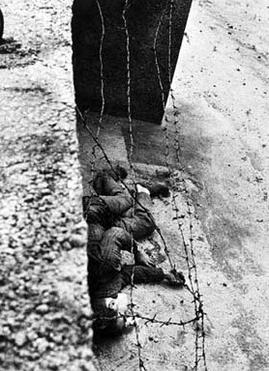
The body of Peter Fechter lying next to the wall Whatever doubt existed about the real meaning of the Berlin Wall should have ended on August 17 1962, almost exactly a year after construction on it began, when East German guards shot a man trying to escape and left him to bleed slowly to death in full public view.

The original excuse for the Wall was to keep spies and saboteurs out. Virtually no one believed that, of course, including Nikita Khrushchev, who knew that a generation of the most talented and energetic young people from Eastern Europe were escaping the metaphorical “Iron Curtain” through Berlin and put a literal one in place to stop them. Khrushchev did genuinely believe in the long-run superiority of the Soviet system. But he knew the truth about the concrete emplacements and barbed wire.

A few “useful idiots” in the West nevertheless took Khrushchev’s excuse at face value, of course. Mind you, despite Lenin’s pungent phrase such people are generally quite useless and, curiously, rarely idiots in the literal sense. Rather, as Orwell noted back in 1945, “One has to belong to the intelligentsia to believe things like that. No ordinary man could be such a fool.”

You’d think even they would see the light after this appalling episode, in which one fugitive made it to the west despite numerous barbed wire cuts while the other, shot repeatedly, died slowly in great pain while western guards threw him bandages and a crowd gathered and called for those on the eastern side to help him.

I actually feel sorry for the East German guards, forced to watch because if they had intervened they too would have been shot. It was not they but the regime, and behind it Moscow, that stood staring in stony indifference.

The amazing thing is that for many of the years the Berlin Wall stood its meaning continued to be ignored. It was an unmistakable tribute to the horrors of Bolshevik tyranny, a regime that could not survive with open borders because everyone would leave. And yet academics, pundits, and agitators in the West repeatedly claimed the two systems were fundamentally equivalent, which required them to nod and wink at the lie that the Wall was fundamentally protective even though as history.com acidly notes, “In the nearly 30 years that the wall existed… no one was ever shot trying to enter East Berlin.”

If only such self-delusion were as much a thing of the past as the actual Wall. But it is still with us today and, I imagine, will be as long as freedom and oppression square off over the barbed wire.

It happened today - August 16, 2015

Elvis Do you realize that if Elvis Presley were alive today, he’d be dead? No, really.

The idea that Elvis did not die back on August 16, 1977 rapidly went from a sentimental fad to a stock joke, with him abducted by aliens, going back to his home planet in Men in Black, living in suburbia, appearing on the Simpsons.

Revealingly, I wrote that last bit before bothering to Google and there he is in eight separate episodes in one way or another. He would be. He’s that kind of icon. But here’s the thing. Elvis was born on January 8, 1935. So if he were alive today he’d be 80. And there isn’t much about his lifestyle that suggests longevity, from the speed to the fried peanut butter sandwiches. He’d have died older at some point in between.

Yes, older. It’s odd how if someone dies prematurely, they are fixed forever in our minds as being that age. It is true that, for instance, all those boys who lie in rows in Normandy really are forever 21, or 18, or 27 in the sense that they did not get to experience growth into full adulthood and then maturity and worse. Age did not weary them, nor the years condemn. But there is therefore no 42-year-old version of them to imagine “if they were alive today” in the 1960s, and no 90-year-old version for today.

Likewise we have no 75-year-old Elvis to imagine hiding somewhere and smirking at all the fuss in 2010. If he didn’t die, we somehow suppose, he’d be 42 from then on though, ideally, without all the sequins. I’m a pretty big Elvis fan, but his wardrobe and his sound did get a bit off the rails in the 1970s. Still, who among us? The point is, when people first denied that he was dead, he would have looked much the way he did in 1977. But gradually he’d have kept getting older. Until one day he didn’t.

I remember being more than a little surprised by this consideration in the case of my own father, who died fairly young 20 years ago. I’d been thinking what he might look like “now”, partly by comparison with a cousin who had always looked a lot like him and is now well past the age at which my father died. And then it struck me that had he not died when he did, time, chance and various health problems would probably have gotten him at some other point since anyway.

In my mind there were only two conditions; him being alive and him dying on the actual day he did. But of course there are plenty of other scenarios and in all of them, at some point, the curtain comes down. Ditto for Elvis Presley.

So even if “Elvis lives” he dies eventually. And almost certainly in the past by this point.

It happened today - August 15, 2015

Woodstock posterThey say if you can remember Woodstock you weren’t there. And indeed I did not attend the giant countercultural rock festival that began on August 15 1969. So I’m allowed to remember it. And I do, mostly in a good way.

Indeed, as I tell my students in modern American history, Woodstock is the high point of “the Sixties”, the moment it looked as though it might all actually work. In the eyes of “the squares” a gigantic free rock concert, with people taking strange drugs and doing casual sex, would end in murder and rapine.

It didn’t. On this occasion there would be no “I told you so” from Nixon’s comically orthodox VP Spiro Agnew. It looked as though it really would be possible to find a new and better way, based on love not hate, peace not war, giving not taking, a genuine dawning of the "Age of Aquarius” (the festival was billed as “An Aquarian Exposition”).

Even Jimi Hendrix’ iconic closing performance of The Star Spangled Banner was splendidly affirmative and inclusive. No quoting Mao here, no Che Guevara.

Of course it didn’t work. All sorts of dark forces were getting loose, from the Manson Family to the disaster at Altamont a month later to the drug-overdose deaths of musicians including Hendrix. I think nothing better underlines the fundamental unworkability of the dream than the endless calls of “Show us your tits” at a festival billed as “Woodstock ’99”.

Young women persuaded by feminists that desexualizing your body by doing exactly that is the key to liberation might want to reconsider whether raucous cheers from the frat house backbench really spell empowerment. It turns out there are sound reasons for “repressive” social institutions that restrain our baser impulses including men’s. But there are also things wrong with a society divided, frantic, bitter, overly mechanized and processed.

In the end the stars they could reach in August 1969 were, indeed, just starfish on the beach. But for all that, there was something beautiful and noble as well as fragile about the original Woodstock idea of finding a better way. So without losing our judgement, or our sense of human depravity, we should try to remember what they thought was wrong and cherish what was good about their ideas for making ourselves and our society better.

It happened today - August 14, 2015

Three Saints BayThe Russians are coming. The Russians are coming.

Actually that’s old news where Alaska is concerned. The first permanent Russian settlement there, Three Saints Bay on Kodiak Island, was established by fur trader Grigori Shelikhov back on August 14, 1784.

Today it seems like a pretty no-hope venture. But the Russians got as far south as northern California by 1812, before being firmly dislodged by the British and Americans. Eventually Moscow gave up on Alaska and, desperate for money, sold it in 1867.

If that result doesn’t surprise you, it’s worth considering why it doesn’t. After all Russia, like France and Spain, was no slouch at expansion in its heyday which, in all cases, lasted some centuries and which in the Russian case the sinister Vladimir Putin is trying to fan back into flames. Russia managed to grab Siberia, a prize largely deserving of Voltaire’s unfair “quelques arpents de neige” jibe about Canada and then some. But in all three cases, France, Spain and Russia, the heavy hand of government, so apparently useful in pushing a colonial venture forward, has the paradoxical effect of draining it of vitality, turning it into a source of weakness not strength.

In the 18th century, many nations’ colonies looked more impressive than Britain’s. But the big coloured swaths of New France, New Spain and so on, at least on a map, were substantially empty of committed settlers and swarming with officious bureaucrats. Meanwhile Britain’s colonies, from Canada to Virginia to Australia, were dynamic.

Sometimes so much so that they revolted. But of course that story ended happily, with Britain and the United States shoulder to shoulder in the great conflicts of the 20th century, and Canada, Australia and New Zealand right there with them. There is no equivalent French or Spanish breakaway flourishing ally. To say nothing of Russia’s recent squalid annexation of Crimea and its designs on Ukraine, neither of which it has any idea how to govern decently.

So yes, a permanent Russian settlement in Alaska and into North America was never probable. And a good thing too.

It happened today - August 13, 2015

Ronald ReaganRemember Ronald Reagan? The conservative who actually ran on what he believed in, brushed aside liberal contempt with his own, rallied a nation and restored America’s greatness? Oh yeah, that guy.

Well, on August 13 of 1981 he signed the Economic Recovery Tax Act (a.k.a.Kemp-Roth) into law. Along with a subsequent bill in 1986, it cut the top marginal rate on high-income earners from 70 to 30% and helped trigger a long boom including the personal computer revolution. Looooooser.

Reagan was of course mocked for his “supply side” economics during the 1980 campaign. All urban sophisticates knew that deficit spending stimulated the economy and that there was a tradeoff between inflation and unemployment. True, both were skyrocketing at that point but never mind. Keynes said big government was the answer and by golly it was the answer people wanted.

As noted, Reagan mocked the mockery, and unleashed the creative energy of the American people instead of that of the American government. And he was hardly the unlettered senile moron of liberal mythology. He instinctively understood the Laffer Curve and the arguments of people such as, particularly, Jude Wanniski in The Way the World Works. But he also understood them in much more detail than most newspaper columnists believed. And he put them forward with conviction.

Maybe we could try it again, huh? People seem to feel that the United States is over the hill now, a fading power, divided and over-governed. Well, what do you think was going on in the 1970s? If the Land of the Free could have marginal tax rates over 70% then (and that was down from the 90%+ of the dreaded Eisenhower era, admittedly inherited from FDR). And people think Canada is hopelessly and irrevocably a big-government country.

It is of course true that the United States ran deficits under Reagan and budgets continued to grow not shrink. It’s not all his fault; Congress passes budgets, not the president, and the Democrats controlled the House and didn’t give him everything he wanted. Still, if he’s to get credit for pushing through tax reform he can’t hide in the bushes on spending, on which he did not fight as hard or as successfully. But revenue was up under his lower tax rates from where it had been forecast to be under Carter’s higher ones.

It’s a bit odd that having mocked supply side economics before it was introduced on the grounds that it could never work, liberals proceeded to start mocking it for having worked the wrong way, for having made the rich richer and the poor poorer blah blah blah. Hey, at least it did work. And you’d think conservatives would have something good to say about it.

Instead we are all, as Richard Nixon infamously said in 1971, Keynesians now. Stephen Harper and company ran deficits in the face of hard times with all the enthusiasm of Barack Obama and more, indeed, than FDR himself ever mustered.

Perhaps Reagan was a better role model, there and here. Perhaps an appropriate legacy would have been a dramatic reduction in tax rates, instead of endless loopholes, big deficits and meddlesome arrogance.

At least, you know, for conservatives.