Posts in It happened today
It happened today - September 5, 2015

On September 5, 1957, an unknown writer named Jack Kerouac won the reviewers’ lottery when the New York Times raved about his second novel. As Kerouac’s girlfriend told a journalist, “Jack went to bed obscure and woke up famous.” Which is odd given the 1950s’ reputation for mindless conformity and the Times’ reputation for sober respectability.

Now On the Road actually is well-written. If you are willing to be, Kerouac will sweep you along on his Romantic odyssey of the intensity of being in the moment. But it’s also a dark, bleak book, full of characters who are not merely messed up but conspicuously incapable of compassion or kindness (and its attitude toward women would not play well with radicals today). Apparently it was cool to be a “Beat”, that is, into the beat of jazz but also beaten by a world of conformity, capitalism and nuclear warheads. (The Beatles, incidentally, chose their name as youthful poseurs adopting this attitude, though they later grew into genuine greatness.)

The weird thing is, non-conformity was totally “in” in the 1950s as it is today. (As I have before, I strongly recommend Rebel Sell to anyone thinking of adopting the nonconformist habits and attitudes of the majority right down to tattoos and expensive coffee.) Indeed, one of the great puzzles of the 1960s, properly understood, is not how hard the push against the Establishment was but how feeble the counter-push when there even was one.

As Richard John Neuhaus would later recall, in First Things in 2006, about his own days as a protest marcher, “It is hard to remember now the ways of the old establishments, before their institutions came under assault from what we loosely call the sixties. In those days, for instance, the National Council of Churches was a national pillar comparable to, say, the American Medical Association. We, the young radicals, were on fire with anti-establishment rhetoric, and I was rather taken aback when the establishment evidenced such eagerness to be part of the movement against itself.”

Or to quote Digby Anderson in National Review, who had no such past, “the … question… about the erosion of our moral and family structure. It is not: How competent was the attack? But, How incompetent was the defense? Why did Middle America and Middle England roll over in the Sixties and allow mantra-moaning youngsters to walk all over them?”

How indeed? There are many reasons “the Sixties” were what they were, the shock of recognizing deep-rooted racial injustice foremost among them. But if you look more closely at “the Fifties,” you realize that most of the serious intellectual work of what would become the counterculture was done then (or in the late 1940s), from C. Wright Mills to Norman O. Brown to the appalling Alfred Kinsey. And the Establishment, then as now, was trendy and shallow and keen to be “hip”.

Hence everyone watched Rebel Without a Cause and read On the Road and didn’t think hard about the underlying message as long as they were “with it” by doing so. There’s something false about the book in the end. Including the Romantic legend of him writing it in a three-week inspired frenzy when in fact he laboured on it for six years. But what’s more important is that Kerouac himself was a wretch who died a decade later of alcoholism. Which is pretty much what you’d expect reading the book.

If, that is, you read it carefully for meaning not coolly for effect. It’s surprising how few people did in the allegedly strait-laced Eisenhower Era.

It happened todayJohn Robson
It happened today - September 4, 2015

Augustus resigns the crown to OdoacerSpeaking of Rome, spare a fleeting thought for Romulus Augustus, the last emperor of the classic “Western” Roman Empire, deposed on September 4 back in 476 by a German barbarian named Odoacer who then gave himself the surprisingly modest, even cheesy title of “king of Italy". You knock off an emperor, I’d think you’d at least claim to be one.
Mind you, it wasn’t much of an emperor; a figurehead for his father’s own usurpation, he was known derisively as Romulus Augustulus (“little Augustus”). And there was little of Augustus about him, though he apparently survived somehow for more than 30 years after being hurled off the throne. And there wasn’t much of an empire left by the time Odoacer, a mercenary before he mutinied (a common problem as the Empire crumbled), put a formal end to it.

In another sense, though, the Roman Empire never fell. I’m not referring to its Byzantine half, which stumbled ingloriously through various difficulties and bequeathed us the adjective “Byzantine” for politics noted for excessive complexity and cynicism even by the dismal standards of the human race before fizzling out in 1453. Nor is the subsequent resurrection of the “Holy Roman Empire” convincing; as Voltaire cuttingly put it, it “was neither holy, nor Roman, nor an empire”.

What I mean is that Rome, the civilization where the rule of law first got a real solid footing, never fell culturally. I’m not even sure it fell politically except in the very formal sense. For in all the lands once subject to Rome except those conquered by Islam, and those settled from such places, a different view of government has prevailed ever since, one that accords more dignity to the individual in practice than is found elsewhere.

Rome is, famously, the place where Athens met Jerusalem, where skeptical philosophy and monotheism fused in Christianity. But it is also a place where the words “Civis Romanus sum” (“I am a Roman citizen”) brought real legal protection. And when the idea that individuals had rights on Earth met the idea that they mattered to God, the result was a very different way of seeing life and the world.

When Rome fell, the “Middle Ages” officially began. Or, in some tellings, the Dark Ages that led to the Middle Ages that were also bleak and dark. But it’s not so. There was a kind of light in Western Europe not found elsewhere, that would have been familiar to the Romans and to some extent the Greeks but not to anyone else.

To be sure, many horrors were perpetrated in what came to be known as “Christendom”, often by people loudly proclaiming their piety. But the fact remains that if you’re looking for a decent place to live, a place migrants flee to not from, you’re basically looking inside the successor states and cultures to the Western Roman Empire. That’s why I say in a very real sense the Roman Empire lived on with great power and dignity.

Unlike Romulus Augustulus, who merely lived on somewhere. No one can now find his bones. Odoacer’s dynasty, too, petered out pretty fast. But we still live in the shadow of Rome or, more truly, the light.

It happened todayJohn Robson
It happened today - September 3, 2015

France declares war on Germany On September 3rd back in 1939 Britain and France bit the bullet and declared war on Germany. It can’t have been an easy decision and I admire them for it.

Of course their problem was largely self-inflicted; they wound up having to fight Hitler over Poland because they’d chickened out over Czechoslovakia 12 months earlier, betraying an ally to buy time for an enemy. As Churchill told Neville Chamberlain when he came back from Munich, “You were given the choice between war and dishonour. You chose dishonour and you will have war.’”

Not only that, they got worse war. I’m pretty sure the Allies would have beaten Germany easily in a war in 1938; Czechoslovakia was well-armed and hard to conquer, its terrain utterly unsuited to a Blitzkrieg. Hitler’s rearmament program was considerably less advanced. And the Nazi-Soviet Pact had yet to be signed.

Indeed, I’m pretty sure that had Britain and France mobilized when Hitler sent his troops into the Rhineland in 1936, German generals would have overthrown this despised upstart Bohemian corporal and the whole mess could have been avoided. And while I understand British and especially French reluctance to face another war so soon after the horrors of World War I, which literally decimated France (one third of men between 18 and 45 in 1914 were killed, another third wounded), those who prefer dishonour to death surprisingly often get both.

Certainly France bit the dust pretty fast after going to war over Poland, and Britain came frighteningly close. Mind you, French losses from 1939-45 were far smaller than they had been between 1914 and 1918, although French generals managed to squander a surprising number of soldiers’ lives in the utterly futile effort to stop the Nazis in the spring of 1940. Yet I doubt that many in France preferred a reasonably bloodless defeat once it had happened. War is not to be undertaken lightly, but neither is appeasement, which generally just means fighting in a worse spot later. Certainly it did in this case.

The leaders of both nations must have known in 1939 that they were in a tight corner largely of their own making. But in such situations politicians generally prevaricate and procrastinate. They did neither, and whatever one thinks of their conduct to that point, and however badly the war turned out for Poland, they did find their courage and their principles in 1939 (one rarely finds the latter without the former). And for that they deserve praise.

It happened todayJohn Robson
It happened today - September 2, 2015

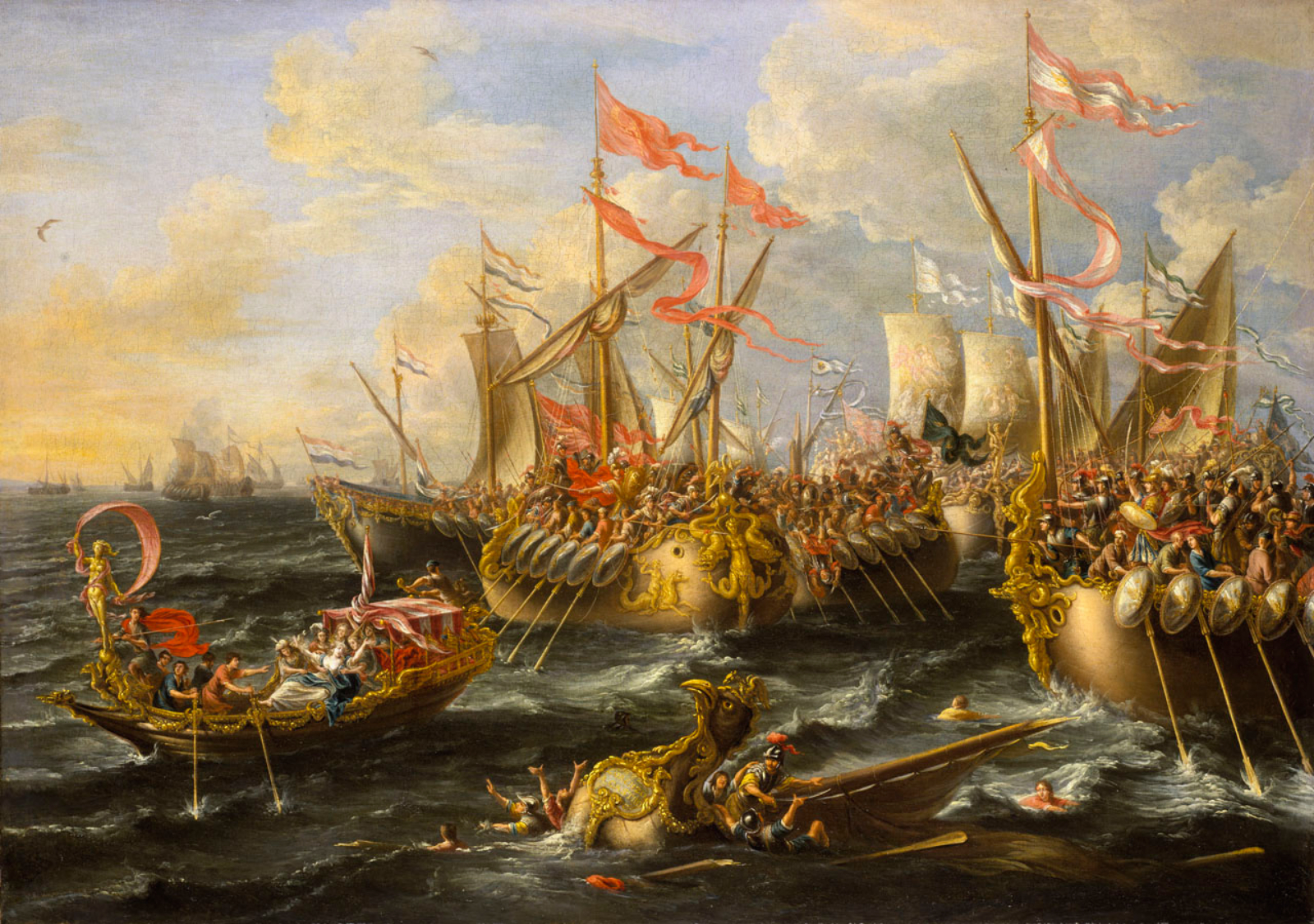
Battle of ActiumHistory is full of what-ifs, and you can lose yourself in them. Everything can come to seem so highly contingent that no real patterns emerge. What if Hitler had been killed in World War I? What if Washington had died as a child? What if either man’s grandfather had been dead drunk and made a horrible impression the first time he met his future wife? And yet we study history because there are patterns.

All of which brings me, obviously, to the battle of Actium, on September 2 of the year 31 B.C. I know, I know, it all seems so long ago now. As C.S. Lewis once wrote, when he lectured on the origins of Christianity to R.A.F. members he expected them to be skeptical because the stories the Gospels told involved miracles. Instead, he said, “my impression is that they disbelieved them simply because they dealt with events that happened a long time ago: that they would be almost as incredulous of the battle of Actium as of the Resurrection – and for the same reason.”

So would I please get to the point and say what happened at Actium? Certainly. Octavian crushed the navy of Mark Antony and Cleopatra, who fled to Egypt where they later killed themselves. Octavian, once he defeated them in a final battle at Alexandria, went on to become the Emperor Augustus and the Roman Republic was buried for good. Not least because both Augustus, who denied being Emperor (Princeps or “First Citizen” was the only title he permitted), and his successor Tiberius were benevolent dictators.

Somebody somewhere, and to my great frustration, said there’s nothing more dangerous to liberty than a benign despot and I think it was Augustus he was talking about. At any rate, the collapsing political structure of the Roman Republic was replaced by an Empire very smoothly in part because Augustus ruled so long (41 years) and so well and so did the oft-maligned Tiberius (23 years). By the time you got to the Caligulas and Neros no one remembered how it used to be and, to be fair, no one had a solution to the problems of the republican system anyway. So probably a centralized and autocratic system was coming anyway, and part of Augustus’ contribution was to be an outstanding administrator as well as an excellent military leader. And the world has much to be grateful for in the long and comparatively benevolent effects of the Roman Empire. (As Louis L’Amour of all people said, and this quotation I could find, “Even during the dark days of Nero and Caligula, the Roman Empire was governed well. The terrors they brought were largely spent on their associates at court; the administration in the provinces was only slightly affected, if at all.”)

It was also the Roman Empire that facilitated the spread of Christianity despite official hostility lasting centuries. And yet one writer (Josiah Ober) in a collection of “What if” historical essays called, of all things, What If?2 suggested that

“If Antony had won at Actium, Jesus of Nazareth… would have come to manhood in a very different society – one administered by highly trained Ptolemaic bureaucrats, rather than nervous Roman amateurs like Pontius Pilate. Those Ptolemaic bureaucrats would have had a much closer sense of how Jerusalem politics worked: they might well have found some solution to local concerns about a self-proclaimed messiah that would not have required his crucifixion.”

I don’t know about that on all kinds of grounds. But one is that Antony seems to me to have been gormless and Cleopatra fey. As a couple they just weren’t going to end up winning the war; they reinforced one another’s bad habits. I rather suspect that the debacle at Actium was a perfect miniature summation of everything wrong with them as a “power couple” who were unable to seize power for the same reason they would have been unable to wield it if they had won. And to suggest that absent Tiberius and company the whole Jesus thing would have been quietly set aside is to apply too much hindsight.

Indeed, to anticipate the impact of the crucifixion on world history rather requires being a Christian; otherwise killing this guy looked like the standard and doubtless highly effective solution to the minor ruckus he and his tiny band of shabby followers were causing. And in fact from the Roman point of view there was never any reason to regret it or, indeed, to notice it much. It’s not as though the crucifixion led to a flurry of memos back and forth and recriminations; apart from two mentions by Josephus and one by Tacitus, all we know about him comes from the Gospels.

Obviously we can never decisively answer any “What if”. But I think it’s fair to say that Anthony lost at Actium because he was a loser, and Augustus won because he was a winner, who went on to reshape Roman politics in a highly effective manner that many people agreed was necessary and that worked reasonably well for a long time.

So Actium went pretty much as you’d expect it to, looking forward or backward.

It happened todayJohn Robson
It happened today - September 1, 2015

Passenger footwear Thirty-two years ago today the wanton Soviet destruction of KAL-007, a Korean passenger flight carrying 269 people, was a significant turning point in the Cold War.

It was just one of countless brutal atrocities carried out under the hammer and sickle. And yet somehow, at a delicate moment in the moral and military rearmament of the West under Ronald Reagan, it laid bare the thuggishness and mendacity of the Bolshevik regime in ways hard to ignore.

Hard, not impossible. There are always some useful idiots willing to downplay the most brazen acts of evil by enemies of the open societies. But for reasonable people concerned that Reagan was the unreasonable one, that American foreign policy was often harsh and unfeeling, the brutality of the initial shooting down of a clearly marked passenger plane with lights on was turned from a tragic mistake into a stark illustration of the nature of the regime by the stone-faced dishonesty of the various cover stories put forward.

The initial shooting down of the plane could have been explained, even partly excused, by a trigger-happy pilot, overly rigid operating procedures, an excess of caution, a cruel or drunken commander. KAL-007 was, in fact, off course and over Soviet airspace when shot down, and the Soviet airspace in question, over the Kamchatka peninsula, contained sensitive secret military installations. But the inhuman response, the icy lack of contrition or regret, indicted the whole system.

What the Soviets really communicated, beyond any rational doubt, was that they were not sorry for what they had done. Their various specific lies about the plane being a spy plane, flying blacked out and so on were hardly relevant and too horrible to be tragicomic. The fact that the pilot responsible clearly indicated what he was tracking, was ordered to shoot it down, obeyed the order and was subsequently decorated revealed plainly the difference between a system that made mistakes and a system that was a mistake, between those who sometimes did wrong in pursuit of right and those who were on the side of darkness.

I remember well a political cartoon at the time showing one of the many peace marches of that period (all in the West, of course) with pieces of the plane raining down on horrified participants with the caption “red rain”. To be concerned about nuclear war and “superpower tensions” was reasonable, even to some extent commendable. But to portray the Cold War as a standoff between morally equivalent rivals was never reasonable. And incidents like this one drove that point home to all but the most bitterly angry radicals.

The West would, I am confident, have won the Cold War anyway. But there was enormous opposition to Reagan’s policies at the time, and horror at his rhetoric, his characterization of the Soviet Union as an “evil empire” destined for the “ash heap of history.” Its conduct in this lamentable episode could not have been better designed to prove him right.

It happened todayJohn Robson
It happened today - August 31, 2015

Wanted On this day back in 1888 Jack the Ripper killed the first victim definitely linked to his series of murders. And if his goal was to become famous, he certainly succeeded. He continues to fascinate us. But why?

Certainly the 20th century has seen far worse horrors, including serial killers with far higher body counts. And Jack the Ripper is far from the worst among uncaught, unidentified serial killers. And yet the interest persists.

When I was hired at the Ottawa Citizen back in 1997, one of the earliest Essay pieces we published purported finally to identify the Ripper. And yet another book has now made this claim about a different man, fairly plausibly as far as I can see (it says the killer was hiding a leaf in a forest, murdering a series of prostitutes to conceal his motive in killing his own wife for taking to prostitution). But so what?

I’m not indifferent to the victims. Every human life matters and the fact that someone had a sordid and unhappy life is no reason to be any less concerned to protect them if possible and avenge them if necessary. But it won’t help them, or anyone else, very much to find the perpetrator now. And if it is important, well, there are countless unsolved cold case murders we could be equally worried about.

Of course the Ripper’s crimes were especially gruesome, earning him his nickname. And while death is rarely an entirely pleasant affair, there are better and worse ways to go. But again, and regrettably, he’s far from alone in inflicting agonizing humiliating deaths on his victims. Indeed, the Ripper did not abduct and torture as too many serial killers do. Much of his mutilation followed the fairly quick deaths he inflicted.

Perhaps the fascination lingers because he operated in Victorian London, inflicting sudden grotesque death in a setting as generally placid and civilized as mankind has ever seen. It’s not entirely a complacent or reactionary stereotype; the murder rate in late 19th century England was low, though not as far as we can tell significantly lower than it is today. But this sort of grotesquely random violence might fascinate us, and horrify us, not only because of a generic human dread of being suddenly yanked out of our mundane activities into a hideous death but because it suggests that there is nowhere we can hide. Even if we managed to recreate a society as formally devoted to the stiff upper lip, high standards of conduct, and restrained manners, evil would still stalk us.

I suppose it’s possible that if we could identify him, even so many years later, it might help to reduce that feeling, to give us some sense that ultimately evil will be found out. It would not give the victims back the life and dignity he stole, of course, but it would let us know what happened and maybe even explain it to some degree, the how, the who and some of the why, depriving evil of some of the power it derives from its vastness and unknowability.

Indeed, speaking of evil and explanation, it’s also possible that the Ripper fascinates us because the singularly dreadful and dehumanizingly weird mutilations he inflicted suggest that if we could just look on his face we would at least be able to inspect pure evil, interrogate it, and understand it.

I doubt it. My guess is that as with modern serial killers, including those involved in state mass slaughter like Adolf Eichmann, if you actually saw the Ripper close up, in a photo or illustration, and knew it was him you’d see banality, mediocrity, a surrender to evil by a weak personality not a dazzling exhibition of it by its bold and original fount. The manifestations of evil are generally squalid not grandiose, and he’s unlikely to be an exception.

So yes, it would be nice to identify him, to close the book on the case and say over the victims’ graves that we do know why you died or, failing that, we at least know who killed you. It would also put a stop to books and articles finally unmasking him again. But in the end, the Ripper does not matter that much. He does not matter as much as his victims.

He is more famous than he deserves to be.

It happened today - August 30, 2015

Fania KaplanOn August 30, Lenin was shot. Badly? I’m afraid so. He survived. What if it had turned out otherwise?

I’m not in favour of assassinations on moral or practical grounds. But if ever one was justified this would be it. Lenin was shot in 1918, by Fanya Kaplan, a member of the Socialist Revolutionary party that Lenin’s Bolsheviks were busy repressing in the name of the genuine freedom to hear and spout only Bolshevik doctrine during the Russian Civil War. Given that the SRs had recently won the only remotely free elections in Russian history, it can be viewed as part of the civil war and is certainly not the initiation of violence against a legitimate regime.

Now if Kaplan’s aim or luck had been better and Lenin had died from the three bullets she fired (one missed, one hit his shoulder and one passed through his neck; she herself was of course fairly promptly shot in the back of the head), it is highly probable that the Bolsheviks would not have won the Civil War. There were some genuinely talented individuals around Lenin, from Trotskii to Stalin. But none had his combination of theoretical clarity, organizational skill and rhetorical passion.

Mind you, it is hard to think of a genuinely inspiring leader of any of the other factions either, for good or evil. And the situation in Russia in the summer of 1918 was so confused that any number of possible outcomes are at least plausible. But while few of them are attractive, it would be hard to imagine anything worse than Lenin’s victory followed by Stalin’s takeover of the Bolshevik Party that plunged Russia into the horrors of forced industrialization, agricultural collectivisation including deliberate man-made famine, and the extermination of the “bourgeoisie” in Stalin’s great purges.

If Kaplan had killed Lenin I believe that outcome would have been avoided, possibly at the cost of a sordid, stagnant and ineffective White regime that restored some relative of the Tsar as a figurehead. It wouldn’t have been pretty, but it also wouldn’t have involved tens of millions of people deliberately exterminated. And if she’d missed altogether I suspect it would also have been avoided.

While Lenin survived her bullets, those injuries contributed to his stroke from stress and overwork in 1922 and his death in 1924, at just 53 years of age. And this death cleared the way for Stalin to seize power, exploit the breathing space of the mid-1920s to reorganize the Bolshevik regime and plan the drastic transformation he imposed on the U.S.S.R. from the late 1920s through 1941. Had Lenin lived longer, he would probably have squeezed Stalin out of his inner circle.

I don’t mean that in an entirely good way. It’s more a matter of birds of prey not being gregarious, in Edmund Burke’s pungent phrase. I simply imagine that Lenin would have grown uncomfortable with Stalin’s ambition, and Stalin with Lenin’s continued hold on power, and in the end a showdown would have ended in Stalin’s defeat.

Had it turned out that way it’s no guarantee of a better outcome for Russia or the world. Some people have suggested that Lenin was inherently more decent than Stalin, or that advancing age and bitter experience had mellowed him. I don’t see it and the few reasonably frank accounts we have from his inner circle don’t support that view. Indeed, in his final days Stalin’s right-hand man Vyacheslav Molotov (who lived until 1984 and was an unrepentant Stalinist to his dying day, sending angry letters berating the Politburo for going soft) told an interviewer “Compared to Lenin, Stalin was a mere lamb.”

It’s a disturbing thought and would take some doing. But Molotov knew both men well. And certainly in reading Lenin’s speeches and writings I personally find a profoundly unattractive, frantic, vicious personality devoid of compassion or decency. But he was also older than Stalin, though only by eight years, and by 1929 he would have been approaching 60, unlikely to have the furious energy required to undertake what Stalin did even if nothing in his experience or character mellowed him.

Now Stalinism is largely a topic for another day. But I believe that in contrast to the normal portrayal of him as a power-hungry muddled mediocrity Stalin had a horrifyingly clear and profound grasp of the theoretical imperatives of Bolshevism. He was a true Leninist. (See his brief 1924 volume Foundations of Leninism for what amounts both to his leadership platform in the Bolshevik power struggle following Lenin’s death and his program once in power; there’s an eerie and ominous consistency there. Like Hitler, he said what he meant and meant what he said and accomplished evil on a scale no confused second-rater could possibly have managed.) And when Stalin had consolidated political power he was at the peak of his own intellectual and psychological powers and able to unleash horrifying forces on Russia and the world.

Indeed, contemplating what Stalin wrought, I feel fairly safe in saying Lenin could hardly have done worse. He certainly might have done less. So it is a great pity that, if Fanya Kaplan could not kill Lenin outright, she did not manage to miss him altogether.

It happened today - August 29, 2015

Death of AtahuallpaOn August 29, 1533, Francisco Pizarro strangled Atahuallpa, the last real Inca Emperor. And that’s the good news. The alternative was to be burned alive if he didn’t pretend to convert to Christianity in return for a relatively merciful execution.

It’s hard to defend either Pizarro’s habitual conduct or Spanish imperialism in general. And certainly Pizarro’s behaviour in this matter was belligerent and treacherous to an appalling degree, though European diseases inflicted more harm on the Inca people than human malice ever could. On the other hand it’s pretty hard to speak well of the Inca, warlike and arrogant people who considered their emperor at least a demigod and practiced large-scale human sacrifice, though at least they didn’t also practice cannibalism as the Aztec did. (By the way, Wikipedia says with typical modern multicultural delicacy that “The Incan people thought it was an honor to die as an offering.” Yeah. I bet. Especially the ones doing the killing. I still imagine it was hard to find volunteers.)

However one may settle the question of which empire was more disagreeable, the really striking thing about the fate of Atahuallpa is just how one-sided the encounter between them was. There may have been more Inca than Spaniards, around 12 million versus just under 10 million. But they were never about to cross the ocean and invade Spain. Instead, Pizarro led a laughable 180 men against tens of thousands of Inca soldiers and crushed them. Using European technology including writing, and European military organization, he overwhelmed Inca armies and stormed their capital, executed the emperor and installed his half-brother as a puppet. There was never the slightest chance of the Inca strangling a King of Spain even though their record of conquest does not suggest any greater scruples about such an action.

It will not do to point to greater European perfidy or militarism, or for that matter boldness, to explain the overwhelming, shocking imbalance of power between its civilization and that of any other part of the world by 1500, to the point that a tiny band of scruffy adventurers could overthrow a mighty empire despite insufficient resources and planning that wasn’t even done on the back of an envelope because they didn’t have any.

We sometimes take such things for granted because we know they happened. But step back for a moment and ponder the sheer implausibility of it and you find yourself facing a great mystery.

So again I urge people to consult Jared Diamond’s Guns, Germs, and Steel to get some sense of how the entire period since the end of the last glaciation and the emergence of agriculture, the unequal distribution of arable land and domesticable plants and animals, created this otherwise baffling military, technological, organizational and demographic imbalance, with all its vast and often horrendous consequences including the sordid end of the last independent Inca emperor.