Posts in It happened today
It happened today - October 23, 2015

Jean Bodin Just over three centuries ago, on Oct. 23 1707, the Parliament of Great Britain first met. If that sounds odd, it’s because it was the successor to the Parliament of England and, in a very loose sense, that of Scotland, following the 1706 Acts of Union passed in both parliaments. It sat until 1801, when the Parliament of the United Kingdom of Great Britain and Ireland came into existence. And a fine thing it was too.

It is instructive to compare the flourishing of representative institutions in England with their withering in Europe as the Middle Ages ended. By the 16th century even a terrifying bully like Henry VIII did not dare undertake major initiatives without parliament, whereas in France a leading political theorist, law professor and member of the Paris Parlement, Jean Bodin, wrote “When edicts are ratified by Estates or Parlements, it is for the purpose of securing obedience to them, and not because otherwise a sovereign prince could not validly make law” while in 1527 the president of the highest court assured king François I “we do not wish to dispute or minimize your power; that would be sacrilege, and we know very well that you are above the laws.”

Indeed, the French Estates General did not meet at all from 1614 until the collapse of the ancien régime. Meanwhile the English parliament confirmed kings, deposed them if they were tyrants, protected rights and ensured that no one was above the law.

As for Scotland, well, the truth is that even it had a parliament quite unlike that of England. As James I complained on becoming king of England as well as Scotland (where he was James VI), the parliament in Edinburgh listened to him “not only as a king but as a counselor. Contrary, here, nothing but curiosity from morning to evening to find fault with my propositions. There, all things warranted that came from me. Here, all things suspected!” And indeed the Scottish parliament ended as it had lived, in a supine and crooked act of acquiescence to instructions from above to dissolve itself.

In this, as in many other things, the Scots benefited enormously from the Act of Union. They acquired representative government that really did limit rulers, were incorporated in the mighty polity that launched the Industrial Revolution, founded the Anglosphere, ruled the waves, and dominated the globe culturally.

The union with Ireland from 1801 was obviously never as happy or successful, leading to the separation of the Irish Free State in 1922 and the ongoing “troubles” in Ulster. But if Daniel Hannan is to be believed in Inventing Freedom, the relationship between the rest of Ireland and Britain has never been closer or happier. If only the same could be said of Scotland.

That there should now be such petty discontent with Great Britain north of the border, and such lukewarm defence of it on both sides, is a tragedy and a pathetic one. I blame the British elite, which seems to me not to cherish its history and its traditions and have put up such a feeble fight against Scottish separatism.

The summoning of the first Parliament of Great Britain should be cause for celebration. If only there were celebrants.

It happened today - October 22, 2015

On October 22 of 1899, an obscure academic printing press released the first advance copies by an obscure Vienna doctor of an obscure volume that changed nothing including his bank balance as it took years to sell the first 600-copy print run. But then it changed everything, as pop interpretations of Sigmund Freud’s The Interpretation of Dreams swept popular culture and helped convince us that everything is relative, which is the signature tune of the post-modern era.

Freud’s theories are, of course, complex. And the understanding of Freud, that whatever we thought we were doing we were really trying to have sex, probably with our mothers, leaves out some details. But it captures the essence in two important ways. First, it is debased. And second, if even partly true it reduces all our conscious thoughts, our logic and our sense of self to illusions, banishing free will and moral responsibility.

As Marshall McLuhan put it in the 1960 essay “Popular/Mass Culture: American Perspectives”:

It is often said that the major development of this century has been the discovery of the night world of dreams…. By day, we are the bottom half of a double boiler. We are all steamed up but we don’t know what’s cooking.

Now if true it makes even talking about dreams pointless, because our interpretation of dreams like everything else will be driven by unconscious processes that put on a peculiar puppet show in our conscious minds for no purpose anyone could discern even if it had one. But people latched onto it anyway without understanding its implications.

According to Paul Johnson in Modern Times, there was a weird confluence between empirical verification of some of Einstein’s theories and intellectuals’ discovery of Freud following the devastating and demoralizing experience of the First World War that helped undermined the pillars of reason. Now as Johnson insists, it was not in any way Einstein’s fault; his misnamed “Theory of Relativity” has nothing to do with everything being relative. It merely demonstrates that the objective laws of physics are different, under extreme conditions, than Newton thought, and that mass, length and chronology are altered by motion of one body relative to another. But it didn’t matter what he said, it mattered what intellectuals thought he said. And they thought some guy with a brain so giant he tossed off aperçus about E=mc2 before breakfast had proved everything was relative.

The concept became absolutely pervasive. Will Durant, a tireless popularizer of history and philosophy who with his wife and coauthor Ariel won the Presidential Medal of Freedom in 1977, wrote in his 1924 The Story of Philosophy that “Philosophy is to history as reason is to desire: in either case an unconscious process determines from below the conscious thought above.”

Again, if true, it renders all philosophizing pointless and impossible. And yet we go on writing books, just as professors who preach that everything is relative would be shocked if their employers took that attitude toward their employment contracts. Freud’s own theories are absurd and empirically unsound, though his one-time collaborator Carl Jung’s are surely even worse. But they were embraced with a troubling eagerness by people who apparently wanted to be told they were not responsible for their actions so they could cease to exercise all that tiresome self-control.

Those people were, of course, the human race, among whom we are included. And the temptation is a perennial one. But it really burst loose in the period after World War One, making ours the Age of Relativism, in which life is not just a dream, it’s a bad one.

It happened today - October 21, 2015

Henry with Leo XOK, I don’t like Henry VIII. I haven’t even tried very hard. I was frightened by a Masterpiece Theatre biography when I was a child (the line one courtier uttered on leaving the king’s deathbed, “How can life bear to linger in that rotting hulk?” still haunts me) and never quite got over it. But he was not a likeable man, and he was dangerous, a really bad combination.
Consider the title “Defender of the Faith” bestowed on him by the Pope on October 21, 1529. What? You cry? Wasn’t that the Henry who broke with Rome so he could ditch his wife for his mistress’s sister, grabbed the monasteries and handed them to his buddies and sycophants, and ran through five wives before the final one outlasted him because he couldn’t conceive male heirs and blamed the women?

Yup. That would be him. Henry was a “Renaissance man” of many talents. He really did write Greensleeves. And he fancied himself a theologian; he got this title from Leo X because he had defended the seven sacraments effectively against Luther. But Henry was not just larger than life, he was more self-absorbed, a classic modern figure.

He thought he could make himself the English Pope and have nothing else change just because he wanted it. He was dismayed to find that ordinary people started arguing about the Bible and religion just because he decided to chuck Rome over the side. And his seizure of the monasteries was not just architectural and social vandalism (it shattered the elaborate and deep-rooted system of charity in England). It was clearly contrary to the spirit of the law, which said if an organization founded on bequests is dissolved the land, money etc. go back to the donors not to the guy who seized them.

Of course the Pope, or rather his successors, would find Henry’s title a bitter jest. Clement VII refused to annul his marriage to Catherine of Aragon, possibly because her nephew the Holy Roman Emperor Charles V would have walloped off his head if he had. And Paul III rescinded the title though the English parliament voted it still in effect and in fact it is to this day though Prince Charles has mused about styling himself “Defender of Faith” in a vague and non-denominational sense.

The whole story is odd because one tends, at least if educated in a certain tradition, to regard Britain’s exceptionalism as founded in significant measure on Protestantism. As Daniel Hannan argues in Inventing Freedom, the Anglosphere’s self-understanding in the 18th century was almost as Protestant as it was free; George Washington had to suppress Guy Fawkes day celebrations for political reasons during the Revolutionary War, reasons connected with Quebec, precisely because it was enthusiastically celebrated. But the England of Magna Carta and of Alfred the Great was Catholic, if unlike continental Catholic political communities in all sorts of impressive ways.

For that matter, the Tudors had far more sympathy with the French system of absolutism one associates with Catholicism in politics than with the liberty under law that had long been, and despite the Tudors and Catholic Stuarts long remained, central to the British, American and Canadian identity.

As for Henry, well, he was mad, bad and dangerous to know, as Anne Boleyn quickly and fatally discovered. As did Thomas More and so on and so on.

He was the defender of his own selfish interests and nothing else, the scariest member of a troublesome dynasty of schemers that ended gloriously with Elizabeth I but started badly, conducted itself scandalously, and created precedents that it is fortunate were not followed.

Defender of the Faith ptooey. Henry was a rotting moral hulk all along, and his death from grotesque obesity and other physical defects associated with self-indulgence was good riddance.

It happened today - October 20, 2015

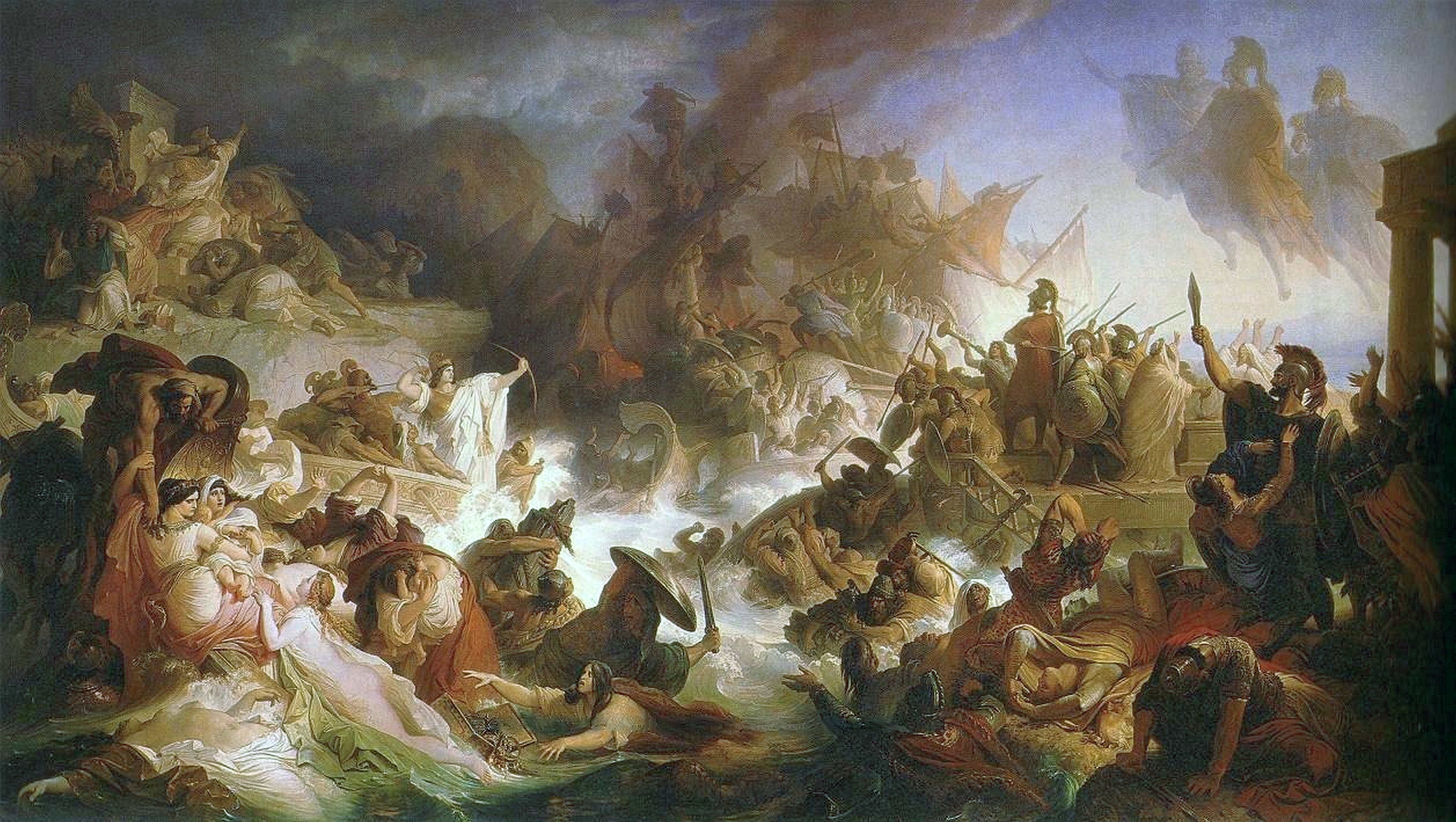
The battle of SalamisWell, that was close. If a ragtag Greek fleet hadn’t defeated the mighty Persians at Salamis on October 20 the improbable story of the West would have stopped before it started.

It happened back in 480 B.C., when what we think of as classical Greece was just getting started. And it was an improbable microcosm of the whole story of West v rest. The Persians had a mighty army and a mighty fleet unified under the rigorous, unquestionable command of a God-emperor. The Greeks were a bunch of squabbling, impertinent, disorganized lovers of a foolish thing called “liberty”.

Of course Xerxes' invincible forces walloped them on land at Thermopylae and at sea at Artemisium. And as they moved south to administer the coup de grace, these ridiculous farmer citizen-soldiers cobbled together a navy and land forces and bickered about strategy and questioned their commanders and, in the actual conflict, had found the right strategy while the Persians had not.

After two more thumping defeats by this rabble the next year, at Plataea on land and Mycale at sea, Xerxes did a sour grapes and decided Greece wasn’t worth conquering anyway and went home to be divine while the Greeks invented philosophy and history and a bunch of other stuff where they questioned dogmas and rulers and quarreled and argued and worked things out in a debate where it mattered what you said not who you were.

The dynamism of the resulting free society, which spread through Rome (where Athens met Jerusalem) to the Anglosphere, has irritated and amused the leaders of closed societies for 2500 years since, and then when attacked has routed and crushed their mighty armies and fleets time and again.

You really should read Victor Davis Hanson’s Carnage and Culture to get a gripping, convincing portrayal of this improbable tale over two and a half millennia. But it all started at Salamis.

Interestingly, we know the names of the historian who recorded this battle, albeit imperfectly, and the Athenian commander Themistocles because the Greeks also celebrated, and mourned, the ordinary people who fought there and at Thermopylae and elsewhere explicitly in the name of freedom. On the Persian side we remember Xerxes and nobody else.

That’s why he lost and we won.

It happened today - October 19, 2015

Geiseric sacking RomeOn this date back in 439 the Vandals under their chief/king Geiseric took Carthage. And, one imagines, left the place quite a mess.
I realise it was that kind of time. Rome itself had already been sacked by the Visigoths in 410 and would get the treatment again by Geiseric in 455 and the Ostrogoths in 546 by which point it wasn’t an empire any more anyway due to endless trashing by barbarians. But the Vandals were special.

First emerging into the light of history, or arguably its darkness, in what is now Poland in the writings of Pliny the Elder, they were a troublesome part-time ally of the Romans for centuries before they erupted and started walloping on everyone in the disorder that accompanied the collapse of the Western Roman Empire. Ultimately they were themselves crushed by the Byzantine Emperor Justinian in 534. But their name lives on as a byword for wanton destruction.

In its own way it’s quite an achievement, especially given the competition then and later. We’re not even sure whether their most impressive leader was called Gaiseric or Geiseric or Genseric but whatever it was one imagines it scrawled offensively across some smashed and desecrated site.

Wikipedia tries to rehabilitate them, saying “Renaissance and Early Modern writers characterized the Vandals as barbarians, ‘sacking and looting’ Rome. This led to the use of the term ‘vandalism’ to describe any senseless destruction, particularly the ‘barbarian’ defacing of artwork. However, modern historians tend to regard the Vandals during the transitional period from Late Antiquity to the Early Middle Ages as perpetuators, not destroyers, of Roman culture.”

I don’t know, though. I can’t imagine anyone ever saying “Oh good, here come the Vandals” and the fact that their name is still a byword for moronically pointless but effective violence suggests they deserve the bad name that has persisted for 15 centuries and counting.

It happened today - October 18, 2015

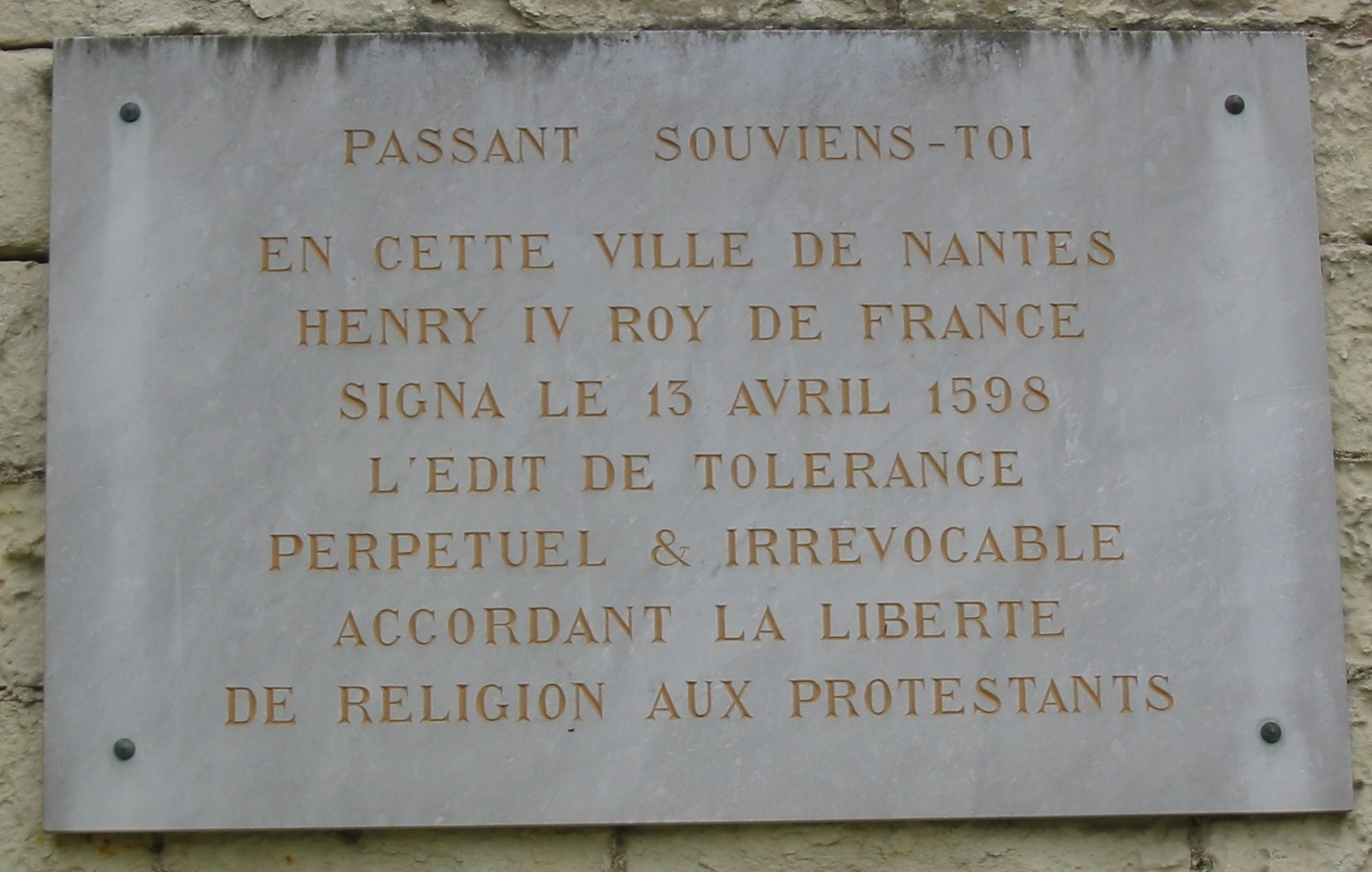
Plaque commemorating the Edict of NantesWell, it was good while it lasted. Sort of. But October 18 is the anniversary of the 1685 revocation of the Edict of Nantes promising toleration to French Protestants, promulgated in 1598 by Henri IV. And the bad thing is, no one was really surprised. Tolerating religious diversity was something French rulers knew in their heads was a good idea. But somehow they never believed it in their hearts.
Now Henri IV himself actually might have believed it. A Protestant by conviction and a Catholic by expedience, he had seen first-hand the damage religious intolerance caused, barely surviving the St. Bartholomew’s Day massacre, converting at least formally to become king, and ultimately being assassinated by a Catholic fanatic which, admittedly, came too late to influence his policy. But for most French monarchs and the French Establishment noble and clerical the necessity of tolerating Protestants to avoid bloody civil war, or stop it, or keep it from erupting again, or stopping it again once it had, was a purely practical business. If it hadn’t been necessary it never would have been done on principle. And once it stopped being necessary it wasn’t done at all.

The Edict of Nantes itself did not extend “religious” toleration. It only sheltered Protestants and only because it had to. Parts of it were revoked by Louis XIII in 1629 after yet another religious war in which the King’s forces, led much of the time by Cardinal Richelieu, devastated and captured the most important Protestant stronghold of La Rochelle. By 1685 the Protestants were no longer a significant threat, so Louis XIV trampled their rights from a position of strength.

Well, yes and no. The trouble with autocracy is that its strength is brittle. France was supposedly gloriously absolute. But it lacked the dynamic resilience of the Anglosphere precisely because tolerance of diversity was a tactic not a principle. Even Britain struggled in practice with what it embraced in theory but France never really embraced it in theory and it showed.

Still does, in fact. Even the French Revolution, supposedly a dramatic change of course, resulted in a secularism as intolerant as the Catholicism it replaced. And to this day the French have a tendency to seek solutions to policy problems in regulated uniformity not decentralized spontaneous order.

Incidentally there is no extant copy of the original Edict of Nantes. That it was considered not worth keeping unlike, say, Magna Carta tells you a lot.

It happened today - October 17, 2015

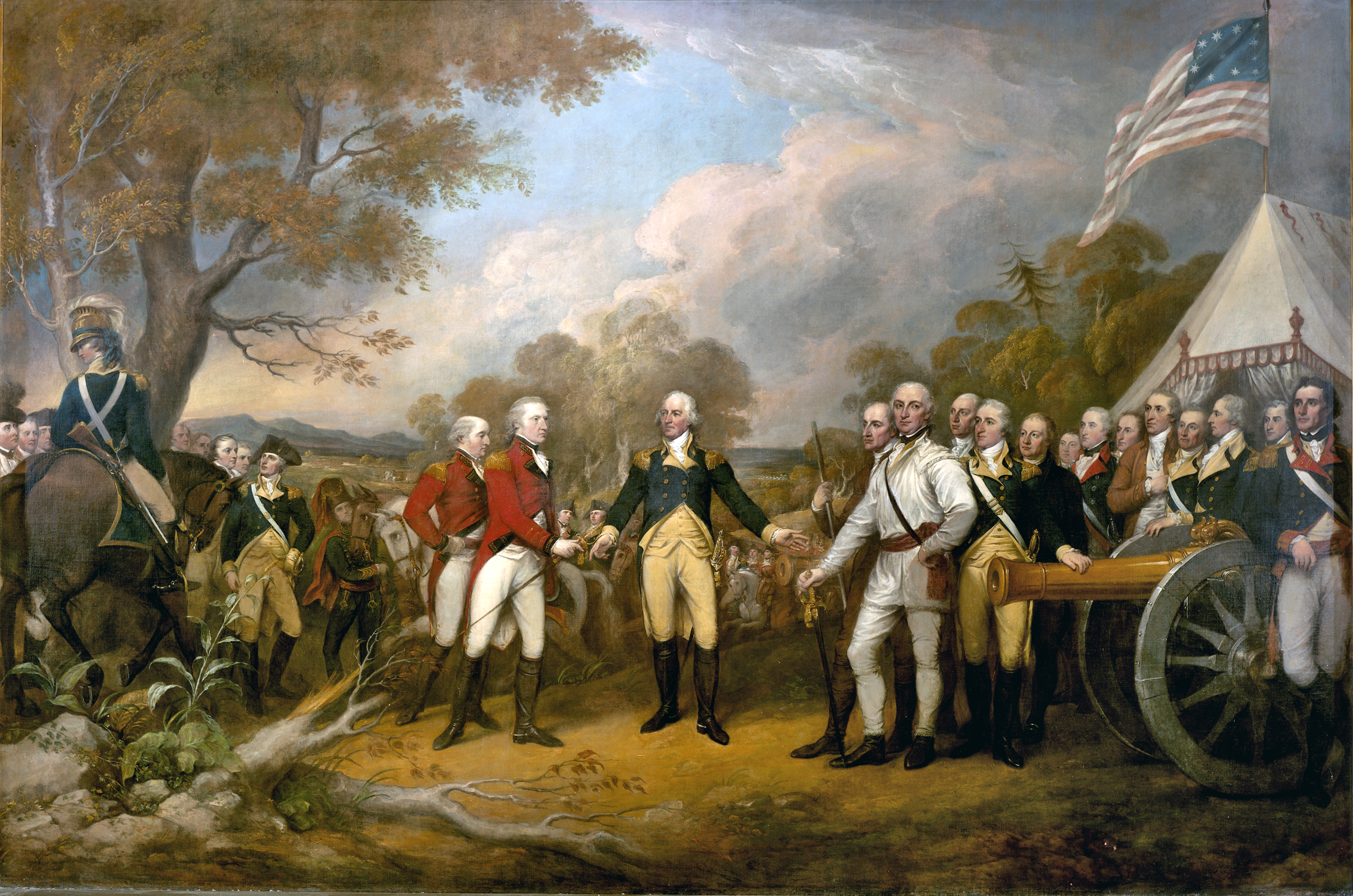
The surrender of General BurgoyneSometimes you lose a battle and win the war anyway. George Washington had a talent for it. But it’s not what happened to “Gentleman Johnny” Burgoyne who lost the Battle of Saratoga. Instead, on October 17, 1777 he was obliged to surrender his forces to American Revolutionary general Horatio Gates in a defeat that convinced the French the rebels could win and brought them in on the American side with decisive effect.

I feel bad for Burgoyne, a colourful high-living character who eloped with the daughter of a leading politician (Lord Darby) and after his wife died had four children with his mistress, a talented playwright and MP whose career was forever defined by Saratoga. He was marching south as part of a pincer movement with Gen. William Howe who, as I argued earlier in this space (see Aug. 27) may not have wanted to win the war and who changed his plans and left Burgoyne in the lurch. Moreover, Burgoyne returned to Britain and was never again given a senior active service command unlike, say, Howe.

The result of Saratoga was tremendous for the Americans, who later named six ships for the battle including one of their first aircraft carriers for the victory, a converted battle cruiser that took part in pre-World War II naval exercises including, of all things, a sneak attack on Pearl Harbor, was twice torpedoed during the war, suffered a severe kamikaze attack at Iwo Jima and was eventually sunk in mid-1946 in nuclear weapons tests (a tough ship, she needed two blasts to sink even then).

I do not digress as badly as it might seem in this naval excursion. For the French navy played a major part in the Revolutionary War including trapping Cornwallis at Yorktown in 1781 where American and French troops forced him to surrender, effectively ending British resistance to American independence.

The French, in the process, did win the battle and lose the war; their plot to break up their hated British imperial rival bankrupted the government so badly it had to convene the Estates General eight years later for the first time in 175 years with catastrophic results. Meanwhile the United States and Britain quickly became informal then formal partners in maintaining global order and fighting the Kaiser, Hitler and then the Soviet Union with France as a junior partner.

As for Burgoyne, though he never again held an active command, he did go on to be commander-in-chief in Ireland, arguably a dubious prize, and a privy councillor, and took part in the impeachment of Warren Hastings, a major parliamentary inquiry into the East India Company led by Edmund Burke, before dying suddenly and being buried in Westminster Abbey. But it’s too bad he was forever defined for his failure in this campaign, which wasn’t especially his fault, could have happened to anyone, and turned out so well for the world and his nation.

It happened today - October 16, 2015

Harpers FerryOn October 16, 1859, John Brown and a small militant band seized the United States arsenal at Harpers Ferry in Virginia, seeking arms with which to trigger a slave revolt. I confess to being conflicted about it. I find it hard not to sympathize with Brown’s raid, and impossible to sympathize with it.

It’s hard not to sympathize because slavery was a monstrous evil, too big for politics, and had already divided the United States so badly that the Civil War was by then as inevitable as anything in human affairs. Slavery was not going to be ended except by force and no “mainstream” politician was willing to advocate such a thing, including Abraham Lincoln, fast rising toward genuine greatness but still seeking the political holy grail of muddled and unworkable compromise.

On the other hand, it’s impossible to sympathize because John Brown was insane, deluded and vicious and his plan could not work. And the latter matters enormously. I am strongly against armed resistance when a government is subject to control of the citizens, and if it was justified against slavery it’s a rare case. On the other hand I do think it would have been justified to shoot down someone trying to recapture a fugitive slave under the duly passed laws of the American Republic. But the key thing about the raid is that no venture led by such a man as John Brown could work and even if it could, that wasn’t that venture. All the raid could do was inflame passions and get people killed including two of his own sons.

Now possibly those passions needed to be inflamed; thousands of Union soldiers would sing “John Brown’s body” in tribute to a man whose living hand they would never have shaken, and shed their own blood and that of others to advance his cause about which they would have refused to hear a speech before the war started. Perhaps Brown finally found the one thing he could do right, not raising a slave revolt but being spectacularly martyred failing to raise one. And once wounded and captured Brown played his part with a dignity not typically part of his life, although the tale of him kissing a black baby in its mother’s arms on his way to the scaffold was pure invention or, to give it its proper name, propaganda. He sought martyrdom and in a very real sense it worked. The raid strengthened militants on both sides and brought the war that ended slavery.

So what if I’d been there?

In some ways the more uncomfortable part of that question is whether I’d have sympathized at all. From our comfortable couches and study chairs we imagine ourselves heroically answering the call at great historical moments that, for some reason, have not knocked at our door. We all think we would have been abolitionists had we lived in the United States in the 1850s although, statistically and logically, it cannot be so.

Consider Robert E. Lee, a man I admire who seems genuinely to have disliked slavery, even detested it. He was given the job of retaking the Harpers Ferry arsenal and capturing Brown and did his “duty”. And interestingly Stonewall Jackson, John Wilkes Booth and Walt Whitman were present for Brown’s execution though not all for the same reasons. Yet Lee, offered command of both the Union and Confederate armies, chose the latter, putting devotion to his “country” (Virginia) above his sworn duty to his actual country and his duty to humanity. A magnificent general and a good man, he fell to the occasion and led the wrong army in the wrong cause in the defining action of his career and his life.

It also haunts me that the raid took place at a spot of such scenic beauty that Thomas Jefferson in his Notes on Virginia declared “this scene is worth a voyage across the Atlantic.” Jefferson is much admired, though not by me, but for all his virtues he was monstrously wrong on slavery, having gone from abolitionism in his youth to reluctant advocate in his “maturity”. And of course his hypocrisy extended to having a slave mistress. Yet if he lived today one imagines, given his generally radical temperament, that he’d be in the forefront of progressive causes from abortion to the politics of identity.

So the fact that we see clearly in 2015 that slavery was bad is not the same as being somehow inherently bound to have seen it clearly had we surveyed the scene form 1855 or, indeed, 55 B.C. But grant me the light to see slavery as the evil it was in 1859 and ask, would I have joined John Brown?

No. No I would not. He was doing the right thing for the wrong reason in the wrong way. And my final and comforting thought on my divided views of Brown’s raid is that noted abolitionist Frederick Douglass, a truly great man, was pestered by Brown to join his group but repeatedly refused and, indeed, tried to prevent others from joining.

If Douglass could say it was the wrong answer to the right question at the time, I can say it now. And yet when it was done, I would have been among those pushed toward war by it, in defence of the liberty of the slaves Brown was trying to start a war to free.