Posts in It happened today
It happened today - December 10, 2015

In Edgar Allan Poe’s famous story “The Purloined Letter,” the amateur sleuth C. Auguste Dupin baffles the police by discovering a missing document cunningly hidden in plain sight. I confess to considering Poe a mediocre and melodramatic writer. But I frequently wish we had Dupin in public debate.

For instance, on December 10, 1977, Soviet authorities arrested four dissidents at a peaceful rally against political oppression and intimidated many others into skipping the event… on United Nations Human Rights Day. Now you know what I think of the UN, which is that it should be disassembled brick by brick and hurled into the East River. It is absurd that such a coterie of dictators and half-legitimate regimes should prate on about human rights in between one-sided resolutions condemning Israel, the only democracy in the Middle East.

More generally, I consider pious bleating about human rights no substitute for engaged citizens willing to defend them, which is what brought us Magna Carta, the Glorious Revolution, self-government in the United Province of Canada and so on. To a considerable degree, thinking proclaiming an international day of do-goodery on this or any other subject constitutes effective action distracts us from many hard realities. But I digress.

The key point is that by their actions the Soviet authorities showed beyond rational doubt that they did not share Western conceptions of human rights, indeed, were actively and resolutely hostile to them. Which did not stop large numbers of supposedly enlightened people from suggesting a moral and geopolitical equivalence between the United States and its NATO allies and the Soviet Union and its Warsaw Pact slaves. And, unsurprisingly, the effort of declaring good and evil to be equivalent quickly, perhaps instantly, led to effectively preferring evil, to blaming America first in Cold War confrontations and quarrels.

Perhaps on reflection I did not digress above. The specific inability to see that arresting dissidents on human rights day means you despise human rights is actually intimately connected with a habit of thinking that ignoring unpleasant realities makes them go away.

It doesn’t. Instead they remain hidden in plain sight, as they once did with Hitler and do today with ISIL. If only C. Auguste Dupin were here to spot the significance of their brazen declarations and actions that they hate and despise us and everything we stand for. It’s right there in front of us. Whatever can it mean?

It happened today - December 9, 2015

Here’s an obscure tidbit. Oh, that’s original in this series, you may say. But on December 9 1950 Harry Gold went to jail.

Harry who? you may say. I’m sure it mattered to him, especially as he got 30 years in the slammer. But what’s it to me?

I’m glad you asked. You see, Gold was a research chemist who was jailed in the United States for spying for Stalin’s Soviet Union. Specifically, he was a courier between the Soviets and Klaus Fuchs, a British nuclear scientist working at Los Alamos on the atomic bomb.

When Fuchs was arrested in Britain for espionage, for which he got 14 years in jail, he named Gold. And after Gold was arrested he in turn named David Greenglass, who in turn fingered his sister Ethel and her husband Julius Rosenberg, who were later convicted and executed for espionage.

Many people oddly persist in considering it all a “Red Scare,” “McCarthyism” and “anti-Communist hysteria”. But the fact is that there was a concerted Soviet attempt to penetrate the American government, including vital military research efforts, and it was surprisingly successful, in part because it found people who were not only vulnerable to bribery or blackmail but who were genuinely ideologically sympathetic.

Gold himself told investigators he didn’t think he was helping an enemy because the Soviets were wartime allies of desperate convenience against Hitler. But why would you betray your own government’s secrets and surreptitiously circumvent security procedures rather than trust its own judgement? Whatever tale Gold told himself, he had been co-opted by a vicious totalitarian regime and movement out of sympathy.

There were many others who did the same including the infamous Alger Hiss (see my Nov. 27 “It Happened Today”). And while you are unlikely to find many active Bolshevik agents in public life today, it is only because that particular form of poisonous radicalism has collapsed under its own evil weight. The temptation, often among people enjoying successful, even privileged lives, remains peculiarly strong.

We do not wish to be paranoid. But vigilance is not paranoia. And we must be watchful for subversion, corruption, coercion and above all hidden, seductive, dangerous ideological sympathy with our enemies.

It happened today - December 8, 2015

On this day back in 1980 John Lennon was shot dead by a deranged former fan in New York City. It was and remains to me a pointed reminder of the fragility of life.

Lennon was not my favourite Beatle. In fact he placed fourth on the list. And I’m not even that huge a Beatles fan though every time I actually hear their music I go “Hey, this is really good.” But the point here isn’t whether I liked Lennon’s philosophy or found it childish, or whether I somewhat contradictorily wish he hadn’t played the lead role in breaking up the band and deprived us of the other music they might have created together along with the stuff I already don’t listen to. (And with all due respect to all the band members, nothing afterward by any of them came close although Paul McCartney’s career certainly flourished to the point that he is as far beyond the reach of my criticism as he is beyond the reach of my praise.)

The critical point is that Lennon was minding his own business, living his own life, giving advice nobody had to follow or listen to if they didn’t want to, doing the big important things that really mattered to him and the small routine ones that make up much of anyone’s existence. And then he was shot down suddenly, without warning, no time to compose his thoughts, make a deathbed repentance for anything he might on explicitly final reflection regret, or even come up with pithy and memorable final words. Instead he was in the middle of something routine, possibly a thoroughly banal train of thought, and suddenly he lay mortally wounded for no reason.

It is in some ways a parable of life. Not that most of us are liable to be murdered, of course. But we may well die suddenly at a moment that is not merely not of our own choosing, but that we had not remotely considered might be our last and is not directly connected to anything bad or foolish we just did. As Ray Charles once disquietingly observed, “Live every day like it’s your last, ‘cause one day you’re gonna be right.” And you almost certainly won’t know it when you wake up that morning.

I’m not sure Charles was right, though. I prefer Franklin’s advice to “Work as if you were to live 100 Years, Pray as if you were to die To-morrow.” (Poor Richard’s Almanack, 1757)” Especially because of an inscription former Globe editor William Thorsell apparently once saw on a beer mug: “Today is the tomorrow you should have worried about yesterday.”

It is wrong to give no thought to the future. But it is also wrong, very wrong, to take it for granted. Lennon himself once said “Life is what happens while you’re making other plans.” And sometimes it’s death that does instead.

It comes indeed like a thief in the night and does not dependably send a card ahead of time announcing the visit. And whatever we do, we must live it in the shadow or the light of that knowledge.

It happened today - December 7, 2015

All together now. December 7th is a day that will live in…

Infamy, of course. So said Franklin Delano Roosevelt to a joint session of Congress the next day, asking for a declaration of war that was promptly granted by the Senate 82-0 and by the House 388 to 1 (the lone “nay” came from Jeanette Rankin, a woman with the courage of her absurd pacifist convictions – see my Rebel Media piece from April 2). The next day Germany and Italy declared war on the United States, neatly solving FDR’s problem of concentrating on the greater menace of Nazi Germany despite greater popular anger at Japan.

I do not know if Pearl Harbor still lives in infamy. In the United States in significant measure it does. But forever is a long time, and things keep happening, and most young people doubtless remember what happened on 9/11 more clearly than 7/12. But both were sneak attacks by merciless foes who totally misunderstood the nature of their adversary.

After Pearl Harbor, a baffled Roosevelt asked “What kind of people do they think we are?” What he meant was not that Americans were so nice nobody should hate them. Nor was he shocked and sad, rendered immobile by this setback. Rather, he was genuinely puzzled how the Japanese leadership thought they could do such a thing and survive. (Incidentally, when a breathless aide informed him a few days later that Romania had declared war on the U.S. FDR retorted, “Did you ever hear an ant fart in a windstorm?”

One senior Japanese figure who had spent time in the United States, Admiral Isoroku Yamamoto, who planned the attack, knew it was a terrible mistake. “I fear we have only awakened a sleeping giant and filled him with a terrible resolve.” And so it proved.

Remember: Japan spent a decade plotting to pounce on the United States, defeat it and so demoralize it that it quit. The United States turned around and, despite losing much of its Pacific fleet at Pearl, delivered a devastating blow to Japan at Midway just seven months later with an outnumbered and outgunned task force, turning the tide of the war in the Pacific forever. Likewise, it was not three months from the fall of the World Trade Centre towers to the fall of the Taliban in supposedly impenetrable Afghanistan.

It is true that the United States found “rebuilding” Afghanistan harder practically and conceptually than ousting the odious regime that sheltered Osama bin Laden. (Well, one of them, anyway.) But still, there seem to be two pretty clear lessons here.

First, our enemies hate us, spend years plotting against us, and will sneak up on us and try to do us in if given half a chance. Second, whoever attacks the Anglosphere should dig themselves a nice comfy grave first.

The second is some comfort given how reliably we seem to overlook the first. Perhaps Dec. 7 is a good day to remember both.

It happened today - December 6, 2015

On December 6, 1933, a United States federal judge ruled that Ulysses by James Joyce was not obscene. How on earth could he even tell?

I sort of applaud the ruling, not as most sophisticates do because dirty books are a positive blessing provided they are hard to read and the characters are deeply unhappy. I applaud it because it is not the state’s business to tell adults what not to read. It does not in my view relieve us of the obligation to reject things that are literary or moral rubbish.

Frankly, keeping my philistine streak going here, I consider Joyce guilty on both counts. Obviously he was a technically talented writer and his radically innovative stream of consciousness narration was cleverly done. But to what end?

To try to wash off the know-nothing stench, I should say that as a young man I considered myself sophisticated because I read things like Thomas Pynchon’s Gravity’s Rainbow, which is extremely clever, impenetrable and very definitely obscene. As far as I know, having never read it and not planning to, Ulysses is also obscene.

Indeed, I think it was absurd for a judge to say it was not rather than to say it didn’t matter. Or rather, that it didn’t matter legally speaking. I wish judges would not twist the law instead of relying on plain statements of it like, for instance, the First Amendment to the United States Constitution about abridging freedom of speech.

I also think that whatever obscenity Ulysses may reward the hardy literary voyager with is unlikely to be its worst flaw. Most of us adults know by now what goes where and why, and have some idea what can go wrong when this knowledge is misused. We don’t need to hear it from James Joyce.

Nor do we need to read self-obsessed deliberately incomprehensible endless books about a man whose life was a massive alcoholic downer. Joyce was a feckless, irresponsible parent and husband, utterly self-absorbed, qualities most short online biographies pass over in silence in order to gush about his brilliance because they exert a strange attraction for many intellectuals.

Supposedly his long-suffering wife Nora once asked him “Why don’t you write books people can read?” It’s a good question, and if she didn’t really ask it she failed him as a critic and a wife.

Is Joyce’s work including Ulysses obscene? Probably yes sexually. Certainly so technically and morally. As is intellectuals’ admiration for him.

It happened today - December 5, 2015

Seventy years ago today, on Dec. 5 1945, five U.S. Navy Avenger torpedo bombers vanished in the “Bermuda Triangle”. Oooooooooo!

I remember the Bermuda Triangle or “Devil’s Triangle” being big in the 1970s. Since it was also the decade of “what’s your sign”, Chariots of the Gods (technically first published in German in the late 1960s), pyramid power and other superstitious nonsense driven by gullibility remarkable even by human standards, I suppose we shouldn’t be surprised.

We should however be skeptical. Yes, boats and even planes disappear there sometimes. It’s because the ocean is big and dangerous and things can go wrong and the “Bermuda Triangle”, stretching from Florida northeast to Bermuda, south to Puerto Rico and back to Florida, is a rather busy part of the ocean so a lot of things travel through it. Some don’t make it. But on a percentage basis there’s nothing weird about it.

The World Wide Fund for Nature, for instance, identified the 10 most dangerous waters for shipping in 2010 and this place didn’t make the list. And many of the most colourful tales are inventions or distortions of a rather childish sort.

Bermuda itself is quite a hazard to shipping. Popping up unexpectedly all by itself out in the Atlantic and surrounded by a maze of reefs, it was such a menace in the old days that its crest shows a shipwreck. Not because of aliens, monsters or a space-time vortex. Just a rock you didn’t see coming.

That humans are determined to believe in rubbish like the Bermuda Triangle is a comment on us not it.

It happened today - December 4, 2015

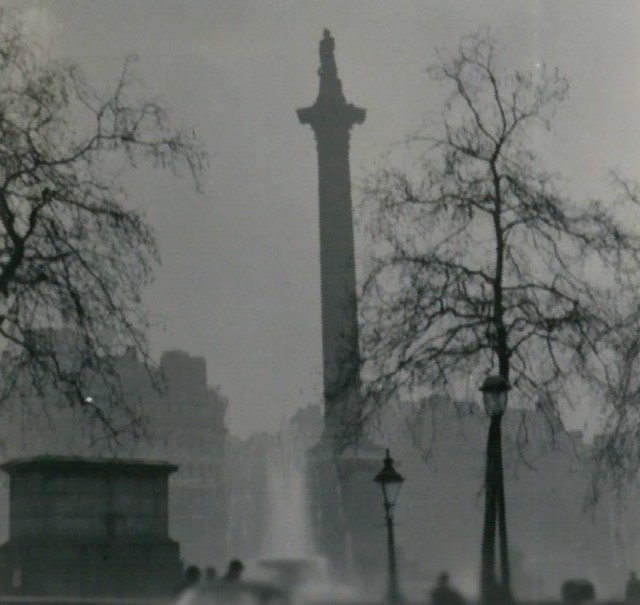
On this day in 1952, Dec. 4, many Londoners drew their last breath. And don’t think it was easy.

It was the beginning of the last and worst of London’s infamous “pea soup” fogs. They may seem romantic in a Sherlock Holmes story. But in fact they were the product of horrifying pollution generated by a great city heating itself with coal.

Year after year, the problem got worse. And periodically, an “inversion” would trap the dirty air over the city, full of smoke particles, hydrochloric acid, sulphur dioxide and so on, choking the young, the old, the unwell and causing a spike in unnecessary deaths. At least 4,000, and perhaps as many as 12,000, before the fog dissipated on Dec. 8.

It is amazing how bad it was. You literally couldn’t see three feet in front of you. All transit had to stop, and all traffic.

It wasn’t the first such fog. Indeed, in the classic “penny dreadful” novel The Trail of Fu Manchu (OK, now you know, I’ve read such stuff) describes the 1934 fog that could actually be seen seeping into a hotel and “coming down the steps in waves.” If such things get worse slowly, you tend to ignore the fact that they’re getting worse. Until they get really intolerable.

After 1952 the British acted. They acted with good humour (indeed this fog prompted the classic 1954 Goon Show “Forog”). But they also acted with determination. They placed serious restrictions on the more unbreathable forms of pollution and as energy technology advanced and the rules were tightened, the air over London gradually cleared.

It’s a lesson worth remembering on all sorts of grounds. First, and the left might want to cheer here, it’s not all doom and gloom on the environment. Moreover, the government can do some things right including on that file. Second, and the right might want to cheer here, government succeeded here because it enforced rather than violating property rights, specifically your right not to have the air on your own land and in public spaces fouled, and because it set rules and let entrepreneurs find solutions rather than dictating mechanisms. Third, smog that kills babies is real pollution. Carbon dioxide isn’t.

That one may produce some hissing. But it’s true anyway.

It happened today - December 3, 2015

Remember the AMC Pacer? If so, it’s probably not in a good way. The last “car of the future” rolled off the assembly line on Dec. 3 1979 and into automotive history. Or was it a fishbowl?

The Pacer, part of AMC’s attempt to be really different from the “Big 3” was different indeed. Short, squat, too wide to park, with huge windows, and mismatched doors that were a nightmare for British drivers, it was also weirdly heavy for a car aiming to meet anticipated stringent fuel economy standards and terribly underpowered.

AMC hyped it as “a piece of tomorrow” when it appeared in 1975 and it acquired a bit of that cult classic status reserved for mechanical “hopeful monsters,” tributes to the persistence and daring of human ingenuity in the face of an often hostile universe. But like so many efforts to imagine the future, it would have looked good on the set of Star Trek but didn’t get you from here to there in real life.

Cars built to look good, work well or honour tradition seem as a rule to have much more of a future than cars built for the future. Perhaps there’s a broader lesson there.