The Cardinal who would be Prince

August 17 is a red-letter day in the annals of dubious achievements. For it was on this date in 1498 that for the first time ever a cardinal of the Roman Catholic Church resigned his office.

Now you might be thinking, with Benedict XVI in mind, that it’s not an admirable rather than dubious achievement. Someone humbled by their incapacity to perform this exalted office, laying it aside instead of clinging to the pomp and prestige. (Or you might just hate the church and wish they’d all resign, but that’s a topic for another day.)

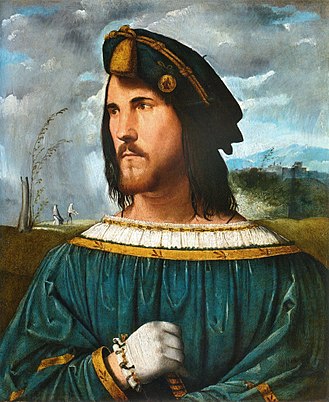
The problem is, the person who resigned back then was Cesare Borgia. Now clearly he should never have been a cardinal due to his enthusiastic embrace of murderous wickedness, not to mention that he was the illegitimate son of the Pope who made him a cardinal, Alexander VI. (OK, he was just Roderigo Cardinal Borgia when he had Cesare, and probably he didn’t poison people, at least not much, but still.) But Cesare only resigned the post in order to further his and his father’s ambitions by becoming Duke of Valentinois.

It didn’t work. After his father died in 1503, followed after only 26 days by his sympathetic successor Pius III, he was tricked into supporting a deadly family foe Giuliano Della Rovere for the papacy, as Julius II. Four years later Borgia fell into an ambush and was mortally wounded and stripped of everything but a red fig leaf, even the leather mask he wore apparently to hide the ravages of syphilis. Again not the ideal accoutrement for a cardinal.

Cesare Borgia’s career was, apparently, a significant inspiration for Machiavelli’s The Prince. Which might make you question Machiavelli’s judgement as well as his morals except for one point about his infamous book that has been almost universally overlooked lately. The Prince is supposedly the ultimate how-to guide to amoral realism, a kind of Achieving Brutally Cynical Power for Dummies. But in the 18th century it was generally seen, correctly in my view, as a satire, a thinly, even transparently veiled scathing denunciation of power-mad cynics.

If you really were a cynic and tutor to cruel dictators, you would not take as your role model someone whose nasty career ended with ignominious and degrading death in his early 30s. Even if he did at least vacate the cardinalship while vertical, for base motives.

Battle of the Oh No Not Again

If I told you that this is the anniversary of Henry VIII’s 1513 victory over the French at Guinegate, in the Battle of the Spurs, would it provoke yawns at another battle that seems deeply unmemorable? Puzzlement that Henry was fighting the French in France on behalf of the Pope in company with the Holy Roman Emperor? Or would you just wonder what battle in those days didn’t involve spurs?

Well, I can settle the last one easily. The name was a cruel jest about the speed with which the French cavalry departed the field, discarding lances, standards and even armour in their haste to escape. Ouch.

As for its consequences, they did include the ill-advised Scottish invasion of England on behalf of their “Auld alliance” French buddies that ended disastrously at Flodden Field. But we all know that the tale of “Henry VIII and his buddy the Pope” story didn’t turn out well in the end. And in fact this “War of the League of Cambrai” also ended badly, with a fairly decisive French victory in 1516, some 17 years before Henry chucked his first wife and the Roman Catholic church while, with absolutely characteristic chutzpah, keeping the title “Defender of the Faith” given him by Pope Leo X in 1521.

Why then am I droning on about it?

Well, for one thing, it’s an opportunity to heap more opprobrium on Henry VIII, who richly deserved it, for his vainglorious strategic overreach. But also to note how longstanding was the English concern not to face a united Europe. There were significant debates about whether to pursue the “blue water” policy generally favoured by the Tories, using the navy to contain whatever continental menace might arise, or the Whig strategy of timely interventions in European squabbles to keep said menace small.

On the whole this strategy worked, to the consternation particularly of the French who aspired for many centuries to be that menace, only to end up the butt of cruel English taunts. There is even a rumour that the peculiar British most rude hand gesture dates all the way back to archers at Agincourt, who were threatened with having their index and middle fingers cut off if captured; regrettably it appears to have no historical foundation. But the English did fight with remarkable skill, backed by remarkable statesmanship over the years, a tribute to the resilient dynamism of free societies.

Henry VIII was still an untrustworthy maniac, though.

Sacking Taranto. Again.

The coat of arms of Taranto On August 15 of 927 the Saracens sacked Taranto. Again. It’s a real nasty habit.

The first time they showed up, in 840, they turned it into a slave depot as well as a base for raiding, destroying and enslaving. After it was recaptured in 880, the Saracens came back in 882 and grabbed it again. Finally chased off, they returned in 927 and destroyed it, enslaving all the survivors. It was rebuilt. So they attacked it again in 977.

Taranto is in Italy. What were the Saracens even doing there, and so soon after Mohammed? Same thing they were doing in Tours in 732, I guess.

There’s this whiny Islamist narrative about how theirs is a religion of peace but the “Crusaders” keep attacking them so they have to kill them wherever they live in self-defence. And I do not deny that Christians have perpetrated many atrocities over the centuries. Indeed, when two Byzantine generals retook Taranto in 880 they um enslaved the original inhabitants. But these attacks on Taranto, as with the conquest of Spain and the attack on France, and indeed the violent seizure of Jerusalem and other Christian and Jewish holy places, happened centuries before the First Crusade which was, after all, a counterattack by any rational measure.

As indeed, by any rational measure, vicious unprovoked attacks from the Islamic world on the Christian one are far more common than the reverse. Even when European powers colonized the Middle East in the 19th and early 20th centuries, they neither enslaved the inhabitants nor sought to forcibly convert them. And it is Christians who are under siege in the Muslim world today, not Muslims in the (post-)Christian West.

So why is there no demand for a historical apology for the incessant aggression and massive enslavement by Muslim rulers and armies virtually from the moment the Koran appeared, no offer of or request for reparations, no discussion of this astonishing record of belligerence?

It does appear to be something of a habit, after all. And not an attractive one.