https://www.youtube.com/watch?v=LdbSX9PheMc The audio-only version is available here: [podcast title="Ask the Professor, September 1"]http://www.thejohnrobson.com/podcast/John2016/September/Ask_Professor_51.mp3[/podcast]

September 1 was a bad day for France back in 1870. They lost the crucial battle of Sedan in the Franco-Prussian War, forcing the surrender of their army and their Emperor Napoleon III the next day. Now for my money they were well rid of the latter. But their defeat, despite the efforts of the promptly proclaimed Third Republic to fight on, had to hurt. And in the end, it turned out to be a very bad day for the rest of the world too.
It’s not that they had much of a dog in this fight. And the establishment, bloody course and violent suppression of the Paris Commune in the aftermath of the war was mostly bad for France while offering an object lesson about political radicalism to those willing to learn it. But the Franco-Prussian War had several pernicious consequences.
First, it allowed Bismarck and company to complete the unification of Germany and establishment of the German Empire whose subsequent aggressive course was the main cause of the disastrous First World War, which in turn set in motion the events leading to Hitler’s aggression and the Second World War.
Second, and related, the fact that the Franco-Prussian War was such a quick affair led politicians and the public alike, in Germany, France, Britain and throughout Europe, to overlook the possibility that the next major war would be protracted. It’s easy in retrospect to say that developments in weaponry and logistics in the 19th century, the implications of the First and Second Industrial Revolutions for wars between advanced countries, would almost certainly lead to the long, hideous stalemate of World War I, with its muddy, bloody trenches and millions killed.
In fact it could have turned out otherwise (for more on this see my documentary The Great War Remembered and stay tuned for my book of the same name). But it was a possibility given too little weight in the run-up to 1914; far too few people pondered the risk that the long, sanguinary American Civil War was a harbinger of worse to come. If Sedan had gone the other way, if the Franco-Prussian War had lasted several years, even if the French had ultimately succumbed, it might have opened men’s eyes a little wider to the really nightmarish possibilities of allowing an assassination to escalate into a general war in the summer of 1914.
“The first edition of the Dictionary of the French Academy published in 1694, defined history as the ‘narration of actions and of matters worth remembering.’ The eighth edition, in 1935, said much the same: ‘the account of acts, of events, of matters worth remembering.’”
John Lukacs At the End of an Age p. 51n [oddly, in this otherwise excellent book, Lukacs indignantly rejects this definition – but for once I’m with the French Academy on this one].
 If assassination really never has changed the history of the world, as Disraeli claimed, it’s not for want of trying. And with World War I much on my mind as I finish up a book on it, I’m thinking the assassination of Franz Ferdinand certainly triggered events that even if they were more or less waiting to happen do seem to have been unleashed by his assassination even though he wasn’t likely to do anything worthwhile had he lived. But I also think it’s something of a historical finger in the eye of various assassins to reflect on the ways in which disease has done what they could not.
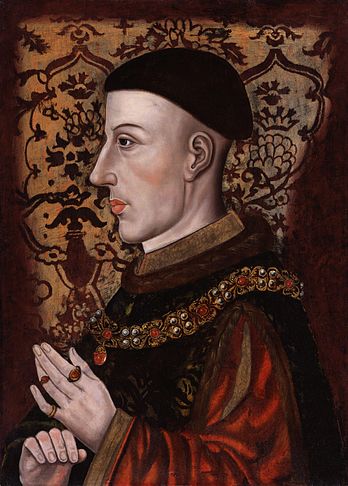
Take Henry V. Please. I mean, he is dead. Take him and bury him. He died on August 31, 1422 while campaigning in France, of… dysentery. And really, why not? Lots of people did. Kings don’t have some special dispensation to die only of elevated-sounding or elegant maladies. So yes, the hero of Shakespeare’s play (or plays if you count the two where he’s a wild child as well as the one where he grows up) with that Agincourt speech ended up not victorious and reigning happily ever after nor even dying heroically in battle but instead… how shall I put this tactfully?... kind of pooped his guts out.
Ugh. But that’s more or less what it amounts to.
OK. So he’s dead. And dead young, just 36, after just 9 years on the throne, before he could fulfil his promise as a king if any.
Much as I love Shakespeare, his judgement in such matters or at least his publications are not to be relied on. He was a propagandist for the Tudors who had taken the throne by killing off the last reigning Yorkist king Richard III and helping dispose of any other potential claimants not wiped out in the Wars of the Roses between Yorks and Lancasters. And thus he, or his patrons who might have caused him to perish if he’d gotten out of line, had a vested interest in making the Lancasters look good to make the Yorks look bad. (His negative portrayal of Richard II, predecessor to the Lancasters, is by contrast entirely justified, even insufficiently harsh.) But were they?
I don’t mean were the Yorks bad. I’ve addressed that elsewhere and the answer seems pretty clearly to be no, not even Richard III whose reputation was blackened by Shakespeare on his way to the parking lot under which he was recently found buried. I mean were the Lancasters good?
There were only three of them so it should be easy to answer. And crucially, Henry VI was not. I’ve heard his character praised. But he was a weak king and mentally unstable and his inability to rule contributed to the Yorkist rise to power, or lunge for it by some accounts. And he was also handicapped by coming to the throne very young because his father died early. That being, of course, Henry V. All the Lancasters were Henrys.
I can’t really tell if Henry IV was a good king. Shakespeare portrays him as such, with Henry V growing into a worthy heir throughout the cycle of plays. But his reign was marked by endless troubles, revolts and plots. And if he showed skill and even judgement in surviving them, he didn’t have much chance to establish a domestic record before dying of some unidentified disease or diseases that caused disfigurement, seizures and his early demise at age 45 after just 13 years on the throne.
As I’ve said before, if he’d just admitted he wasn’t king of France and gone home, he would have done his kingdom considerable good. And himself, as it turns out, because war is always a risky business and poor sanitation in those days sure didn’t make it safer.
Thus Henry VI took over, in name at least, at age nine. Months not years. So he was a pawn, puppet and object of a tug of war for the first 15 years of his reign, and never developed a strong character.
Had his own father lived even to the same age that his father had, Henry VI would at least have been nine years old when he took over, and presumably had a more stable childhood with at least some guidance and certainty from his father. Had Henry V lived to be, say, 60, then Henry VI would have come to the throne in 1446 in his mid-30s.
Of course he might still have been an awful king, harsh and greedy, weak and treacherous or just lazy. He might have been an OK king. He might even have been a good one. And if he had been good, or really bad, the Wars of the Roses would probably have been avoided altogether or, alternatively, been less destructive because the Yorkist cause would have been more obviously just and commanded greater support.
Either way, the end result, with the Tudor usurpation and subsequent brutally cynical break with Rome, would have been highly unlikely. We cannot know what would have happened, naturally. Possibly something even weirder or more outrageous. Maybe something worse for the future rise of England and the Anglosphere with its unique liberty under law.
My crystal ball tends to cloud over in such cases. But before doing so, it says to me that Henry V’s ignominious death did help destabilize England with far-reaching consequences in ways that your average assassin can only envy. And envying a bacterium, virus, worm or amoeba (dysentery is a syndrome not a disease and can have various causes) is exceptionally ignominious too.
“economist, n. a scoundrel whose faulty vision sees things as they are, not as they ought to be. – after Ambrose Bierce”
Daniel K. Benjamin in PERC Reports Vol. 17 # 5 (12/99) p. 16 [Bierce, himself one, had defined a “cynic” that way in his Devil’s Dictionary].
“You cannot run away from a weakness. You must sometimes fight it out or perish; and if it be so, why not now, and where you stand?”
Robert Louis Stevenson

OK. Here comes some weird stuff. Now you may say history is full of strange things, many of them also horrible. And you’d be right. But in this instance I have prehistory in mind.
Don’t think I can’t count when I then allude to the discovery on August 30 1909 of the Burgess Shale in southeastern B.C. by Charles Walcott. I realize 19-09 is not prehistory and Walcott is not a trilobite. But here’s an interesting bit. For reasons best known to rocks, the Burgess Shale formation was exceptionally good at preserving the soft bits of fossils normally lost (think how much we know about dinosaur skeletons and how little about their skin, feathers or ears if they even had any).
In fact the Burgess Shale is one of the oldest formations yet found with soft fossils, dating back a mind-bogging half billion years. And so Walcott found a bunch of odd critters, so many that he spent 15 more years there, collecting and struggling to categorize more than 65,000 fossils and fossil fragments.
Zzzzzzz.
No, wait. It gets weirder. You see, the rather linear, even plodding vision of them evolutions at that point didn’t have much room for mass extinctions of entire kinds of animals.
Dinosaurs, you cry? But no. They were held to be big lumbering inferior lizards well into the 1960s, as my beloved childhood How and Why Wonder Book of Dinosaurs could testify if it too had not gone extinct. Since evolution kept improving things, it wasn’t meant to have gigantic dead ends. So Walcott tried to fit his finds into existing taxa.
Taxa is the plural of taxum, which isn’t what governments do to everybody. It’s one of those categories in the evolutionary tree, the kingdom phylum class order family genus species business that scientists still insist everything must fit into in an orderly mathematical way. But whatever the validity of this arrangement, one thing is sure. Not every little turtle makes it to the ocean and not every taxum makes it to the 20th century.
By the 1960s this idea was becoming widely accepted, along with a more dynamic, even chaotic vision of evolution, with long periods of quiet and bursts of innovation (“punctuated equilibrium”) and specialization that took a good thing too far and went thud. And thus in 1962 someone took another look at Walcott’s actual stuff instead of descriptions and analyses of things that didn’t seem to fit well into extant taxa.
I should note here that I’m not sneering. Virtually every significant museum has huge storerooms full of stuff that has piled up over the years that they don’t have space to display or time to examine. And when someone does examine it they often find surprises.
That was certainly true when Alberto Simonetta went into the dusty Burgess Shale boxes and found a great deal of really strange stuff including so-called “hopeful monsters” like Opabina, with five eyes and an aardvark-type schnozzle, and the famous or infamous Hallucigenia, well-suited to convincing scientists that they or Mother Nature had been taking banned substances.
Scientists have been quarreling over them ever since, with varying degrees of good and ill humour. But I’ll tell you what. I’m very glad Walcott dug them up and then Simonetta dug them out of storage. Because there’s some wonderfully weird beasties in it.
Not that I would have wanted to meet one for real. Even a small one. Too many spines. Too many eyes. Fascinating, yes. And wonderful. But a bit horrible as well. There are some things about nature you want to admire from behind a sheet of glass a few hundred million years thick.

The line between good and evil may as Solzhenitsyn said run through every human heart. But some systems do tend to encourage the former and others the latter. For instance what is one to make, even three quarters of a century later, of the fact that on August 29 of 1942 the Red Cross was obliged to reveal that the Japanese government had refused to allow free passage of food, medicine and other supplies for American POWs in its custody?
Even the Nazis allowed supplies in through Switzerland to POWs. And they were guilty of enormous evil of every sort. Yet after enormous local efforts by the American Red Cross to collect blood, food, bandages and so on, the Japanese flatly refused to allow neutral ships to bring it in.
The weird thing is you could just have killed POWs. The Japanese were certainly known to behead captives and worse. Yet in their treatment of, for instance, the Canadians seized when Hong Kong fell, or Filipinos, Americans and others on the “Bataan Death March” had an extra streak of malevolent cruelty.
The purpose clearly was not just to kill, but to inflict suffering. And not for any instrumental reason, to intimidate or to extort. Nor was it done reluctantly by most of the guards and others involved, at the behest of a small sinister group who would torture and kill their families if they did not cooperate.
As with the Holocaust, there was a surprising degree of popular enthusiasm. Yet such things do not, with rare and appalling exceptions, break out spontaneously. Somehow or other a system is created that exacerbates the tendency toward cruelty in such a way that superiors press it on subordinates who in turn eagerly engage in such practices and push superiors toward greater cruelty. And even if it begins with some sense of purpose, to create discipline, frighten enemies or punish opponents, it eventually gains a kind of momentum of its own that is staggering in its wanton cruelty, and often baffling in retrospect even to those who were enthusiastically part of it at the time.
For the Japanese to accept Red Cross contributions to POWs would even have helped their own war effort by reducing the already limited diversion of food and medicine to POWs that were at least temporarily being kept alive. And so even as we examine our own conduct and thoughts carefully at all times and in all situations, so we must also keep a wary eye on our own institutions and those elsewhere that can, indeed, exacerbate the problem of evil in the human heart.