“Unhurt people are not much good in the world.”
Irish literary critic Enid Starkie, quoted in “Social Studies” in the Globe and Mail Dec. 11, 2007 (parenthetically, I would not have thought there were enough of them for it to matter)
“Unhurt people are not much good in the world.”
Irish literary critic Enid Starkie, quoted in “Social Studies” in the Globe and Mail Dec. 11, 2007 (parenthetically, I would not have thought there were enough of them for it to matter)
My latest for The Rebel: https://www.youtube.com/watch?v=-3kQHa6x-JI
The audio-only version is available here: [podcast title="Rebel, September 1"]http://www.thejohnrobson.com/podcast/John2016/September/160901Rebel.mp3[/podcast]
https://www.youtube.com/watch?v=LdbSX9PheMc The audio-only version is available here: [podcast title="Ask the Professor, September 1"]http://www.thejohnrobson.com/podcast/John2016/September/Ask_Professor_51.mp3[/podcast]

September 1 was a bad day for France back in 1870. They lost the crucial battle of Sedan in the Franco-Prussian War, forcing the surrender of their army and their Emperor Napoleon III the next day. Now for my money they were well rid of the latter. But their defeat, despite the efforts of the promptly proclaimed Third Republic to fight on, had to hurt. And in the end, it turned out to be a very bad day for the rest of the world too.
It’s not that they had much of a dog in this fight. And the establishment, bloody course and violent suppression of the Paris Commune in the aftermath of the war was mostly bad for France while offering an object lesson about political radicalism to those willing to learn it. But the Franco-Prussian War had several pernicious consequences.
First, it allowed Bismarck and company to complete the unification of Germany and establishment of the German Empire whose subsequent aggressive course was the main cause of the disastrous First World War, which in turn set in motion the events leading to Hitler’s aggression and the Second World War.
Second, and related, the fact that the Franco-Prussian War was such a quick affair led politicians and the public alike, in Germany, France, Britain and throughout Europe, to overlook the possibility that the next major war would be protracted. It’s easy in retrospect to say that developments in weaponry and logistics in the 19th century, the implications of the First and Second Industrial Revolutions for wars between advanced countries, would almost certainly lead to the long, hideous stalemate of World War I, with its muddy, bloody trenches and millions killed.
In fact it could have turned out otherwise (for more on this see my documentary The Great War Remembered and stay tuned for my book of the same name). But it was a possibility given too little weight in the run-up to 1914; far too few people pondered the risk that the long, sanguinary American Civil War was a harbinger of worse to come. If Sedan had gone the other way, if the Franco-Prussian War had lasted several years, even if the French had ultimately succumbed, it might have opened men’s eyes a little wider to the really nightmarish possibilities of allowing an assassination to escalate into a general war in the summer of 1914.
“The first edition of the Dictionary of the French Academy published in 1694, defined history as the ‘narration of actions and of matters worth remembering.’ The eighth edition, in 1935, said much the same: ‘the account of acts, of events, of matters worth remembering.’”
John Lukacs At the End of an Age p. 51n [oddly, in this otherwise excellent book, Lukacs indignantly rejects this definition – but for once I’m with the French Academy on this one].
 If assassination really never has changed the history of the world, as Disraeli claimed, it’s not for want of trying. And with World War I much on my mind as I finish up a book on it, I’m thinking the assassination of Franz Ferdinand certainly triggered events that even if they were more or less waiting to happen do seem to have been unleashed by his assassination even though he wasn’t likely to do anything worthwhile had he lived. But I also think it’s something of a historical finger in the eye of various assassins to reflect on the ways in which disease has done what they could not.
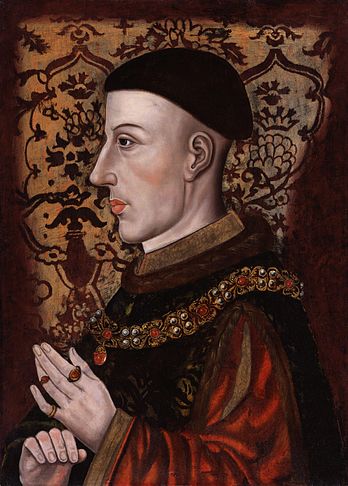
Take Henry V. Please. I mean, he is dead. Take him and bury him. He died on August 31, 1422 while campaigning in France, of… dysentery. And really, why not? Lots of people did. Kings don’t have some special dispensation to die only of elevated-sounding or elegant maladies. So yes, the hero of Shakespeare’s play (or plays if you count the two where he’s a wild child as well as the one where he grows up) with that Agincourt speech ended up not victorious and reigning happily ever after nor even dying heroically in battle but instead… how shall I put this tactfully?... kind of pooped his guts out.
Ugh. But that’s more or less what it amounts to.
OK. So he’s dead. And dead young, just 36, after just 9 years on the throne, before he could fulfil his promise as a king if any.
Much as I love Shakespeare, his judgement in such matters or at least his publications are not to be relied on. He was a propagandist for the Tudors who had taken the throne by killing off the last reigning Yorkist king Richard III and helping dispose of any other potential claimants not wiped out in the Wars of the Roses between Yorks and Lancasters. And thus he, or his patrons who might have caused him to perish if he’d gotten out of line, had a vested interest in making the Lancasters look good to make the Yorks look bad. (His negative portrayal of Richard II, predecessor to the Lancasters, is by contrast entirely justified, even insufficiently harsh.) But were they?
I don’t mean were the Yorks bad. I’ve addressed that elsewhere and the answer seems pretty clearly to be no, not even Richard III whose reputation was blackened by Shakespeare on his way to the parking lot under which he was recently found buried. I mean were the Lancasters good?
There were only three of them so it should be easy to answer. And crucially, Henry VI was not. I’ve heard his character praised. But he was a weak king and mentally unstable and his inability to rule contributed to the Yorkist rise to power, or lunge for it by some accounts. And he was also handicapped by coming to the throne very young because his father died early. That being, of course, Henry V. All the Lancasters were Henrys.
I can’t really tell if Henry IV was a good king. Shakespeare portrays him as such, with Henry V growing into a worthy heir throughout the cycle of plays. But his reign was marked by endless troubles, revolts and plots. And if he showed skill and even judgement in surviving them, he didn’t have much chance to establish a domestic record before dying of some unidentified disease or diseases that caused disfigurement, seizures and his early demise at age 45 after just 13 years on the throne.
As I’ve said before, if he’d just admitted he wasn’t king of France and gone home, he would have done his kingdom considerable good. And himself, as it turns out, because war is always a risky business and poor sanitation in those days sure didn’t make it safer.
Thus Henry VI took over, in name at least, at age nine. Months not years. So he was a pawn, puppet and object of a tug of war for the first 15 years of his reign, and never developed a strong character.
Had his own father lived even to the same age that his father had, Henry VI would at least have been nine years old when he took over, and presumably had a more stable childhood with at least some guidance and certainty from his father. Had Henry V lived to be, say, 60, then Henry VI would have come to the throne in 1446 in his mid-30s.
Of course he might still have been an awful king, harsh and greedy, weak and treacherous or just lazy. He might have been an OK king. He might even have been a good one. And if he had been good, or really bad, the Wars of the Roses would probably have been avoided altogether or, alternatively, been less destructive because the Yorkist cause would have been more obviously just and commanded greater support.
Either way, the end result, with the Tudor usurpation and subsequent brutally cynical break with Rome, would have been highly unlikely. We cannot know what would have happened, naturally. Possibly something even weirder or more outrageous. Maybe something worse for the future rise of England and the Anglosphere with its unique liberty under law.
My crystal ball tends to cloud over in such cases. But before doing so, it says to me that Henry V’s ignominious death did help destabilize England with far-reaching consequences in ways that your average assassin can only envy. And envying a bacterium, virus, worm or amoeba (dysentery is a syndrome not a disease and can have various causes) is exceptionally ignominious too.
“economist, n. a scoundrel whose faulty vision sees things as they are, not as they ought to be. – after Ambrose Bierce”
Daniel K. Benjamin in PERC Reports Vol. 17 # 5 (12/99) p. 16 [Bierce, himself one, had defined a “cynic” that way in his Devil’s Dictionary].
“You cannot run away from a weakness. You must sometimes fight it out or perish; and if it be so, why not now, and where you stand?”
Robert Louis Stevenson