Reading the wave

Can I just kick this one off with a bird’s head or some odd circles and waves? Or perhaps a more comprehensible drawing of a thumbs-up, directed at good old Jean-François Champollion. You respond with an ornate question mark? Well, he’s the guy who on September 27 of 1822 published a decipherment of the Rosetta Stone. And the sphinx never looked back.

The Rosetta Stone is, fairly famously, the great key to reading ancient Egyptian inscriptions because some clever chap way back when had written the same thing three times in three different languages: Ancient Greek, Demotic (the Egyptian not the Greek kind) and Ancient Egyptian. I say fairly famously because it is the most visited object in the British Museum which is not exactly short of other interesting exhibits. And of course Egypt wants it back so they can treat it with the same care they have given to various other antiquities.

The actual text is kind of odd, basically declaring King Ptolemy V divine which he wasn’t.

Interestingly, even ancient Greek was a challenge in those days. Not the truly classic Aristotelian stuff which scholars could read, but the Hellenistic bureaucratic jargon of the Rosetta Stone and similar such bumf. As for Demotic, nobody knew what it was including even whether it was alphabetic, until people who weren’t Champollion got hold of prints of the Rosetta Stone and discovered that it basically was.

Then Champollion really cracked the hieroglyphic stuff. He may not have been “good old” after all; he was apparently an annoying character who didn’t give others due credit, which not only made his life difficult but led to a lot of hair-splitting, or glyph-splitting, or stone-splitting, about the accuracy of his translation. But recently he’s been given full credit as an annoying genius.

So what? Who cares about a bunch of squiggles?

We do. That’s what really stands out to me about the whole venture. It might be that the ancient Egyptians had something really important to tell us about life, the universe and everything. Though if so, I still don’t know what it was and maybe won’t until the sphinx finally opens up. But we just wanted to know, to understand, to connect with them even if it was purely one-way, because they too were humans, groping through the fog, and they mattered even if their religion was an unholy mess.

There’s a huge contrast between the West, with its obsession with historical memory, even of non-Western peoples, and the habit in much of the world of ignoring or erasing it because it had not achieved the degree of perfection of those doing the destroying. An attitude which helps explain why that degree was and is so low, from Nazis to ISIL.

In some sense people were determined to decipher hieroglyphic in the Hillary-Everest spirit. Just because it is there, we’re going to figure out what it says. But even more it’s because people were there and we just had to say hello, we’re here too, how was it on the banks of the Nile back then? And by golly we managed to read the squiggles and get some idea.

P.S. What’s with the pyramids? You can level with us, so to speak. How did you do it? And why?
It happened todayJohn Robson
Athena wept

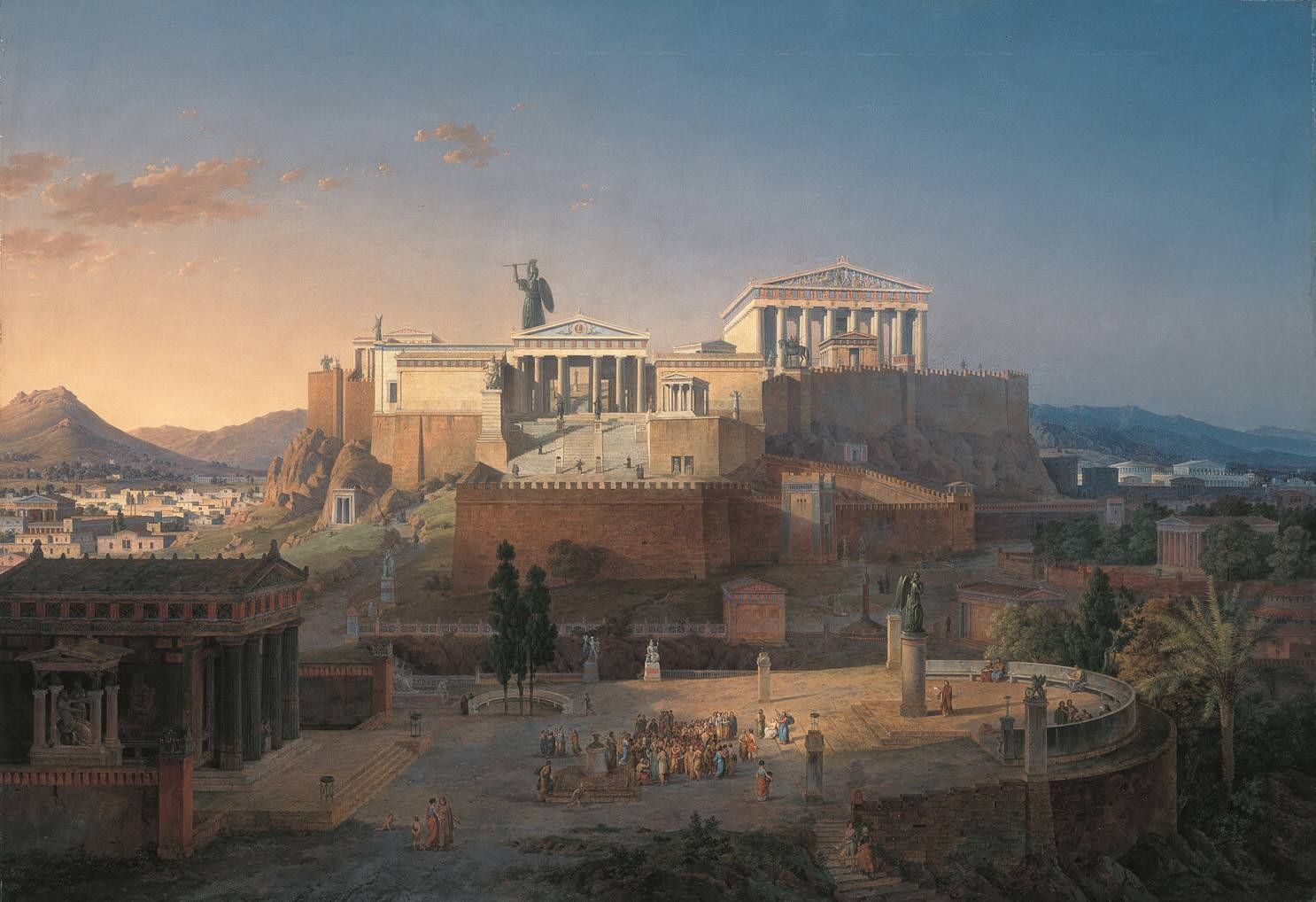
Reconstruction of the Acropolis and Areus Pagus in Athens, Leo von Klenze, 1846 (Wikipedia) One thing I really hate is when someone blows up the Parthenon. Which they did on September 26, 1687.
Now you might point the finger-bone of blame at the Venetians, whose artillery touched it off. But they in turn might note that marble doesn’t habitually explode unless some tasteless vandal is, say, storing gunpowder there. Which the Ottomans were.

Yes, it’s our old friends the Turks. Having captured Athens in 1458 they promptly… what did they do? Right. They turned it into a mosque. Thanks for respecting the religious impulses of others even if you consider them mistaken.

Then came the disaster of 1687, during the “Great Turkish War” from 1683-1699, the same one in which the Ottomans attacked Vienna for the last time, or so we hope. The Venetians were trying to recapture Athens, of all outrageous infidel provocations. And so the Turks fortified the Acropolis and filled it with gunpowder even though they’d already blown up the Propylaea or “entrance” to the Athenian Acropolis in 1656.

As Oscar Wilde noted in a different context, one might be regarded as a misfortune. Two looks like carelessness. And indeed it speaks of carelessness, if not contempt, toward the achievements of other cultures and civilizations, the same inability to appreciate the beauty and nobility of human striving toward the divine even if misguided that led the Taliban to destroy ancient Buddhist statues in Afghanistan or the deliberate destruction of shrines in Iraq by ISIL and in Mali by various Islamist rebels.

Beautiful as the Parthenon’s remains are today, we have sketches from the mid-17th century that show how much more had survived intact for over 1500 years until this catastrophe. And while one might also blame the Venetians for targeting the Parthenon, which the Ottomans may have thought they wouldn’t given its historic value and beauty, the decision to use it as a military asset is surely the main cause of the disaster.

OK, so the Turks had an issue with defending Athens and it might have seemed a good place to store munitions. But it wasn’t given what happened. And anyway, sometimes there are things more important than keeping your illegitimate conquests. Or not, depending who you are.

Lord Elgin takes a lot of heat for having collected a lot of what was left of the Parthenon and took it to the British Museum with the disputed permission of the Sultan. But at least he wanted to preserve and display it.

It sure beats blowing it up, through malice, carelessness or a combination of the two.

It happened todayJohn Robson
POBFAD

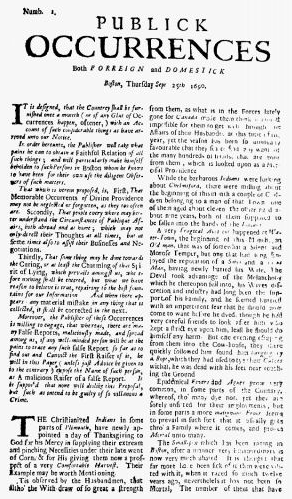
The newspaper business is a precarious one. No, no, I’m not going to whine about how we were on easy street with ad revenue until some fool invented the Internet. I’m talking about the sad, inspiring tale of “Publick Occurrences Both Forreign and Domestick” which appeared in Boston on September 25, 1690 and… promptly disappeared.

It has the distinction of being the first newspaper published in the Americas. There had been single-sheet “broadsides”. But now you got one of those multipage things you can’t cope with on a bus and I can only imagine what it was like in a carriage or wagon. (BTW I am old enough to remember the first appearance of the Toronto Sun, following the demise of the old Telegram, with ads in the subway saying “You don’t have to be Houdini to read the sun” and showing someone not looking at all like Houdini failing to escape a broadsheet. But I digress.)

I love the name. Publick Occurrences Both Forreign and Domestick. With lots of “ks” despite the drudgery of typesetting in those pre-digital days. Never mind “National Post” or “Globe” or “Star”. Let’s go long. Especially with the brilliant acronym POBFAD. I also love the fact that it promised to appear monthly “or, if any Glut of Occurrences happen, oftener.”

That’s quite an “if” to contemplate in the modern world with its obsession with novelty and an ever-faster pace of change. It’s also disquieting, especially for someone with claims to be a journalist, to reflect on what we would do if there was only enough news to publish once a month except in the unusual event of a “glut of occurrences”. Or to wonder whether we manage to create the impression of such a glut every day by failing to distinguishing the truly important from the trivial and faddish on the theory that there has to be news, an endless stream of it, or we couldn’t print it.

In the case of POBFAD, it turns out there was a glut of occurrences directly related to its publication. It was a one-event glut. But one is enough if it’s the colonial government striking you down five days later as presumptuous, offensive and inaccurate and insisting that anyone wishing to “Set forth any thing in Print” get a state licence.

In fact Americans went right on publishing things the authorities considered scurrilous, not always without cause, especially from the time of the early 18th-century Great Awakening. And these newspapers played an important role in the development of a colonial identity leading up to the Revolution at which point the authorities certainly had a “glut of occurrences” on their hands.

Looking back, I’d rather be killed by the Internet than the Massachusetts government. At least that way you can still blog. I think POBFAD would be a good name for a blog, come to think of it. Even if the Internet sometimes seems to represent the ultimate glut of non-occurrences.

It happened todayJohn Robson
Up, up, and... still there

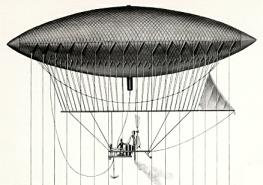
Here’s something that went nowhere. On September 24, 1852, Henri Giffard became the first man to… No, you have no idea. Neither did I. And yet I once again have to tip my hat to pioneers of a technology that won’t die but never really lived. Because he was the first man to drive a blimp using a steam engine.

I suppose I should say a “dirigible” since he was French. And what he did was pretty cool. It was the first passenger dirigible. Others had planned steam engines in Zeppelin/blimp/dirigibles, including Australian Dr. William Bland, who exhibited a model and designs at the Great Exhibition of 1851 in London of one he thought could go 50 miles per hour in theory. But Giffard’s went in fact, with a mighty 3 horsepower engine and a steering apparatus that actually worked.

Which is cool. But what I really like, in the spirit of all those early airplanes flapping mightily then crashing onto their hapless pilot in ungainly fragments, is the idea of getting into a bag of hydrogen with a 19th-century coal-fired steam engine. I mean, what could go wrong? (I should mention that when I first took my wife to my parents’ cottage, which did not have electricity, she expressed concern about the safety of the propane lights, stove and yes fridge. I replied in the true 19th-century pioneer spirit that all I was doing was putting an open flame to explosive compressed gas and could see no reason for unease. In fact the fridge did later explode but luckily we weren’t there and it was over half a century old so I suppose it had a good excuse.)

Not much did go wrong. In 1852, I mean. Especially considering what might have. Giffard, who had the good sense to point the exhaust pipe down rather than up toward all that flammable hydrogen, drove his dirigible 27 km from Paris to Trappes (I told you it went nowhere) and could not get back because of high winds that overpowered his mighty engine. But he did turn back and forth and in a circle, proving a powered airship was, indeed, dirigible.

Enthusiasts are still waiting for blimps to be the transportation of the future. And the recent headline “World’s biggest aircraft ‘the Flying Bum’ crashes on test flight” tells you they may have a long wait ahead of them. But I’m still impressed by anyone who’d get into a steam-powered dirigible, crank it up and say “Let’s hit the sky” or however you say it in French. And then not hit it in an uncontrolled fashion, as the first man to fly from Paris to Trappes thanks to the explosion of his fuel and levitation sources simultaneously of the sort that, I gather, claimed that old fridge one otherwise peaceful afternoon.

It happened todayJohn Robson