In my latest National Post commentary I reproach the government for the huge carbon footprint of its delegations to international climate conferences.
I was at an event held by Canadians for Language Fairness over the weekend where I talked about our newest project. My talk is below. Many thanks to Danno Saunt for the videos. https://www.youtube.com/watch?v=P4EiZ9RGXG8
https://www.youtube.com/watch?v=NOHKT0_UteU
https://www.youtube.com/watch?v=0o4JYqq9FoI
 So it says here that on November 15 Penda of Mercia was defeated by Oswiu of Northumbria. And evidently he was, since he died on that same day at the Battle of Winwaed or, if you’re Penda, Losewaed I suppose.
Now you may be tempted to dismiss this as a load of antiquarian dingoes’ kidneys since it happened in 655 AD, as part of the darkness that characterised the darker bits of the Dark Ages. Supposedly his victories laid the basis for Mercian supremacy in the Anglo-Saxon heptarchy which I’m sure was a great consolation as cold steel passed through his body at the Winwaed. And in any case Mercia ended up secondary to Wessex in the great events that did establish premodern England as a land of liberty nearly 250 years later. Penda, not so much.
For all that, and considerable obscurity about his antecedents, date of accession, and why he’s the only king called Penda which I’m sure was really puzzling you too, there is one interesting thing. He was evidently a fierce and enthusiastic fighter, cruel in victory and pagan in religion, the last great pagan Saxon warrior king. So he somehow became the focus of two BBC television productions in the 1970s. And it’s amusing to imagine how he would have reacted if he could somehow have seen himself depicted on television with cheap, theatrical sets and people with sideburns in a bleak, Labour-dominated, stagnant Britain.
He would, I suspect, have been surprised that people in those days looked down reflexively on the culture and attainments of his own time. And I expect the TV would have wound up, as his foes often did, in pieces each on its own spike.
“It is proper to demand more from the man with exceptional advantages than from the man without them. A heavy moral obligation rests upon the man of means and upon the man of education to do their full duty by their country. On no class does this obligation rest more heavily than upon the men with a collegiate education, the men who are graduates of our universities. Their education gives them no right to feel the least superiority over any of their fellow-citizens; but it certainly ought to make them feel that they should stand foremost in the honorable effort to serve the whole public by doing their duty as Americans in the body politic…” Theodore Roosevelt in The Atlantic Monthly August 1894
https://youtu.be/uSOASvJJlYo The audio-only version is available here: [podcast title="Ask the professor, November 14, 2016"]http://www.thejohnrobson.com/podcast/John2016/November/Ask_Professor_62.mp3[/podcast]
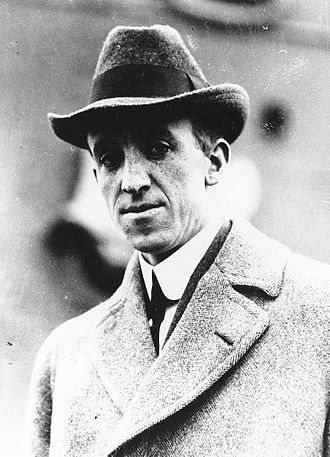 Often they sneak up on you. Genuinely historic events, I mean. Indeed, when you look at list of “It Happened Today” type things, the most recent ones frequently appear ephemeral, earthquakes and conferences and sports victories, precisely because they are headline-grabbers rather than things we know from experience still seemed important a century or more later. What might people have thought in late 1910 would be key events from their own time?
Well, how about the one involving Eugene Burton Ely? What’s that? It seems to have vanished and him with it? Well, I don’t know how big a noise it made back then either, at least figuratively. But it was probably kind of loud at the time and it got considerably louder as the years went by.
What Ely actually did, you see, was take off from a ship in an airplane on November 14, 1910. Given the technology of the time, just seven years after the Wright brothers first took off at all, and using an improvised platform on the bow of a cruiser, it sounds like an elaborate and expensive way to die. (Which he did in a plane crash less than a year later, managing to jump from a wrecked plane despite a broken neck, only to die within minutes while ghastly bystanders combed the wreck for souvenirs including his hat.) But the fact is that, like those guys with the steam engines in hydrogen blimps, people do have an incorrigible habit of pushing the limits of technology and it certainly does move things along even if it makes their life insurance premiums a thing of horror.
Planes taking off from ships remained a curiosity through at least the First World War. But it ended only 7 years after his feat. By the late 1920s, aircraft carriers were a reality, though they got more attention in Japan than in the West apparently. Hence the success of the Imperial Japanese Navy, at least from a short-term perspective, in sneaking up on the Americans at Pearl Harbor. And while the Royal Navy’s defeat of the dreaded Bismarck resulted from a successful attack by torpedo bombers from HMS Victorious, the fact that all the Royal Navy had on hand were these obsolescent biplanes underlines that the British still had more faith in surface vessels at that point (the planes were in fact Fairey Swordfish which is probably not a name you could use today).
So does the fact that the Americans had war-gamed successful aerial attacks on Pearl Harbor in 1932 and 1936 and blown off the results. Of course it’s easy to see in retrospect how it would turn out. But a number of people saw it ahead of time.
By that of course I mean in the 1930s. Back in 1911, there must have been some people who saw the implications of Ely’s feat, though it wasn’t until 1933 that he was posthumously awarded the Distinguished Flying Cross. For most people at the time, the reaction must have been either “Those airplane chaps certainly are brave” or “That guy must have a death wish.”
Unless of course it was “Eugene Barton Who”?
“Anything that is worth doing has been done frequently. Things hitherto undone should be given, I suspect, a wide berth.” Max Beerbohm
 Today is the anniversary of the St. Brice’s Day Massacre. And almost nothing with “Massacre” in its name is good even if it’s also named for a saint. The St. Valentine’s Day Massacre, for instance, is not a romantic event.
In case the details have faded, and they have, the massacre happened on November 13, 1002 (St. Brice’s, I mean, not St. Valentine’s) at the behest of the dreaded Aethelred the Unready. And it proves that a person can be both weak and vicious and also that the two in combination are even worse than either by itself.
Aethelred was, you may recall, about the worst monarch from the House of Wessex, who seems to have acceded to the throne due to his mother arranging the murder of his half-brother, Edward the Martyr, and once there was unreliable or even treacherous with his courtiers and ineffective in fighting the Danes, vacillating between paying them the Danegeld and battling them.
In 1002 he decided he’d had enough and ordered a massacre of we’re not quite sure who. Certainly not all the Danes in the British Isles; his oily writ did not extend to the Danelaw. Possibly some rather nasty mercenaries. They may have deserved to die, and the Danes had been raiding and pillaging in a most obnoxious manner for centuries.
So I don’t mind trying to get rid of them. I do rather mind sudden massacres although it may be, as Aethelred later claimed, that they’d been planning similar treachery themselves. But what I really mind is a cruel but feeble stroke that ends up, as this one did, provoking Sveyn Forkbeard to invade the next year, some say partly because his own sister was a victim of the massacre.
Sveyn came back repeatedly and not in a good way, invoking the massacre regularly although given the Danes’ general approach it may simply have been an excuse. But in the end he actually became king of England in 1013, only to die the next year, after which Aethelred was briefly restored, died in 1016 and after the tragic death of his son Edmund Ironside Canute (properly Knut, I suppose) became king.
The long and the short of it is that Aethelred was a sniveling, impulsive, cruel man, not even Machiavellian in the common sense of that word. He struck repeatedly but ineffectually, getting the worst of both worlds and earning opprobrium without being feared. So he’s an inspiring role model, but only for his superb illustration of antistatesmanship and his compelling example of what not to do.
By the way Brice himself was a 5th-century bishop of Tours who is no more responsible for it happening on his feast day than St. Valentine is for gangsters opening up on one another with machine guns.