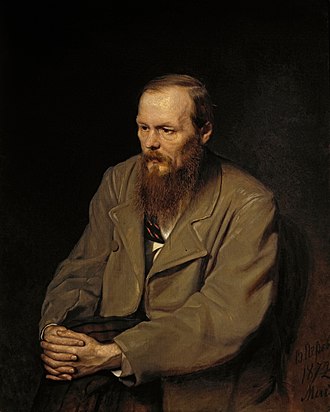
Hey Fyodor, Bang! Just Kidding

On this date in 1849 the Tsar’s government sentenced Fyodor Dostoevskii to death. It was a true Russian classic.

In the first place, they arrested and sentenced him for belonging to a revolutionary circle, not for writing unbearably long depressing tormented novels. Not that a man should be sentenced to death for such deeds although if he complains that he’s not enjoying huge commercial success one might justifiably say that the problem might lie with his books at least as much as with his audience.

Nor should he have been sentenced to death for his political views or activities. He held such mad notions as that censorship was bad and so was serfdom. And the “Petrashevsky circle” to which he belonged, partly because they helped him survive despite having no money, was in fact extremely mild in its goals and its, well, I was going to say methods, but really it was just the methods it advocated since it never really got sufficiently organized or energetic to undertake much of anything.

The Tsarist government, painfully aware of the fragility of its superficially omnipotent and seedily magnificent regime, nevertheless reacted harshly to all efforts to develop what we would now call “civil society,” however feeble. So 60 of them were arrested, tried under martial rather than civil law just because, and 15 were sentenced to death, which a higher court stroked its long grey beard and declared to have been a judicial error and they should all be executed. So they were lined up and theatrically pardoned at the last minute by a personal letter from Tsar Nikolai I, who had staged the whole thing.

Instead Dostoevskii and others were, duh, sent to Siberia and treated with such flippant cruelty that it’s amazing anyone survived. But he did, both four years’ hard labour and then even more dangerous compulsory military service, and went on to have a miserable life, sickly, unhappy in love, poor much of the time and a reckless gambler when he had any money.

So now of course he’s a literary giant. But I digress. My point here is that the whole oppression-mock execution affair was a Tsarist classic, witlessly repressive yet unwilling to use genuinely brutal force in a sustained way. The Bolsheviks not only regarded the Tsars as vicious monsters, they somehow convinced the world it was true and that their own regime was, if worse, only marginally so, and at least had better motives.

The truth is that Tsarism was more marked by stagnation than any sort of systematic, energetic effort to make people miserable. The Tsars and their advisors mostly figured that any significant political development would be disastrous and tried to make sure none happened. I don’t endorse this policy, and in the end it failed in a very disastrous way. But I will say this.

If Lenin or Stalin had sentenced a writer to death, or even if they hadn’t, there would have been nothing mock about their execution or mysterious accident. If they sent someone to Siberia, they almost certainly stayed there permanently. And we wouldn’t now have their 38,000-page books to pore over.

It happened todayJohn Robson
Wish I'd said that - November 16, 2016

“But, as a famous old saying by a great nineteenth-century con man has it, ‘It’s much easier to sell the Brooklyn Bridge than to give it away.’ Nobody trusts you if you offer something for free.” Peter F. Drucker, Managing the Non-Profit Organization: Principles and Practices

Famous quotesJohn Robson
Pending technological progress

Stained glass window, depicting Penda's death at the Battle of the Winwaed, Worcester Cathedral. (Wikipedia) So it says here that on November 15 Penda of Mercia was defeated by Oswiu of Northumbria. And evidently he was, since he died on that same day at the Battle of Winwaed or, if you’re Penda, Losewaed I suppose.

Now you may be tempted to dismiss this as a load of antiquarian dingoes’ kidneys since it happened in 655 AD, as part of the darkness that characterised the darker bits of the Dark Ages. Supposedly his victories laid the basis for Mercian supremacy in the Anglo-Saxon heptarchy which I’m sure was a great consolation as cold steel passed through his body at the Winwaed. And in any case Mercia ended up secondary to Wessex in the great events that did establish premodern England as a land of liberty nearly 250 years later. Penda, not so much.

For all that, and considerable obscurity about his antecedents, date of accession, and why he’s the only king called Penda which I’m sure was really puzzling you too, there is one interesting thing. He was evidently a fierce and enthusiastic fighter, cruel in victory and pagan in religion, the last great pagan Saxon warrior king. So he somehow became the focus of two BBC television productions in the 1970s. And it’s amusing to imagine how he would have reacted if he could somehow have seen himself depicted on television with cheap, theatrical sets and people with sideburns in a bleak, Labour-dominated, stagnant Britain.

He would, I suspect, have been surprised that people in those days looked down reflexively on the culture and attainments of his own time. And I expect the TV would have wound up, as his foes often did, in pieces each on its own spike.

It happened todayJohn Robson
Wish I'd said that - November 15, 2016

“It is proper to demand more from the man with exceptional advantages than from the man without them. A heavy moral obligation rests upon the man of means and upon the man of education to do their full duty by their country. On no class does this obligation rest more heavily than upon the men with a collegiate education, the men who are graduates of our universities. Their education gives them no right to feel the least superiority over any of their fellow-citizens; but it certainly ought to make them feel that they should stand foremost in the honorable effort to serve the whole public by doing their duty as Americans in the body politic…” Theodore Roosevelt in The Atlantic Monthly August 1894

Famous quotesJohn Robson
Flying off the bow

Often they sneak up on you. Genuinely historic events, I mean. Indeed, when you look at list of “It Happened Today” type things, the most recent ones frequently appear ephemeral, earthquakes and conferences and sports victories, precisely because they are headline-grabbers rather than things we know from experience still seemed important a century or more later. What might people have thought in late 1910 would be key events from their own time?

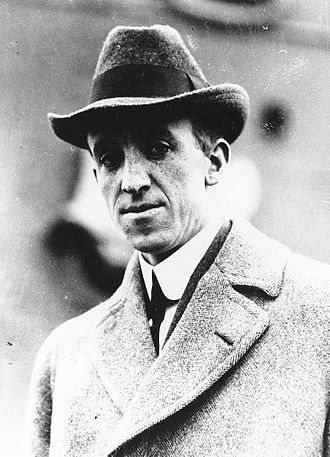
Well, how about the one involving Eugene Burton Ely? What’s that? It seems to have vanished and him with it? Well, I don’t know how big a noise it made back then either, at least figuratively. But it was probably kind of loud at the time and it got considerably louder as the years went by.

What Ely actually did, you see, was take off from a ship in an airplane on November 14, 1910. Given the technology of the time, just seven years after the Wright brothers first took off at all, and using an improvised platform on the bow of a cruiser, it sounds like an elaborate and expensive way to die. (Which he did in a plane crash less than a year later, managing to jump from a wrecked plane despite a broken neck, only to die within minutes while ghastly bystanders combed the wreck for souvenirs including his hat.) But the fact is that, like those guys with the steam engines in hydrogen blimps, people do have an incorrigible habit of pushing the limits of technology and it certainly does move things along even if it makes their life insurance premiums a thing of horror.

Planes taking off from ships remained a curiosity through at least the First World War. But it ended only 7 years after his feat. By the late 1920s, aircraft carriers were a reality, though they got more attention in Japan than in the West apparently. Hence the success of the Imperial Japanese Navy, at least from a short-term perspective, in sneaking up on the Americans at Pearl Harbor. And while the Royal Navy’s defeat of the dreaded Bismarck resulted from a successful attack by torpedo bombers from HMS Victorious, the fact that all the Royal Navy had on hand were these obsolescent biplanes underlines that the British still had more faith in surface vessels at that point (the planes were in fact Fairey Swordfish which is probably not a name you could use today).

So does the fact that the Americans had war-gamed successful aerial attacks on Pearl Harbor in 1932 and 1936 and blown off the results. Of course it’s easy to see in retrospect how it would turn out. But a number of people saw it ahead of time.

By that of course I mean in the 1930s. Back in 1911, there must have been some people who saw the implications of Ely’s feat, though it wasn’t until 1933 that he was posthumously awarded the Distinguished Flying Cross. For most people at the time, the reaction must have been either “Those airplane chaps certainly are brave” or “That guy must have a death wish.”

Unless of course it was “Eugene Barton Who”?

It happened todayJohn Robson