Posts in It happened today
It happened today - November 8, 2015

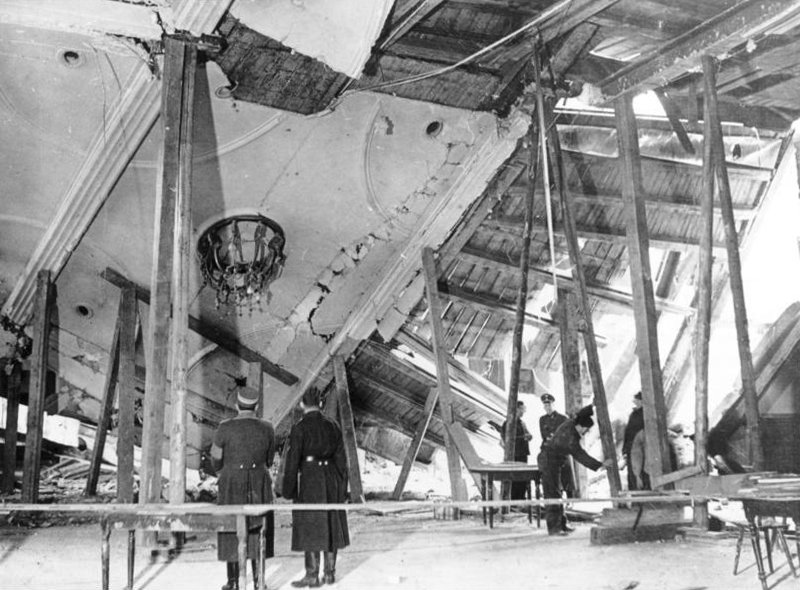
On Nov. 8, 1939, Johann Georg Elser did not assassinate Hitler. Nor, to be fair, did a lot of other people. At least Elser tried.

On the whole I do not approve of assassinations. But by the time Elser set his time bomb, Hitler had started World War II. And while the Holocaust was not yet fully under way, it was fairly clear what kind of regime the Nazis had created.

I also do not approve of radical communists, which Elser apparently was. The regime Stalin had created by 1939 was no better than the Nazi one; if it was less prone to attacking its neighbours it was primarily a matter of being less well placed to do so.

Still, I do wish Elser’s bomb had killed Hitler and other top Nazis as intended, instead of killing 8 other people, and wounding 62, at the Bürgerbräukeller, the Munich beer hall from which the Nazis had launched the feeble Beer Hall Putsch 16 years earlier, on Nov. 8, 1923.

Of course, no one is ever told what would have happened. I believe there are all kinds of occasions on which removing the top Nazi leadership would have prevented World War II, or even just removing Hitler, including the 1936 remilitarization of the Rhineland, when German generals would have ousted the Nazis if the Western powers had shown any sign of resistance. But killing Hitler in November 1939 obviously could not have that result.

It could have led to the public rallying round Hitler’s Nazi successor, who would have been likely to continue the war as ruthlessly as Hitler but probably without his extraordinary daring that proved so effective in the first year. Alternatively, it might have led to the collapse of the Nazi regime and the coming to power of a nationalist equally determined to continue the war but more willing to listen to the advice of military leaders. It might even have led to the collapse of France followed by the trapping and destruction of the BEF at Dunkirk and a negotiated peace. Or to a negotiated peace in the spring of 1940, before any dramatic successes of the Blitzkrieg, with only minor adjustments in Germany’s borders.

We cannot say. But we can say that Hitler was a maniacal war leader. And virtually any of these scenarios would have meant no Holocaust on the scale that actually occurred.

So no, I cannot approve of Elser’s beliefs and I have grave reservations about his methods. But this is one assassination that should have succeeded.
It happened today - November 7, 2015

Everyone knows that the American Republican party symbol is an elephant. But why?

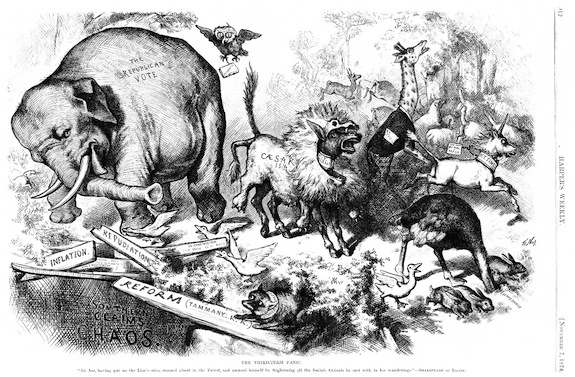
The short answer is that on Nov. 7, 1874, cartoonist Thomas Nast drew it as one in Harper’s Magazine. I suppose it beats a donkey. But why did he choose an elephant and why did it stick?

For that matter, why a donkey for the Democrats? That one is more of a political classic. It dates back to 1828, when his adversaries called Andrew Jackson a jackass and, instead of groveling, apologizing or fleeing, he defiantly adopted it as symbol of determination on his campaign posters.

An amazing number of political emblems originate as abuse that fails because its targets are not frightened, including labels like Whig and Tory. Still, if you had a choice you’d probably not want a braying, stubborn, generally undistinguished animal. Which brings us back to the elephant. Sort of.

Nast’s 1874 cartoon showed a donkey dressed in a lion’s skin scaring animals at the zoo including an elephant labeled “The Republican Vote.” (Connoisseurs will know that 19th and 18th-century political cartoons tended to be festooned with labels that seem to me to prove they weren’t really funny; jokes that need elaborate explanation have missed their mark.) So I guess the idea was that it was unreasonably timid for its size or something.

The odd thing is that it stuck. Nast was a skillful and influential cartoonist (among other things, his drawings of New York City political bigwig “Boss” Tweed in a convict outfit helped bring the man down and, indeed, after he fled justice, led to his identification by Spanish police who recognized him from those cartoons). So I guess he did a good elephant.

He also did a good donkey and helped reinforce its identity as the Democrat. But a key part of the puzzle is that parties, and cartoonists, need emblems to make jokes or create images that communicate a lot without needing elaborate explanation. A singularly wise or dim looking donkey, a bold or frightened elephant, give depth and impact to a political cartoon. In that sense it’s analogous to the persistence of “Grit” and “Tory” in Canada not for visual but for typographic reasons: They fit readily into print headlines. (For all you kids out there, there used to be these things called newspaper that were on actual paper and you had to pick them up and couldn’t be retweeted.)

Likewise with nations: John Bull or a lion for Britain, an eagle or Uncle Sam for the United States, a bear for Russia. And um a beaver for Canada. What, were we late to the emblem handout? Yeah, we’ll take the buck-toothed terror of trees in wet areas. Cool. And where are the animal emblems for our parties?

Even Teddy Roosevelt’s relatively short-lived Progressive Party got to be the “Bull Moose” party and we have plenty of meese. Our cartoonists need emblems. Can’t someone stick an animal on the parties?

OK, I can’t think of suitable ones off the bat. And a bat wouldn’t be ideal for those who favour any given party. But if Republicans can be elephants and Democrats donkeys to general satisfaction without too much quarreling over the logic, perhaps we could throw a few classic Canadian emblems into a hat, a polar bear, a Canada goose, an elk and stuff and have a “draw”.

Otherwise we keep having to choose politicians sufficiently remarkable-looking, in good ways or bad, to be prime caricature material. Which we’re doing OK at for the most part. But I’d still go for animals and, luckily, the beaver is already taken.

It happened today - November 6, 2015

On Nov. 6, 1917, the Canadian Corps captured the infamous village of Passchendaele. Or rather, what was left of it after the bloody, brutal, apparently pointless battle to which it has given its name. It’s not exactly Vimy Ridge.

The funny thing is, it’s not exactly not Vimy Ridge either. The battle is often regarded as the epitome of the stubborn, callous, stupid nature of Allied generals in World War I, including thinking it worth persisting in costly attacks until they actually could claim someone in their side’s uniform was standing on the objective that no longer existed and wasn’t worth much anyway and certainly not the incredible toll required to take it. And yet (as I argue in my The Great War Remembered) this rather flippant dismissal of the entire leadership of Western armies in that awful conflict overlooks a number of key points.

First, Germany had attacked its neighbours and occupied and brutalized most of Belgium. It would have been foolish and cruel to let them get away with it, and weak and cowardly to quit a war intended to free this ally just because it was hard.

Second, relentless Allied pressure on the German positions from 1915 through 1917 was wearing them down too. German losses on the Somme, Passchendaele and elsewhere were not just enormous but unsustainable, driving them to gamble on unrestricted submarine warfare that, by bringing the United States into the war, sealed their fate.

Third, like Vimy in the spring, Passchendaele did not merely divert German forces that might have been used to devastating effect elsewhere, including against a French army large parts of which had mutinied in the summer of 1917 and were not prepared to fight until late fall. It also kept driving the Germans back, slowly wearing down not just their army but also their strategic position.

In the spring of 1918, the Germans launched one last desperate offensive, Operation Michael, that broke the Allied lines in a number of places and very nearly did win the war. Without the losses, and pressure, of battles like Passchendaele they might have had that little bit of extra strength needed to take Paris and drive to the English Channel.

Yes, it was a victory purchased at enormous cost, of Canadian and other Allied lives. It was not a glorious battle, to the extent that any battle is glorious. But it was a victory, the product of dogged tenacity, tactical skill and strategic intelligence. It should be remembered, with a shudder but also with pride.

It happened today - November 5, 2015

Well, well. Penny for the guy? After all, it is Guy Fawkes day. Not that a penny would get him far today. Nor would most people know who he was or why he had a day.

You know, of course. Being a keen student of history you’re well aware that “Guido” Fawkes (b. 1570), as he came to call himself, was an unbalanced Catholic fanatic partisan of Spain in the religious wars of the 16th century who attempted to blow up King James I and the English parliament in 1605 by stuffing the basement of the House of Lords with barrels of gunpowder.

It was a crackpot plot that failed rather dismally, though it did prompt the witticism that Fawkes may have been the only man who ever went to Parliament with entirely clear intentions. And if you were pro-Catholic, there were more suitable kings to target than James. But I digress.

The point is, Fawkes became a symbol of Catholic treachery in a nation and a political culture that increasingly identified itself not only as free but also as Protestant, to the point that the Observation of 5th November Act made it an annual day of thanksgiving for the failure of the plot within months of that failure.

Daniel Hannan discusses this now largely discarded aspect of Anglosphere self-understanding in his splendid Inventing Freedom, including noting that George Washington took steps to suppress celebrations of Guy Fawkes Day during the revolution partly from a genuine distaste for sectarian bigotry and partly from a calculated wish not to alienate Catholic Quebecers.

The American Revolution signally failed to draw in Quebec, of course. But it did significantly contribute to the disappearance of Guy Fawkes Day from the North American continent. You would get very strange looks from most people if you suggested celebrating it, showed up with the requisite effigy of Fawkes (or, earlier, the pope) to burn in a bonfire and chanting:

“Remember, remember, the 5th of November, gunpowder treason and plot/ I know of no reason why gunpowder treason should ever be forgot!”

Even the British, who abolished the Observance of 5th November Act a few centuries later, in 1859 (among other reasons, Queen Victoria found the anti-Catholicism distasteful), have largely given up the begging of “pennies for the Guy”, perhaps thanks to inflation as well as increasing distance from the cultural origins of this weird festival.

Now as fall starts turning into winter they increasingly instead just adopt our sensible habit of carving scary shapes in pumpkins and dressing as zombies to get bad candy and… well… never mind.

It happened today - November 4, 2015

On Nov. 4 of 1880 Ka-ching! The Ritty brothers of Dayton, Ohio patented the first cash register.

I might seem to date myself with that “Ka-ching!” there. Cash register don’t make that noise anymore. They boop and beep and I imagine the youth of today are baffled by the opening of Pink Floyd’s classic song “Money” if they even know what the song is. But the cash register remains characteristically modern.

In the first place, it was ingenious. James Ritty, a saloon keeper, was concerned that employees sometimes pocketed the proceeds of a sale instead of putting it in the drawer. And on a trip to Europe he was fascinated by a device for counting the revolutions of the propeller and somehow got the notion that a similar mechanism could ring up sales.

Ring is the key word. When he got home James and his mechanic brother John invented a device that not only popped open the drawer when you entered the sale amount, they made it ring so they would know when a sale had been made and, more importantly, would notice if someone came and went but no bell rang. The very expression “ring it up” comes from that.

So, annoyingly, does the modern habit of ending prices with .99 or .95 or some such irritating fraction of a dollar. It’s not because merchants think we’re too stupid to grasp that $2.99 is basically three bucks. It was to force the clerk to make change so they’d have to ring up the sale, not just take the customer’s cash, wish them a good day and slip it into their pocket.

The cash register is also very modern in that, once invented, it kept being improved, including adding a paper roll to keep a record of transactions, entirely suited to a bureaucratic age where, as the Who once put it, “In the battle on the streets, you fight computers with receipts”. (The Internet says it’s “fight computers and receipts” but I remember it differently.) And now of course the receipts are increasingly digital in substance as well as sound effect.

I also think it’s characteristically modern in that it’s a response to the impersonal nature of modern commerce. Businesses are too large for owners to have much idea what’s going on at the front of the house, and customers are anonymous so you don’t hear back from your neighbours that they were in the place and start getting suspicious that your staff didn’t mention it or, ahem, put the money in the till.

It seems such a natural way of doing business, whether it rings or boops at you, that it’s vaguely disconcerting to realize that people had been buying and selling for ten thousand years, and using money rather than barter for roughly 5,000, before such a device was either possible or necessary.

We do indeed live in strange times, and not entirely in good ways. Impersonal, enormous, dishonest, bureaucratic and digitized. And we call it progress.

It happened today - November 3, 2015

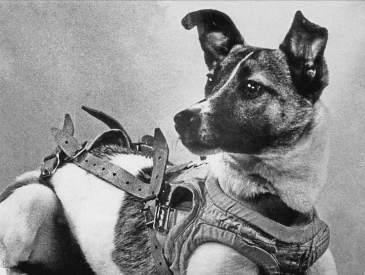
On Nov. 3, 1957, the Soviets put the first dog in space. And killed it there. They would.

It was superficially an impressive achievement. As it had already been for the Soviets to put the Sputnik satellite into space less than a month earlier. And scary, because the very same technology that could put a satellite up in orbit could also put a nuclear warhead up and then down again, rendering all the West’s strategic defences obsolete. But it’s one thing to be able to put a radio transmitter or even a nuclear bomb up there and quite another to do it with a living thing. It requires a more elaborate and more fragile payload.

To do both within a month created a panicky feeling in the West that those no good Commies had somehow sneakily gotten really good at science and inventions instead of the supposedly creative free people of the democracies. But it was, like virtually everything about the Soviet Union (and, today, China), either an outright fraud or an illusion because it was achieved at far too high a price by forcing virtually unlimited resources into a priority sector at the expense of everything else.

In this case the Soviets starved their civilian economy to overdevelop the military sector of which of course the space program was a component. And they managed to launch rockets ahead of the United States but their moon program was a bust; they never put a man there. It is indicative both of this forced, artificial pace and of the underlying brutality that when they put a dog into space they never had a plan to bring it back.

In one sense, of course, it doesn’t matter. Thousands of stray dogs are put down every year and it doesn’t really matter if one dies in a very public way, a way that even advances the cause of science. In fact it was far from clear that a complex organism could survive the enormous G-forces of a launch, or whether some unknown phenomenon would prove lethal above the atmosphere anyway. And Laika actually was a stray dog, picked up on the streets of Moscow. Absent the space program her prospects were dismal anyway.

It doesn’t matter. In the West there would have been outrage at sending a dog up there knowing it was a one-way trip. If the dog had died from unsuspected or uncontrollable risks, it would have been one thing. But to sling it up there with a callous “There’s more where that came from” attitude would have produced a massive outcry.

The fact that the Soviet system was invulnerable to such sentiments, from inside or outside the official apparatus, looked like a strength, allowing it to concentrate single-mindedly on important goals and not count the costs. But costs are just as real even if you don’t count them, and moreover when you don’t count them they pile up until they unexpectedly overwhelm you.

Characteristically, the true time and cause of Laika’s death was not revealed until 2002, over a decade after Communism collapsed. She was killed by excessive heat buildup within hours. The rocket malfunctioned. And if there’d been public discussion of the flaws in the program, if heads had rolled, if officials had been afraid to make further mistakes, it would have forced them to think more carefully instead of just flinging resources at it in order to build enormous rockets that lost the space race.

Rather a metaphor for the whole system, actually.

It happened today - November 2, 2015

On Nov. 2 1789 the French Revolutionary government confiscated church property. It soon used it to back a ruinous paper money scheme, so it did itself no good in the short run. But it did lasting harm in the long run.
More accurately it continued a long-standing pattern of harm because of the lack of rule of law. The seizure of church lands was “lawful” in the bureaucratic sense of having been done according to a formal rule made through an elaborate process. But it was not lawful in the deeper sense of being done under a long-standing, fixed, fair set of rules grounded in liberty and applicable to everyone. Indeed, the goal of exterminating the religious beliefs of the populace was itself proof that the new regime had no conception of an organic connection with the actual French.

In one sense the church had no conceivable complaint, having itself been a key prop of an ancien régime that was not lawful the way the English/British government had been from time immemorial. It had possessed powers and privileges that were arbitrary and unfair and was in 1789 hoist on its own petard.

On the other hand, by failing to try to establish genuine rule of law the revolutionary government made things worse in many ways and better in none. It slaughtered its enemies, itself went to the guillotine, and was succeeded by Napoleon, chaos and political comedy that rarely sank to the level of real tyranny but rarely rose to the level of good government. Even today the state in France is in a real sense rootless, hovering over the people rather than rising from them even if the British example of liberty under and the shocks of truly lawless regimes in the 20th century have made it somewhat less unreasonable and arrogant.

The suggestion would doubtless have met with scorn and then violence at the time, and was not fiscally practical. But it would have been far far better to pay for the lands seized in 1789, as a policy and a precedent. Or not to seize them at all, but simply bring them under a uniform system of law grounded in the people and binding on rich and poor, mighty and obscure, lay and clerical.

N’est-ce pas?

It happened today - November 1, 2015

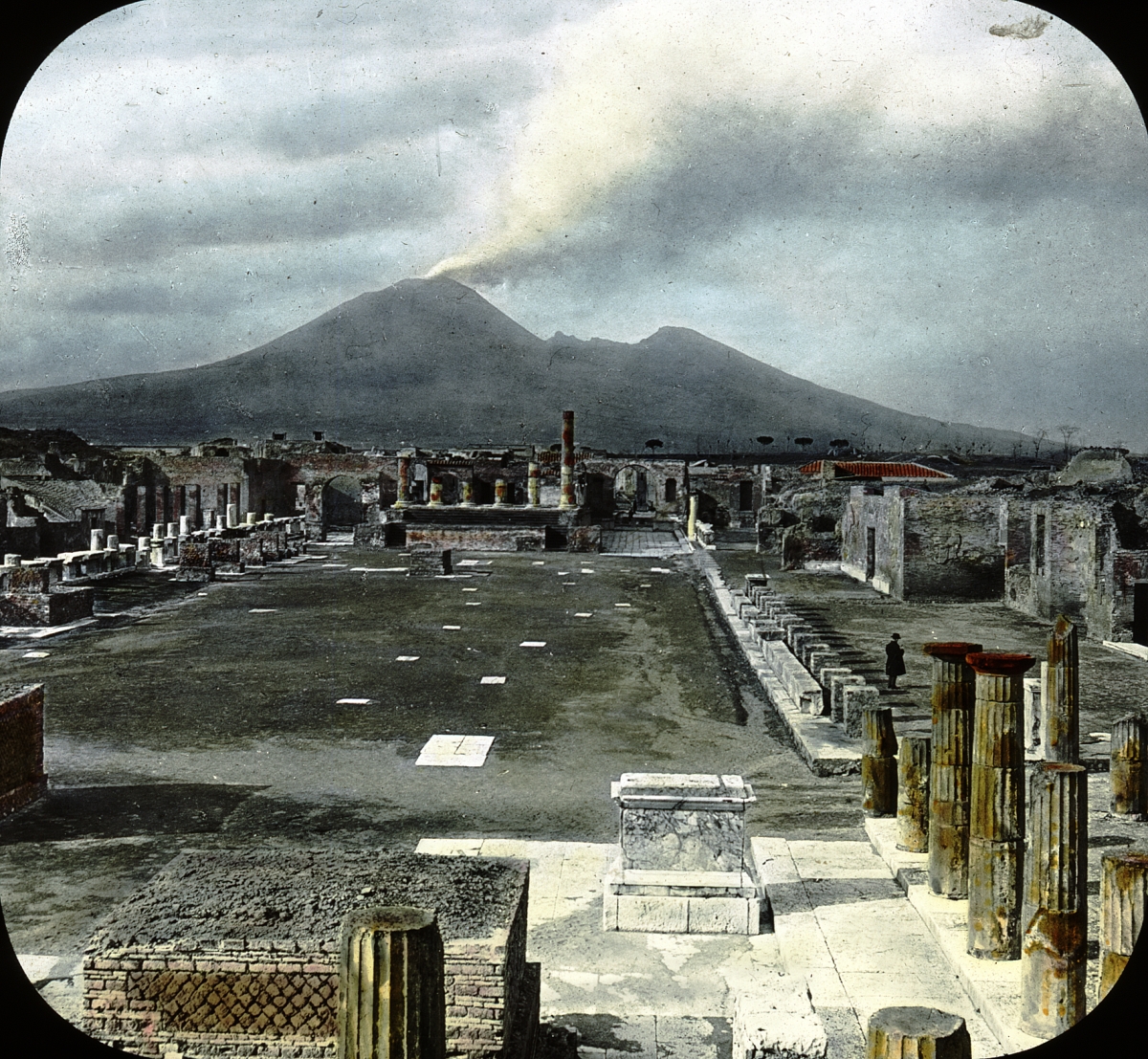
Don’t look now. But I think Vesuvius is smoking kind of hard. Or rather, it was on Nov. 1 of 79 A.D., when it erupted and buried Pompeii. Obviously that’s bad if you lived here. Because then you died there. But it certainly was a boon for archeologists, because the fact that all those people died suddenly beneath ash that tended to preserve everything told us what they did when they weren’t conscious of anybody watching them.

If you knew you were going to be frozen for posterity you’d comb your hair, put out the good dishes and dress up, I presume. (Or maybe nowadays take a last selfie and post it with “This is me looking doomed.”) But they were just captured in mid-stride, as it were.

It was also a boon for a certain kind of dramatist. Indeed Edward Bulwer-Lytton, the guy who infamously started a novel “It was a dark and stormy night” but also coined the phrase “the pen is mightier than the sword”, wrote an enormously popular novel The Last Days of Pompeii that I’m currently reading. It’s the ideal soap opera setting because no matter how tangled things get you can always just bring down an ash curtain and it’s all tied up.

Or a favoured few can flee the city, wipe the slate clean and start a new life. So that’s good melodrama.

The other thing about Pompeii, of course, is that it’s a momento mori. We all have plans that seem enormously important and intend to live to be about 150 to get them all done. But death comes like a thief in the night, or a volcano in the hills, and so it’s just as well to spend your time on things that really matter instead of playing a bit part in a Bulwer-Lytton novel and waiting to be dug up in an embarrassing pose.