And there's more where that came from

The Washington Post reports, à propos of the lavish compensation Bill Clinton received as "honorary" chancellor of Laureate International Universities while his wife was coincidentally United States Secretary of State, that:

"In addition to his well-established career as a paid speaker, which began soon after he left the Oval Office, Bill Clinton took on new consulting work starting in 2009, at the same time Hillary Clinton assumed her post at the State Department. Laureate was the highest-paying client, but Bill Clinton signed contracts worth millions with GEMS Education, a secondary-education chain based in Dubai, as well as Shangri-La Industries and Wasserman Investment, two companies run by longtime Democratic donors. All told, with his consulting, writing and speaking fees, Bill Clinton was paid $65.4 million during Hillary Clinton’s four years as secretary of state."

The Post further notes that "The Laureate arrangement illustrates the extent to which the Clintons mixed their charitable work with their private and political lives."

Yeah. That's one way of putting it.

It took guts... and often everything else

Say, is that battered wreck the Victoria? Hip hip hooray. Where’s the boss? Oh dear. Dead on the other side of the world. So why the cheering? Because the Victoria was, on September 6 of 1522, the first ship ever to complete a trip all the way around the world.

We call it the Magellan expedition. And perhaps rightly so, even though he personally expired part-way through, like most of those who set out with him. In Magellan’s case the cause of death, on April 27, 1521, was being repeatedly hit by sharp things by Lapu-Lapu’s warriors in the Battle of Mactan in the Philippines. But the voyage was his idea after all so it makes sense to call it the Magellan expedition rather than the Elcano expedition for the last captain standing, on the deck of Victoria on September 6 1522.

The expedition, and Magellan’s fate, certainly indicate the courage it took to be part of the so-called Voyages of Discovery. This name has come in for much derision in recent years on the grounds that what Europeans discovered already had people living in it. Whaddaya mean, you “discovered” my house? I’ve been here for years. But they did discover much about how one part of the world connected to another and how to get there half-alive that was unsuspected by, say, Lapu-Lapu, who had no more idea there was a Europe than he did that anybody could possibly object to chronic low-grade warfare as a way of life. (Incidentally he’s now a national hero in the Philippines with several monuments and his image is used by the Philippine National Police and the Bureau of Fire Protection. But virtually nothing is known about his life including what his real name was or when and how he died.)

One problem with the PC fuss about “Voyages of Discovery” is that it tends to whitewash the conduct of anyone on the wrong end of them. The Noble Savage myth lives on, with suitably updated terminology. But the inhabitants of Mactan, or of North America, would cheerfully have conquered and mistreated everybody else if they’d been able to. The Europeans, in fact, had more qualms about it than most, part of the dynamism of an open society that explains why it was them “discovering” the Philippines not the other way around. But I digress.

The point is that taking part in these things took incredible bravery whatever its other qualities. If you’re wondering why the Victoria, an 85-ton “carrack,” whatever that might be, was the first ship, in the singular, to get all the way around the globe, it’s because the Concepcion, Santiago and Magellan’s flagship Trinidad were all shipwrecked or scuttled while San Antonio deserted during the horrendous trip through the “Strait of Magellan” between the South American mainland and Tierra del Fuego. I like the chutzpah of deserting with a ship instead of from one. And I do understand that discretion is sometimes the better part of valour. Though of course you could stay in Seville and die too.

Magellan started out with roughly 265 men. Victoria staggered home with just 18 of her original 42 or perhaps 43 although some of the others, from that ship and the expedition generally, deserted rather than taking the standard route of dying, from disease, wounds or by execution after a mutiny in Patagonia, including the slow capital punishment method of marooning the captain of San Antonio, an accountant by profession, who was dumped on some desolate island along with a priest and some biscuits and never heard from again. No. I would assume not.

After the Battle of Maclan in which Magellan perished, the survivors were invited to a banquet by the guy they’d been fighting for, Rajah Humabon of Cebu, who naturally had most of them poisoned or otherwise killed including both the new leaders. You’re welcome.

The pilot of Victoria somehow survived, and became its captain until he was deposed. He doesn’t even rate a Wikipedia entry of his own, but his name does not feature on the short list of those still alive when Victoria limped into Seville Harbour and the pages of history. From which she limped out again in 1570, vanishing with all hands somewhere in the Atlantic.

At least they built a replica in 1992 and another in 2011. Because you do have to admire the guts it took to get all the way around the world or die trying. Even if all else being equal you’d rather admire it from the dock than the deck.

So long, guys. Good luck with, you know, the typhoons, dysentery, treacherous allies, rocks, currents and stuff.

P.S. A carrack turns out to be a three- or four-masted sailing ship, a mainstay of the Voyages of Discovery. All Magellan’s ships were carracks except Santiago which was a caravel, a nimble vessel with triangular or “lateen” sails.

It happened todayJohn Robson
Wish I'd said that - September 6, 2016

“As for being remembered, well, I always thought that was an odd question. I don’t want to be remembered for anything other than what I’m trying to do right now: be a person of some honesty and integrity and reasonable intelligence, who loves his work, makes a lot of friends, and maybe does some good with young people.”

Bo Schembechler and Mitch Albom BO

Famous quotesJohn Robson
Not even a close shave

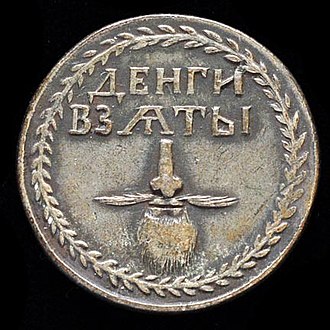
A Russian beard token from 1705, carried to indicate that the owner had paid the beard tax imposed by Peter the Great (Wikipedia)

If you want to know how not to do it, sadly, you can very often ask the Russian government. Like that business with the beard tax.

Huh? Beard tax? Wouldn’t they just shave? And the funny thing is that’s what the government, also known as Peter the Great, was hoping for when he brought it in on September 5, 1698.

You don’t often get a situation where a government introduces a tax hoping it won’t bring in money. But cynics, or perhaps realists, will not be surprised to hear that even then it failed.

Perhaps, as classic radio PI Brad “the Fat Man” Runyon once said, that could stand a little clarification. So here goes.

Peter the Great was a determined “modernizer.” He understood that to rival the West in military might to avoid being overwhelmed by it, Russia or any other what we would now call “underdeveloped” nation had to become prosperous and dynamic. And to do so it would have to adopt many Western cultural habits.

As I’ve written elsewhere, there’s a fatal paradox in any such attempt. Since the fundamental impulse here is to resist Western military power in order to resist its cultural sway, the necessity of adopting its culture to fend off its culture necessarily negates itself. But it also cannot work because the key element in western dynamic spontaneity is its spontaneity. It comes from within, from below, organically. If you have to force it, you just break it.

Which brings us to Peter. He understood full well the power of the West, especially its apparently chaotic, bafflingly successful approach of questioning everything and letting people work things out for themselves in the economy, in government, increasingly at that point even in religion. And he hated it. But he needed it. So he decided, as a singlehanded autocrat, to force it on his people.

Provided, of course, that instead of questioning everything they didn’t question anything, and didn’t think of working anything out for themselves in any important area. He created a new capital, further west and westward-looking, St. Petersburg. With slave labour.

He created a new social hierarchy with bureaucrats in place of aristocrats. The only way you could make it worse, one is tempted to say. But of course if merit had displaced birth spontaneously it would be good. It’s only bad when the whole thing is forced on a sullen populace, not just the serfs but everyone.

Likewise, Peter ordered his courtiers and officials to wear western clothing instead of traditional oriental robes, a legacy of the Mongols. And to shave off their old-tyme beards. The aristocrats balked. God wanted them to have beards. And so Peter placed a heavy tax on beards and in some cases forcibly shaved people himself.

Not only an absolute monarch, Peter was also a scary giant, 6’ 8”. When he shaved you, you stayed shaved. But evidently some of his victims actually carried their severed beards around with them so on the Second Coming they could fish them from their pockets and say see, I would have kept it if I’d dared or something equally unimpressive.

If people had decided in a decentralized, genuinely voluntary way to adopt new habits it would have been a desperately needed breath, nay gust, of invigorating fresh air in a stale and closed Russia. Instead it was a fiery blast that withered society further. Like all such violent modernizers, Peter squeezed more performance out of his government and his people in the short run. But he further weakened their capacity for genuine dynamism.

The result, ironically, was to make Russia even less Western while seeming more so. But in exactly the opposite way to his intention. In that sense, the beard tax was triply counter-productive. Designed to fail to raise money, it raised money, while worsening the problem it was meant to help solve.

Even by the standards of government, it’s an impressive failure.

It happened todayJohn Robson
Fire? Fire!

Here’s a curious-sounding item. On September 4 of 1812, the siege of Fort Harrison began when the place was set on fire. Normally you’d think the fort being set on fire would be the end of the siege.

Not this time. Fort Harrison was held by a tiny American garrison, 15 soldiers and five or so able-bodied civilians along with about three dozen sick soldiers, all commanded by Captain (later President) Zachary Taylor. A very large Indian war band approached, asked for a truce and parley on September 3, and then during the night one of them set the fort on fire and the others attacked.

Unsuccessfully. Things looked pretty grim, with the fire out of control partly because the whiskey went up (there was often strange stuff in frontier whiskey including kerosene and gunpowder – “firewater” wasn’t just an expression). A couple of defenders with working legs made use of them to flee. But Taylor shouted “Taylor never surrenders” and got his men organized to fight the fire.

Did I say men? I should say people. A certain Julia Lambert even got herself lowered into the well to fill buckets faster. And the flames even helped illuminate the attackers as targets.

Well, the long and short of it is that the fort held out successfully for 11 days before being relieved, after somehow patching a 20-foot fire-burned gap in the outer wall and despite having most of their food as well as their hooch consumed in the flames and two attempted relief expeditions ambushed and destroyed.

There is much to be said about the clashes between aboriginals and Europeans in the Americas, and a lot of it is to the discredit of the Europeans. But as I have repeatedly mentioned including in this series, the whole situation cannot be understood without grasping the enormous differences in culture and technology, and indeed the appalling vulnerability of the original Americans to diseases that were carried over the Atlantic from Europe’s farms and cities.

Among these is the degree of organization that let 20 able-bodied Europeans hold off 600 determined aboriginal warriors for a week and a half. And the fact that the attackers asked for a truce then struck during it hoping for the advantage of surprise. Such conduct was neither to their credit nor isolated, and if Europeans said natives’ promises were not to be relied on it wasn’t entirely an invention.

Call it a cultural clash or a misunderstanding if you like. But don’t pretend such things never happened.

It happened todayJohn Robson
Wish I'd said that - September 4, 2016

“It has been often said, very truly, that religion is the thing that makes the ordinary man feel extraordinary; it is an equally important truth that religion is the thing that makes the extraordinary man feel ordinary.” G.K. Chesterton in Charles Dickens

Famous quotesJohn Robson