And then another amusingly dismal event

The General and Extraordinary Cortes of the Portuguese Nation that aproved the first Constitution (Wikipedia)

So September 15 is the anniversary of the “Constitutionalist revolution” in Portugal in 1820. I was trying to make sense of the story but in the end it simply confirmed the aphorism of Sébastian-Roch Nicolas Chamfort that “Only the history of free peoples merits our attention; that of men under despotisms is simply a collection of anecdotes.” And I suppose he would know, being secretary to Louis XVI’s sister and the Jacobin club.

See, Portugal was invaded during the Napoleonic Wars and moved its capital to Rio de Janeiro as well as becoming a British protectorate. And the British seem to have tried to instil liberal ideas while King John VI was far away. As for the king, he apparently hadn’t been much interested in public affairs as opposed to, say, hunting, until his brother died of smallpox and he became heir apparent in 1788 then regent in 1799 when his mother went mad. But he did like running things totally himself.

He came back to Portugal and sort of put up with the liberal constitution imposed by the army on an illiterate peasantry who had no idea what was even going on and nobles and clergy who knew but hated it. So in 1823 a counterrevolution imposed absolutism, which the king put up with, suspending the liberal 1822 constitution and instead promising “personal security, property and jobs”. Oh. That again.

It wasn’t good enough for the hardliners including his own wife, Carlota Joaquina de Borbón, a very nasty piece of work by all accounts who loved the absolutism of her native Spain and despised everything about her husband including his manners. She conspired with their son Michael to force the king off the throne, which failed, conspired again and got exiled, and then in 1826 John died, possibly of arsenic poisoning.

Well, I could go on and on. In fact it may feel that I already did. But the point is there’s really no story here, just anecdotes about the dismal result of political maneuvering in a nation without a tradition of liberty even when some of that maneuvering aims to create such a tradition. After a civil war lasting from 1828 to 1834 Portugal got a constitutional monarchy of sorts, but it presided over instability and coups until the early 20th century when they got a republic and more instability and civil war then dictatorship.

Only in the 1970s did Portugal somehow cast off this dismal succession of anecdotes and via a military coup get something resembling democracy though with 25 governments between 1974 and 2014 and enormous economic problems there’s still far too much anecdote here about human frailty and far too little story of the sort one genuinely does find in the Anglosphere.

So if you have it, cherish it. And if you don’t, do all you can to get it against long odds.
It happened todayJohn Robson
Don't capture Moscow

On September 14, 1741, Handel completed his Messiah. I won’t be writing about that in this installment since I already covered it on April 13 of this year, the anniversary of its first performance. But I do bring it up to suggest again that conservatives who think art is for lefties and losers have a look at Brigitte’s C2C piece… while the Messiah blasts out of their stereo.

Instead I’m going to mention that on September 14, 1812, Napoleon captured Moscow. It was quite an achievement and he must have felt pretty pleased with himself. He was on a roll; he’d won his famous victories from Austerlitz to Jena and Wagram. (OK, I didn’t know about the last one, but in 1809 he walloped the Austrian army and the Fifth Coalition disintegrated so it was pretty cool… if you’re Napoleon.)

Now European geopolitics in this period really does resemble a Monty Python sketch. It was of course Britain that had been the prime organizer of various coalitions against Revolutionary and then Napoleonic France that kept disintegrating thanks to that darn Napoleon. But Britain fought Russia from 1807 to 1812 because Tsar Alexander I declared war after the British attacked Denmark on behalf of Sweden.

Then Britain, Russia and Sweden went what the heck are we doing and signed a secret anti-Napoleon treaty in April 1812. Then France and Russia went to war over who would get to mistreat Poland.

There went Napoleon again. Raising another massive Grande Armée, some 650,000 men including 270,000 French and a lot of allies and conquered types, picking up 100,000 Poles along the way despite Napoleon’s refusal to promise them anything, and winning most of his battles while not noticing he was falling for a rope-a-dope.

After three months following Russian armies that were employing a scorched-earth-plus-Cossack-cavalry-harassment plan, the French army finally squared off against the Russians at Borodino and sort of beat them in a bloody confrontation that left at least 70,000 killed or wounded. The French got the battlefield, but the Russian army got away.

So then Napoleon marched into Moscow on the theory that now the Russians had to surrender. It wasn’t actually their capital. That was St. Petersburg at the time (see the September 5 entry). But still, you seize Moscow, they’re meant to surrender.

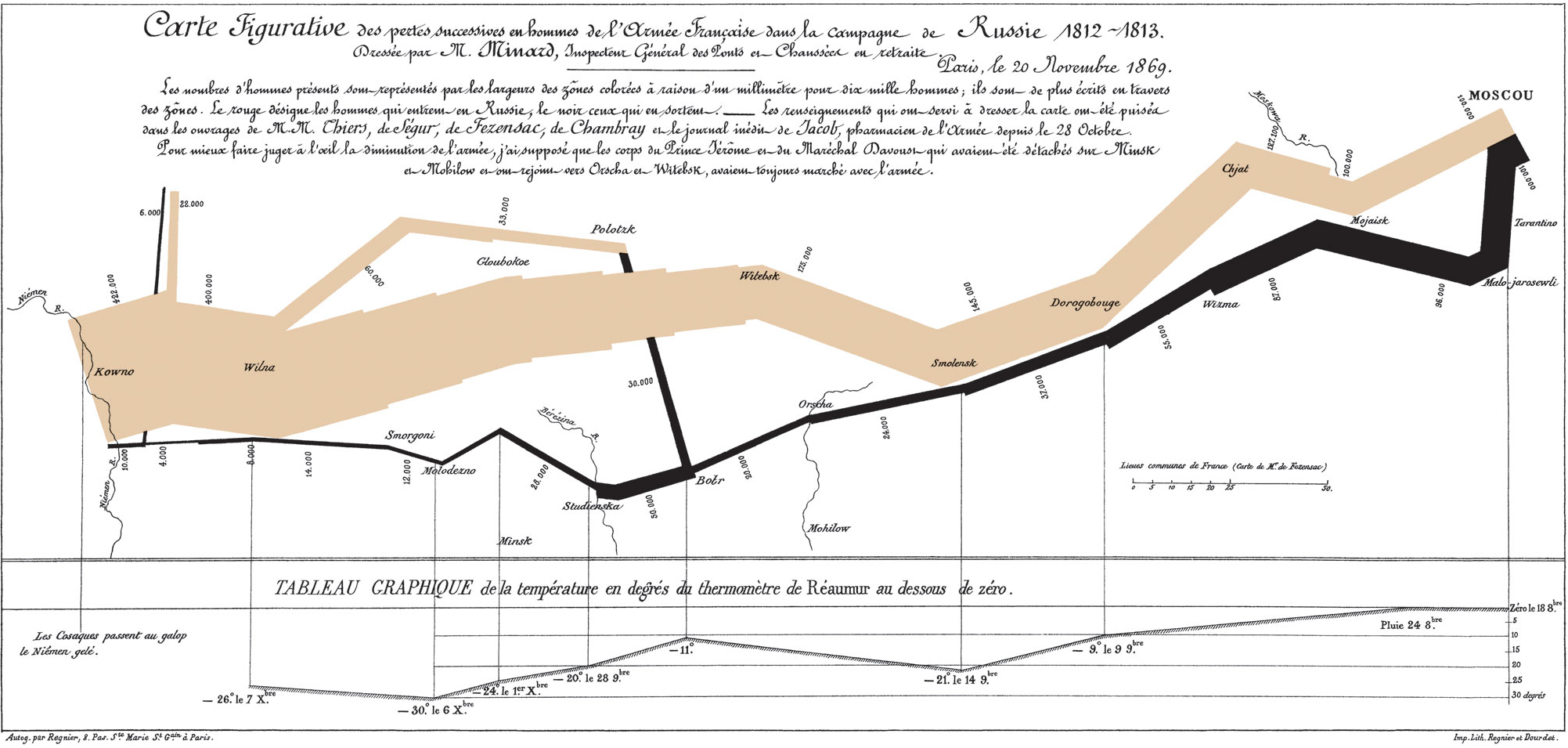
Instead the Russians emptied the city, released a bunch of criminals, and set it on fire. And Napoleon stood there, with winter approaching, going but but but NO FAIR. Then he turned around and left on the disastrous Grand Retreat that all but destroyed his army; only 27,000 soldiers fit for duty remained by the time he lurched back into Poland.

Being Napoleon, he raised fresh forces and tried again, finally meeting his Waterloo at, well, Waterloo in 1815. And the world was left with two notable things.

First, one of the greatest graphics of all time, Charles Joseph Minard’s highly imaginative, compact, informative and chilling depiction of the dwindling Grande Armée on its way to and from Moscow (pictured above). Second, one truly reliable geopolitical rule.

Don’t invade Russia.

It often looks inviting. But it never works. (Well, if you’re the Mongols it works for a while but even they faded out.) It’s just too big, too cold, the defenders are too determined and, as Tsar Nicholas I memorably said, “I have two generals who will not fail me: Generals January and February.”

Even a bigshot like Napoleon, who actually captured Moscow and then stood there going Ooops, I should not have done that.

It happened todayJohn Robson
Three cheers for Wolfe, one for Montcalm

First phase of the battle (Wikipedia)

September 13 of 1759 is a day to be… um… can we change the subject here? Like right now. You see, it was a pivotal victory for liberty in Canada, the preservation of a long heritage of freedom and its extension to people who have benefited immensely from its blessings. It was also significant to world history for evicting absolutism from North America.

Why aren’t we clapping? Oh yeah. That Quebec thing again. Because of course I’m talking about the victory on the Plains of Abraham, a brief affair in itself, about 15 minutes, in which a bold stroke by James Wolfe coupled with bad luck and dubious decisions by Montcalm ended a three-month siege with pivotal strategic consequences in the boringly named “Seven Years’ War.” It is a pity that Wolfe was killed securing this victory; he might well have gone on to further greatness had he lived. (Indeed one Col. William Howe, who distinguished himself by leading 24 volunteers up the slope to capture the only defenders in position on the Plains, later became commander in chief of British forces during the American Revolution.)

Now in fairness it should be said that Montcalm was an excellent general who had previously given the British fits including capturing Fort William Henry in 1757. I am sorry that he died of a wound incurred in the battle and I wish to give him full credit as a brave, intelligent man. But to give him his due does not require me to regret his defeat.

It was good for Canada and the world that Britain prevailed in the Seven Years’ War. It was even good for the inhabitants of New France, who escaped first French absolutism then the madness of the French Revolution. Quebec would not be the dynamic, prosperous, populous place it is today without the blessings of British liberty, as many Quebec statesmen understood in days of yore. That we should have sunk to the level that a francophone Canadian prime minister could regret not being there to awaken and warn Montcalm, and that reenactments of the battle on its 150th anniversary had to be cancelled, is a sign not of sophistication and sensitivity but of groveling witlessness.

Hooray for the Plains of Abraham and Wolfe the dauntless hero.

UncategorizedJohn Robson