Wish I'd said that - October 23, 2016

“we need to recognize that another religion will have another morality, and that in so far as there is a division of morality, there will be some division of sympathy. The Victorians talked as if religion were not merely a private affair but a family joke; a personal accident that could have no effect at all upon public action.”

G.K. Chesterton “A Modern Bigotry”, in G.K.’s Weekly 19/12/31, reprinted in Gilbert Magazine Vol. 17 #8 (July/August 2014)

Famous quotesJohn Robson
What Could Go Wrong Part MDCCCLXXXIII

Lenormand jumps from the tower of the Montpellier observatory, 1783. Illustration from the late 19th Century (Wikipedia) If I confess to any familiarity whatsoever with “Monster High” what little credibility I might possess is liable to plummet ignominiously. But there is an episode in which several of the characters manage to get onto a reality TV show called “Or Die Trying” involving ever more hazardous challenges. And it reminds me of the history of invention.

For instance the guy who made the first recorded parachute jump on October 22, 1783. And as a plot spoiler, he invented the word “parachute” … two years later. So he survived.

His name was Louis-Sébastien Lenormand and he was French; they were very big on this “in the air” thing in those days (see for instance the September 24, 2016 It Happened Today). And what struck me initially as Lenormand plunged past was that he made the jump from 3,200 feet. Or rather, being French and all snootily metric, 1,000 metres.

That’s a long way up. And I thought man, you’ve gotta have some kind of confidence to do the first one from that height. Wouldn’t it be safer to kind of ease into it? But then I realized being killed in a 100 metre fall is no less lethal whereas succeeding is less spectacular. And you’d feel like a fool being killed from 100 metres because a parachute that would have worked from 1,000 didn’t have time to open. So I guess it was actually a nice, careful approach to hurling yourself into the void tied to something that might work. Maybe. Who knows?

Two years later, another Frenchman named Jean-Pierre Blanchard demonstrated the parachute as a practical way of escaping a failing hot-air balloon. With a great deal more prudence than most of the contestants in my version of “Or Die Trying: The Human Ingenuity Version” including Lenormand himself. You see, Blanchard threw his dog out with a parachute on rather than, say, jumping himself.

He later claimed to have done it for real himself in 1793 when his balloon ruptured but nobody saw that one. And don’t try this with your cat; a dog will thank you for letting him be part of the adventure while a cat will secretly claw your balloon in revenge.

Now at this point I should say that the whole parachute story shows rather more prudence than most of these let’s-put-a-steam-engine-under-some-hydrogen ventures in which people demonstrate that you can always find a new way to die. You see, it turns out there are sketches of parachutes going back to the 15th century including, you guessed it, one by Da Vinci. But in the “very dangerous, you go first” spirit that has struggled with “Or Die Trying” since somebody grunted “Hey, let’s tame fire” or even earlier, nobody actually tested their own parachute design or got conned into testing someone else’s for three entire centuries. And when someone finally did, he used sufficient skill and common sense that he improbably survived.

If anyone can use common sense and make the first ever parachute jump. I have my doubts. But Lenormand did make it, and instead of plummeting ignominiously got to name the working device years later. And thanks to him we’re all much safer today in hot air balloons. Even if we’re French dogs.
Wish I'd said that - October 22, 2016

“I never in my life said anything merely because I thought it funny; though of course, I have had ordinary human vainglory, and may have thought it funny because I had said it. It is one thing to describe an interview with a gorgon or a griffin, a creature who does not exist. It is another thing to discover that the rhinoceros does exist and then take pleasure in the fact that he looks as if he didn’t.”

G.K. Chesterton Orthodoxy

Famous quotesJohn Robson
If you don't pack your brain

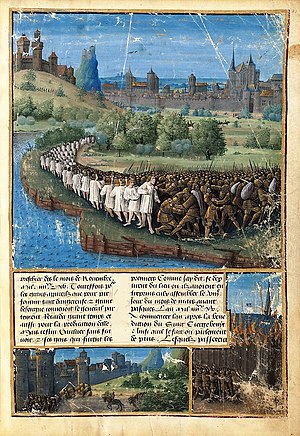
On this date in history, October 21, 1096, the “People’s Crusade” was crushed by the Turks at the Battle of Civetot. It’s one of those episodes that seems to prove religion can make you stupid, although a better lesson may be being human can make you stupid and if you expect God to provide you should try to meet Him half-way. It’s like asking God to rescue you from a flood then refusing to swim to safety as a mark of faith.

In case you haven’t been subjected to this particular outburst of foolish and unstructured religious enthusiasm, it happened as Pope Urban II was organizing the First Crusade, which was a proper military expedition with religious motives that paid attention to mundane things like logistics, weapons, knowing how to fight and having sensible leaders. But while it was brewing this clown called Peter the Hermit, a charismatic monk who claimed to have not only a commission from Christ but an actual letter, went around encouraging people to march on Jerusalem armed only with their faith.

A surprising number felt that this proposition made good sense, including women and children and a few actual soldiers including Walter Sans Avoir. He is often miscalled Walter the Penniless but in fact his name comes from being the lord of Boissy-sans-Avoir. Although common sense was one thing he did not apparently avoir and he died at Civetot when he acquired as many as seven arrows express delivery from the Turks.

The entire People’s Army lacked many other things, from food to sense to decency. Part of their plan to liberate Jerusalem from Muslims involved slaughtering Jews in Germany, something the Church tried hard to prevent them from doing. Then they wandered south-east, puzzling and plundering people who didn’t want to seem inhospitable or impious but also didn’t want these vagabonds eating all their food before falling in the river or having their heads cut off with scimitars.

It ended about the way you’d expect. They finally blundered into battle with the Turks in as tactically hapless a manner as you’d expect and were mostly slaughtered, although the victors generally spared women, children and those who surrendered (not spared in the sense of let them go, of course, but in the sense of let them be slaves) while a few thousand managed to hole up in an abandoned castle, withstand a siege and eventually be bailed out by Byzantine soldiers who knew what they were doing. As for Peter, he slipped away for more supplies and lived on for decades as an increasingly minor celebrity and died in obscurity.

So yes, religious enthusiasm without structure can lead to disaster both practical and moral. But nobody said God wanted you to be an idiot… except people who don’t believe in God. So don’t be an idiot.

Wish I'd said that - October 21, 2016

In the 1930s “Britain and France had come to prefer as leaders the rhetoricless businessman type. And while they had emasculated themselves, there appeared an evil lover to whom Europe all but succumbed before the mistake was seen and rectified. For while the world must move, evil rhetoric is of more force than no rhetoric at all… Britain was losing and could only lose until, reaching back in her traditional past, she found a voice [Churchill] which could match his accents with a truer grasp of the potentiality of things. Thus two men conspicuous for passion fought a contest for souls, which the nobler won. But the contest could have been lost by default.”

Richard Weaver The Ethics of Rhetoric

Famous quotesJohn Robson