Brezhoneg is Looking Up or Vice Versa

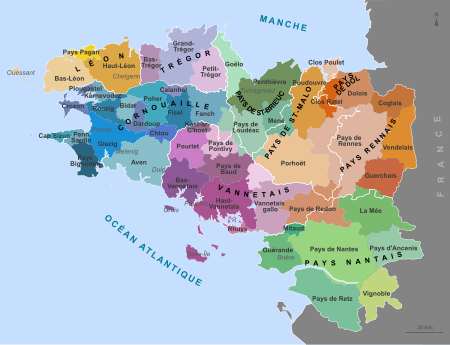
 A French map of the traditional regions of Brittany in Ancien Régime France. The earlier state of Domnonia or Domnonée that united Brittany comprised the counties along the north coast. (Wikpedia) A dictionary is one of those things you just have to have in your house. Unless you have, say, the Internet. But even if you don’t, I expect you haven’t got a Catholicon.

If your response at this point is something along the lines of “Well, no, I’m not Catholic” then you need an encyclopedia. Or, again, for those under 100, the Internet. I’d sure hate to be an encyclopedia salesman these days and I never wanted to be one anyway.

The point is, if you do look up Catholicon in something big enough to have a listing, like your telephone, you will discover that it is the first ever French dictionary, and called the Catholicon because “Katholikon” in Greek, or “Καθολικόν” if you prefer, means “universal”. But it is also, and even primarily, the first ever Breton dictionary. And as it was published on November 5 of 1499, having been written by a Breton priest in 1464, it also has its 6,000 entries in Latin.

That you don’t have to Google. Or French, which you might even speak. But Breton?

Yes. Breton. Or Brezhoneg as it evidently calls itself. It was once pretty big news in Brittany, which is of course not in Britain. It is in France, part of an older Celtic pattern of settlement under which Breton itself is a Brythonic language, which I know thanks to the Interwebs is a family that includes the almost vanished Cornish, semi-vibrant Welsh and extinct Cumbric and was actually brought from Britain to Armorica (sort of Brittany plus much of Normandy) during the Dark Ages when people were fleeing, rampaging or doing both at once over much of that region. And while French eventually became the dominant language in France, unsurprisingly in retrospect but something of a struggle and a government project for quite a while, languages like Breton were big news, as were the “langue d'oc” group, distinct from the langue d’oïl” family because they said oc not oui for yes).

One of the pronounced, so to speak, features of the modern world is a standardization of language along with everything else. And it’s easy to lament the vanishing of quaint things like Cumbric provided you yourself speak, say, English. But it is striking that as recently as 1950 there were around 1 million Breton speakers, some 2% of the French population. And yet today the number is perhaps 200,000, though Wikipedia chirpily notes that “the number of children attending bilingual classes has risen 33% between 2006 and 2012 to 14,709” as though it were on the verge of a major comeback.

It’s not. I’d say Latin has a better chance. (And yes, I’d back such a project without, frankly, having much to contribute to it.) But it is odd to see a language go from first in the first dictionary to what was that again in that fairly brief period, by historical standards, in which you didn’t have to explain to young people what a “dictionary” was.

Destruction of a city and a reputation

Today, Nov. 4, is the anniversary of the 1576 “Spanish Fury” in Antwerp, one of those incidents that casts humanity in a truly dreadful light especially when it comes to public affairs.

Humans are an odd mix of the trite, the appalling and the uplifting. In the midst of darkness they can find light. But they can also create darkness on such a scale that there is no shortage of plausible characterizations of history along the lines of Herbert Spencer’s “history is little more than the Newgate calendar of nations.” The Newgate Calendar was, in case you don’t own a copy, an 18th and 19th century lurid set of stories about people who wound up being executed for having been brutal and dissolute, subtitled The Malefactors’ Bloody Register, and was third only to the Bible and Pilgrim’s Progress on the list of books the average British home would contain in those days). Thus Hegel called history a butcher’s block wile British historian of Parliament Lewis Namier claimed that “History is made up of juggernauts, revolting to human feeling in their blindness, supremely humorous in their stupidity.” Yet it is hard even to find much humour in the conduct of Imperial Spain, especially in this incident.

The “Spanish Fury” begins with the Eighty Years’ War, which already sounds bad and is. It was a revolt by Spain’s “Seventeen Provinces” (what would later become more or less the Netherlands, Belgium and Luxembourg, plus parts of France) against Spanish imperial rule that was as brutal and intransigent as it was bad and unsuitable to these particular regions. And it is already easy to denounce the kind of dynastic politics that would turn the Burgundian Netherlands into the Hapsburg Netherlands and then, in the 16th century, transfer them to Spain with which they had very little in common.

Then you get the Spanish unwillingness to accept the inhabitants’ manifest desire not to be ruled from Madrid, contrasting grimly with their willingness to shed blood over nearly a century to keep it. Which failed.

Indeed, the “Spanish Fury” itself was both counterproductive in preserving Spanish rule and the result of incompetent Spanish rule. It was carried out by troops who were actually mutinying because they hadn’t been paid. By the government of Spain, mind you, not the people of Antwerp. Madrid was as usual bankrupt despite, or perhaps because of, the vast flow of silver from its New World colonies that let it pursue grandiose geopolitical plans without the necessity of governing well at home or abroad.

The mutinous troops rampaged for three days, murdering, raping, looting and burning, killing some 7,000 people and permanently damaging Antwerp, leading to Amsterdam’s rise to the leading city of the region. And this ghastly episode also reinforced negative views of Spain abroad and gave further credence to anti-Spanish propaganda including from Britain, what has been denounced as “La Leyenda Negra” by Spanish historians. But it was by no means all legend. Indeed, this was just one of many “Spanish Furies” in the area over more than a decade.

In the end, these outbursts only increased the determination of the Seventeen Provinces to achieve independence from this tyrannical, bloodthirsty and inept regime, which Spain resisted violently until 1648 when the conclusion of the even more appalling Thirty Years’ War secured the independence of the Dutch Republic though the “Spanish Netherlands” were kept by Spain until 1714 when they went back to the Austrian Hapsburgs.

The whole episode is unbelievably violent, coarse, stupid and persistent. And sadly it’s the sort of thing people do all too often, especially in public affairs.

We wish to inform our readers

Times of India Buildings, ca. 1898 (Wikipedia) Speaking of places everybody’s watching, this is the anniversary of the 1st edition of the Times of India on November 3, 1838. And no, I don’t mean everybody was or is watching India. Back then it was Britain. And if Britain had quality newspapers, the inevitable question was why you didn’t.

You could answer that newspapers were Western and imperialist and you didn’t want one. Before sneaking off to read a British one in private even if it was months old and tattered. Or you could say yours was as good. Or that you were planning one. Or that the government should do something. But you just couldn’t ignore the question.

Now the Times of India, which began life as The Bombay Times and Journal of Commerce, has generally aspired to give the second answer and done very well. It is the third-largest newspaper in India by circulation and the largest-selling English-language daily in the world. (And no, practically nobody cares what the largest-selling paper is in any other language; you see how this works.) And while it too may succumb to this dang Internet thing, it has consistently had a high reputation for quality.

It is an important Indian institution. And yet it is, of course, utterly foreign in origin and conception. Its original publisher was Raobahadur Narayan Dinanath Velkar, who you don’t get points for guessing was Indian. But its first editor was one J.E. Brennan and it published news from Britain as well as India and the world.

As of course it would because the “newspaper” is an entirely western idea, and moreover Anglosphere journalism has a tone not found even elsewhere in the West. And the “World Revolution of Westernization” so brilliantly discussed by Theodore von Laue in his book of the same name has swept over the world to the point that the only places that don’t have newspapers are either total backwaters or places that used to have them before the smartphone came along.

It’s now the United States. But for a long time, including the 19th century, it was Britain (and what could be a more British name than The Bombay Times and Journal of Commerce?). And you can curse imperialism until your teeth ache, and write endless stinging editorials against it. But you’ll still be writing them in a newspaper that you would not begin to have without imperialism, any more than you’d have editorials.