Wish I'd said that - November 8, 2016

“There is one striking feature about [General and future President Ulysses S.] Grant’s orders: no matter how hurriedly he may write them on the field, no one ever has the slightest doubt as to their meaning, or ever has to read them over a second time to understand them.”

“General Meade’s chief of staff” quoted by Horace Porter Campaigning with Grant

Famous quotesJohn Robson
Freeing too few slaves

T.S. Eliot says the last temptation is to do the right thing for the wrong reason. Which brings me to the first mass emancipation of slaves in North America.

It happened on November 7, 1775, in Virginia. Which is 156 years too late, as slavery began in Virginia in 1619 in the same place and same year, in bitter irony, as the first representative legislature in the New World. But we’ll take it, right?

Well, not this way. The problem is, royal governor John Murray, a.k.a. Lord Dunmore, issued his proclamation under duress, offering freedom to any slave who fought for the British. It is hard to think of a less promising moment or setting, including by making emancipation seem like a threat to the freedom of the white inhabitants.

It would have been far better had the British gently encouraged and facilitated growing sentiment for abolition in the northern colonies before 1776, instead of actively opposing it (to the point that Thomas Jefferson, in a monumental act of gall, included an indictment of George III for encouraging the slave trade in an early draft of the Declaration of Independence).

Dunmore’s proclamation didn’t free every slave because slavery was wrong. It made it conditional, and conditional on something difficult and dangerous that not everyone could do. Despite which hundreds, possibly as many as 2,000 slaves did indeed join the royalist forces… who lost anyway. Indeed Dunmore himself had to pull out of Virginia in 1776, taking about 300 ex-slaves with him and leaving the rest in the lurch, if they hadn’t already died of the smallpox epidemic that ravaged his forces.

In 1779 General Sir Henry Clinton issued a more general emancipation decree, freeing slaves owned by revolutionaries throughout the colonies whether or not they enlisted. But even there, the counsel of pseudo-prudence that left humans in bondage if their owners were loyal undermined the moral and even practical impact of the policy.

I do not know that there was anything the British could have done to end slavery in North America in 1775. And indeed a vigorous effort earlier might have produced revolt sooner, at least in the south. Unless of course it had been undertaken in the 17th century before this hideous thing took root. But sometimes you just have to do the right thing.

Doing it at the wrong time for the wrong reason in the wrong way is unlikely to work. So you might as well try to get at least a few of the lesser things right as well.

UncategorizedJohn Robson
We finally surrender

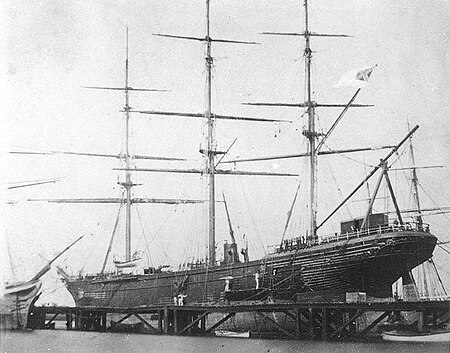
On November 6, 1865, the Confederacy surrendered. If you’ve heard or read otherwise, allow me to introduce the CSS Shenandoah, a tribute to the military skill and doggedness of the South in a cause unworthy of the devotion it inspired.

Shenadoah was a commerce raider, initially launched as the Sea King in August 1863, with teak planks on an iron frame and both sail and backup steam power. Originally a cargo vessel, and built in Glasgow, she was converted to a man-o-war in October 1864 after a rendezvous with another ship carrying officers, guns, ammunition etc. (And no, I don’t know why a ship is “she” but a “man”-o-war. That was before pronouns like Xe and everybody getting their own gender.)

Now you may be thinking October 1864 is a bit late to join the U.S. Civil War, which by that point was just a matter of rather bloody mopping up. But Shenandoah went on a tear, striking at Union merchant and whaling ships in the Indian and Pacific oceans. And she captured or sank 37 of them, a majority after the war was formally over.

Of course there was no Internet in those days. And even after her captain, Lieutenant Commander James Waddell, got hold of a months-old San Francisco newspaper reporting the flight of the Confederate government from Richmond, he preferred to believe the statement by Jefferson Davis that the war “would be carried on with re-newed vigor”.

Finally he learned in August that the armies had surrendered and President Davis and much of his cabinet had been captured. So he headed for Liverpool, the unofficial HQ of the Confederate overseas fleet, concerned that if he surrendered to the Union his crew would be hanged as pirates. In the end they weren’t, and when Shenandoah struck her colours the Confederate flag was lowered for the last time.

Five years too late, of course. I have great admiration for many who fought for the Confederacy, and for their attachment to limited government. But the whole thing was about the loathsome institution of racial slavery and all that courage, dash and grit was not merely wasted but entirely misguided.

P.S. If you’re thinking the Confederate flag still flies grotesquely in places like Mississippi, that’s the battle flag not the actual Confederate flag, and the far greater popularity and familiarity of the “Stars and Bars” reflects, I think, the fact that those who fought for the South were by and large far better than their cause.

UncategorizedJohn Robson
Wish I'd said that - November 6, 2016

“Some Catholic literature today practices a kind of doctrinal minimalism. Seeking to show how little one needs to believe, such apologetics gives the impression that belief is a burden rather than a privilege.” Avery Cardinal Dulles in First Things May 2004 (drawing on but not quoting Karl Barth)

Famous quotesJohn Robson
Brezhoneg is Looking Up or Vice Versa

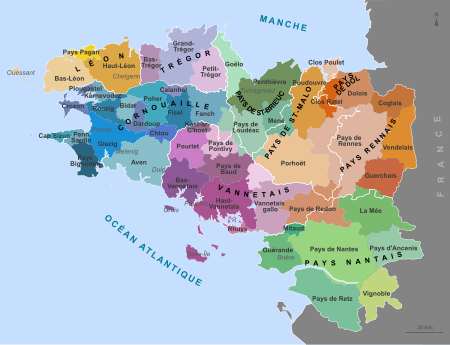
 A French map of the traditional regions of Brittany in Ancien Régime France. The earlier state of Domnonia or Domnonée that united Brittany comprised the counties along the north coast. (Wikpedia) A dictionary is one of those things you just have to have in your house. Unless you have, say, the Internet. But even if you don’t, I expect you haven’t got a Catholicon.

If your response at this point is something along the lines of “Well, no, I’m not Catholic” then you need an encyclopedia. Or, again, for those under 100, the Internet. I’d sure hate to be an encyclopedia salesman these days and I never wanted to be one anyway.

The point is, if you do look up Catholicon in something big enough to have a listing, like your telephone, you will discover that it is the first ever French dictionary, and called the Catholicon because “Katholikon” in Greek, or “Καθολικόν” if you prefer, means “universal”. But it is also, and even primarily, the first ever Breton dictionary. And as it was published on November 5 of 1499, having been written by a Breton priest in 1464, it also has its 6,000 entries in Latin.

That you don’t have to Google. Or French, which you might even speak. But Breton?

Yes. Breton. Or Brezhoneg as it evidently calls itself. It was once pretty big news in Brittany, which is of course not in Britain. It is in France, part of an older Celtic pattern of settlement under which Breton itself is a Brythonic language, which I know thanks to the Interwebs is a family that includes the almost vanished Cornish, semi-vibrant Welsh and extinct Cumbric and was actually brought from Britain to Armorica (sort of Brittany plus much of Normandy) during the Dark Ages when people were fleeing, rampaging or doing both at once over much of that region. And while French eventually became the dominant language in France, unsurprisingly in retrospect but something of a struggle and a government project for quite a while, languages like Breton were big news, as were the “langue d'oc” group, distinct from the langue d’oïl” family because they said oc not oui for yes).

One of the pronounced, so to speak, features of the modern world is a standardization of language along with everything else. And it’s easy to lament the vanishing of quaint things like Cumbric provided you yourself speak, say, English. But it is striking that as recently as 1950 there were around 1 million Breton speakers, some 2% of the French population. And yet today the number is perhaps 200,000, though Wikipedia chirpily notes that “the number of children attending bilingual classes has risen 33% between 2006 and 2012 to 14,709” as though it were on the verge of a major comeback.

It’s not. I’d say Latin has a better chance. (And yes, I’d back such a project without, frankly, having much to contribute to it.) But it is odd to see a language go from first in the first dictionary to what was that again in that fairly brief period, by historical standards, in which you didn’t have to explain to young people what a “dictionary” was.