https://www.youtube.com/watch?v=XKEjsT3Z2EA The audio-only version is available here: [podcast title="Ask the Professor, November 10"]http://www.thejohnrobson.com/podcast/John2016/November/Ask_Professor_61.mp3[/podcast]
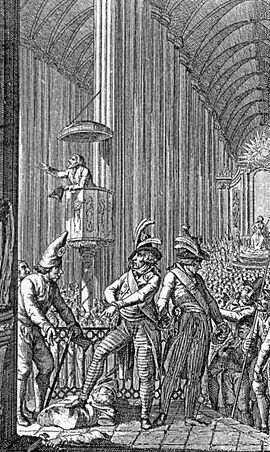 If you like state-created religions, you have reason to celebrate on November 10. Or rather Reason. Because it was on this date in 1793 that the French Revolutionary government tried to impose the Goddess of Reason on its populace, a violent wrenching of spiritual impulses out of their normal course that can only end horribly.
Well, not Goddess exactly. They had Goddesses of Reason in their November 10 Fête de la Raison, but to avoid idolatry they used attractive women. Which isn’t necessarily a direct appeal to reason to begin with and reminds us that Madison Avenue did not invent the “Here’s a pretty girl so buy our toothpaste” approach to public relations.
Evidently the Goddess of Reason in the initial Paris festival was played by the wife of Antoine-François Momoro, the guy who coined the phrase “Liberté, Égalité, Fraternité ou la mort” of which the last part is often forgotten though not by its most enthusiastic practitioners. She evidently dressed “provocatively” and according to Thomas Carlisle “made one of the best Goddesses of Reason; though her teeth were a little defective”.
Now bad teeth fall a little short of Olympus. But technically the Cult of Reason was in any case atheistic. Or worse. In fact the Cult of Reason worshiped a supposedly divine being. But that being was man.
Well, not man exactly. Not man as he was, grubby, superstitious, prone to emotions and infuriating to self-appointed elites through history. Man as he would be if perfected by achieving Truth and Liberty through Reason. Or, if he proved recalcitrant, by removing his head with its troublesome brain.
It is ironic that a government would seek to impose rationality through coercion given that if the whole thing were even remotely reasonable, it ought to have proceeded successfully by persuasion. And it is also ironic that worshiping man is not reasonable if you have anything resembling powers of observation, nor is supposing that man is secretly something utterly different and far better than he is.
Nor even more fundamentally is thinking that pure reason can sustain anything resembling a desire to live or to act. Almost all the greatest minds who have considered the matter, a category that excludes virtually every French Revolutionary I might add, have concluded that there is something we are made for, something inherent in the nature of man, toward which can guide us but is not itself reason and is somehow more primordial. Mr. Spock would have had no logical reason to get out of bed and behave with benign honour all day.
Undeterred by such reasoning, or influenced by reasoning of any kind at all, French radicals proceeded to desecrate churches including dismantling the altar at Notre Dame in Paris and replacing it with an altar to Liberty and carving “To Philosophy” over the doors, and insisting that all cemetery gates should read only “Death is an eternal sleep”. Which is, again, not something a great many very rational people ever believed, let alone felt should be stuffed down people’s throats rather than poured into their ears. Nor are altars or cathedrals “reasonable” if you are insisting there is no deity.
It gets worse. The system soon found its own actual god, in the form of “le peuple”. So the ultimate irony is that a system that began by worshipping man ended by sacrificing him bloodily to a collective “man” that was a Moloch devouring individuals in defiance of Truth, Liberty or Reason.
You know it’s bad when Robespierre steps into rein in your excesses, which he did on May 7 1794 with his Cult of the Supreme Being, a kind of decaffeinated religion with an actual God who’s just this kind of mist that never bothers or judges you. But even Robespierre realized that without a lawgiver there can be no law, in the moral as in the political sphere. So the Cult of Reason was out-reasoned by Robespierre barely two months before the guillotine perfected him on July 28 of that same year.
The French Revolution featured noble sentiments shouted from the rooftops and rivers of blood pouring down the sewer. Exactly the sort of situation Montaigne described with his aphorism “Between ourselves, there are two things that I have always observed to be in singular accord: supercelestial thoughts and subterranean conduct.”
When man begins by worshiping himself he infallibly ends by slaughtering himself, the collectivity elevated then immolated in a blazing pyre of unreason whose fuel is reason itself cut off, dried out and set ablaze by passions rendered uncontrollable precisely by denying their existence.
“The ‘wild’ west is ‘wild’ on purpose: that is, it is civilization on a holiday—one of the most civilized things possible. But barbarism trying to be ‘cultured’ – that is the real horror.” George Santayana “The Genteel Tradition in American Philosophy” (a 1932 lecture at the University of California)
In my latest National Post column I try to find a silver lining in the American presidential result and, with some effort, succeed.
 On November 9 of 1799 Napoleon overthrew the Directory and established the Consulate. It was a huge improvement because instead of a five-man executive and a chaotic legislature you had a feeble legislature and a three-man executive and Napoleon was the man. Well, it was a huge improvement if you were Napoleon.
It’s called the Coup of Brumaire because in those days the French still had the new months the radical excesses of the Revolution had foisted upon them. It’s never a good thing when they start renaming months, even if “Foggy” is kind of a funny name for a month. And the result was a typically foggy French political arrangement.
The legislature had one chamber that could discuss bills but not vote on them, one that could vote but not talk, and one that could do both but was secretly part of the executive and was appointed by it. So the executive was pretty much all powerful. And within it, guess who was in charge. Right. The guy who staged the coup partly because at age 30 he was too young to be a Director under the old system.
I find the whole thing unfair because the Directory had itself gotten rid of the infamous Committee of Public Safety, ended the reign of terror by executing a few of its leading advocates including the egregious Robespierre, and tried to restore sanity to economic policy including ending the hyperinflation idiocy of the assignats. If ever a French government did not deserve to be overthrown, and frankly it’s a short list, it’s the Directory.
There’s one humorous aspect to this whole business. Beyond the fact that French politics is almost always funny as well as alternatively infuriating and tragic. And that’s the thought of two other guys agreeing to form a triumvirate with Napoleon Bonaparte and having no idea they were patsies. It’s been done before, including with Julius and Augustus Caesar. And maybe the others were formidable characters too and it’s only with hindsight that their fate seems predictable. But here’s a challenge: Name either of Napoleon’s other consuls.
I can’t either. But I Googled and they are, or briefly were, Jean Jacques Régis de Cambacérès, 1st Duke of Parma, and Charles-François Lebrun, duc de Plaisance. And perhaps neither was quite the chump he seemed, as Cambacérès wrote the Code Napoleon (not a good thing, but an impressive career achievement) and lived until 1824 and died peacefully, having outlasted Napoleon himself, while Lebrun later became “Arch-Treasurer” under the Empire which is a pretty cool title, and also lived until 1824.
Still, you’d have to be some kind of sucker to have Napoleon say “Hey, let’s share power” and go “Yeah, sure, sounds good to me.”
“Where troops have encamped/ There will brambles grow;/ In the wake of a mighty army/ Bad harvests follow without fail.” Lao Tzu
In my latest National Post commentary I ask what would happen if a Canadian (or American) politician tried being as sorry for a scandal or a bungle as South Korea's president Park Geun-hye.
 You know what would be a great, original, sure-fire idea? A massive infrastructure program to stimulate the economy. Like the one the US just inaugurated on November 8. Of 1933.
That’s right. The Civil Works Administration, an early serving of New Deal alphabet soup that aimed to create millions of jobs, spend hundreds of millions of dollars a month, and build or fix roads, sewer pipes, schools, playgrounds and, something you don’t see today, a quarter of a million outhouses.
That’s right. The U.S. government got into the business of building kaibos for the helpless populace. But hey, jobs jobs jobs, right? And of course it worked. The U.S. government lurched into action when the Great Depression hit, raising taxes, restricting trade, deliberately reducing production of both agricultural and industrial products to increase prosperity (the AAA and NRA particularly), meddling everywhere, insulting businessmen and by golly, the economy recovered in just a decade.
It was, some quibbled, the longest depression in American history precisely because the government decided to wallop the economy at the worst imaginable moment and adopted a long and politically very successful strategy of continuing the floggings until morale improved. But let us not be small-minded.
To this day, every politician faced with a downturn wants to be Franklin Roosevelt. And they hype their plans to spend money we don’t have on infrastructure we didn’t want until the slump hit. And the longer it goes on, the longer the slumps last and the more disappointing the performance of the economy.
I guess we better do it again, huh?