A whale of a tale

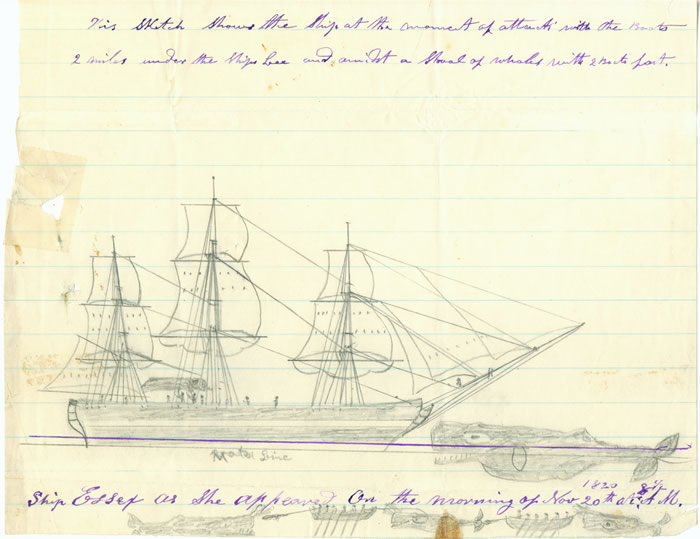
It’s about this whale. Specifically the apparently obscure fact, even by the standards of this series, that on November 20, 1820, an 80-ton sperm whale attacked and sank the Massachusetts whaling ship Essex off the western coast of South America. You go whale, you may be thinking. Instead it was you go Herman Melville, which isn’t as good.

It was also you go cannibalism, because the Essex sank 2,000 miles off the coast. And during 95 harrowing days at sea the originally 20 survivors ate five of their fellows who died and then, yes, began drawing lots to see who else they would eat and got through seven others before the last eight were rescued.

Two of that eight later wrote accounts of their suffering that, according to Wikipedia, “inspired Herman Melville to write his famous 1851 novel Moby-Dick.” Which is a bit odd because unless I missed something, nobody eats anybody in Moby Dick.

You have read it, of course. I mean, it’s the Great American Novel or at least one of them, along with The Great Gatsby, The Grapes of Wrath and some dreck by Hemingway all of which make you wonder what’s so great about great American novels. I personally found Moby Dick ponderous, and the endless intercalary chapters about whale skin were a total waste of paper and I would say my powers of concentration had I in fact bothered to concentrate on them sufficiently to be entirely sure they were intercalary chapters and not just long boring asides.

Which I think I just engaged in one of here. My point is, you have very probably been forced to read Moby Dick at some point, in which case you may very well share my view that the best description of it ever is in the musical Wonderful Town where a woman is trying somehow to jump-start the conversation at a failing cocktail party and comes up with “I was re-reading Moby Dick the other day... I haven’t read that since… well... I'm sure none of us has. It's worth picking up again...:” and then into the ensuing deadly silence petering out with “it's about this... whale.”

Apparently it’s not. It has a whale in it, a big one, white, bites off legs and stuff, modeled on a real, elusive albino whale called Mocha Dick. But apparently it’s really about all those great things like God, social divisions, good and evil and how to render blubber. Not that anyone noticed in 1851 when it was published; it was a commercial failure that sold barely 3,000 copies during Melville’s lifetime and was out of print when he died in 1891. But then people like Faulkner and D.H. Lawrence decided it was strange and wonderful. And to be sure the opening line “Call me Ishmael” is so famous even I have parodied it.

To be fair, there is one thing in the book I do remember approvingly: Melville’s description of the incredible perils of manning a small whaling-boat trying to harpoon a whale, with the threat of death ever-present from the whale’s tail, a rope snaring your arm or leg as it hisses out affixed to a harpoon that has struck its target and so on. And then his point that we do not feel any such danger on an apparently safe city street yet death may await as at any turn from a runaway horse (it was 1851), a falling brick or some such accident. Oh, and the incredibly gross bit where someone harpoons an elderly whale in a giant blood blister. That has stayed with me.

For the rest, it’s one of those classics that makes we wonder about the canon. Though perhaps I should reread it. I haven’t since… well, I’m sure none of us have. But it’s about this whale and, given what humans have done to whales in recent centuries, I do like the bit where he sinks the ship.

P.S. It also set up the gag in the dud sequel Son of the Pink Panther where it turns out Clouseau and Marie Gambrelli had a son who is now a policeman and doesn’t know who his father was because, she explains “Imagine you've always wanted to be a great fisherman... and suddenly you discover that your father was Captain Ahab.”

It happened todayJohn Robson
Wish I'd said that - November 20, 2016

“We talk much about ‘respecting’ this or that person’s religion; but the way to respect a religion is to treat it as a religion: to ask what are its tenets and what are their consequences. But modern tolerance is dearer than intolerance. The old religious authorities, at least, defined a heresy before they condemned it, and read a book before they burned it. But we are always saying to a Mormon or a Moslem, ‘never mind about your religion, come to my arms.’ To which he naturally replies, ‘But I do mind about my religion, and I should advise you to mind your eye.’” G.K. Chesterton in Illustrated London News May 13, 1911, quoted in Gilbert Magazine Vol. 15 #8 (July-August 2012)

Famous quotesJohn Robson
The battle of Hoo Hah

Then there’s Bulgarian victory in the Battle of Slivnitsa. When, you cry, is there Bulgarian victory in the Battle of Slivnitsa, and against whom? Why, on November 19, 1885, in the Serbo-Bulgarian War, which helped solidify the unity of the Principality of Bulgaria and Eastern Rumelia.

OK, you’re thinking. Another Monty Python sketch. But nay. It was in fact a surprising victory for Bulgaria’s young army, dubbed by some the “Battle of the captains vs the generals”. And as for the feeling that even if you knew where Rumelia was you would not care, not even if it was a semi-autonomous region of Ottoman Empire with a Christian governor following the end of the Russo-Turkish War of 1877-78 and the Congress of Berlin in 1878 (no, I’m not making it up and no, I won’t shut up), remember that the disintegration of the Ottoman Empire helped trigger World War I as the Great Powers scrambled to absorb its Balkan fragments or prevent others from doing so.

The Principality of Bulgaria was itself another bit of the Ottoman Empire, made entirely autonomous in 1878. But there was no taping the crumbling corpse of the Ottoman Empire in the late 19th century, and so something constructive had to be done. Instead the usual squabbling ensued.

For some reason Russia and Bulgaria had a falling out in 1883 and so the Russians didn’t want Bulgaria to absorb Rumelia, which is why they withdrew all their officers leaving the Bulgarians without so much as a major, let alone a general. But the Bulgarians were bent on reunification and their prince had no choice but to go along or be deposed.

So they went to war, and while the Ottomans sat there shedding bits, the Serbians intervened. And while there’s an undeniable comic opera feel to these understrength, underarmed and undercommanded Bulgarian battalions and Eastern Rumelian militia with one bad railway upsetting the confident Serbs, only to be stopped by Austrian intervention after which Bulgaria was unified in 1886 but Prince Alexander was deposed by Russian-sympathizing officers the same year (stop here for deep breath), the complex mix of Catholic versus Orthodox and Slav versus Germans and others, as well as divisions among Slavs, exacerbated by growing nationalism, was a proverbial powder keg to the point that the punchline of a popular 1913 London music hall song was “There’ll be trouble in the Balkans in the spring.” And the next summer trouble in the Balkans plunged Europe and the world into the First World War.

I’m not saying I would have known what to do about the Battle of Slivnitsa even if I could have pronounced it, found it on a map without Google, and intervened from London or Paris in 1885. But it’s yet another warning that comic opera clashes in places with funny names are often harbingers of things that are not remotely funny.

It happened todayJohn Robson
Wish I'd said that - November 19, 2016

“’It is obvious that the mind is moved by incongruity.’ That’s Chesterton writing about laughter. He also said ‘laughter is directly related to the strangeness of man on this strange earth.’ Because we are strangers here, we see the incongruities and they make us laugh.” Eric Scheske in Gilbert! Vol. 7 #5 (March 2004)

Famous quotesJohn Robson
A crisis best not forgotten

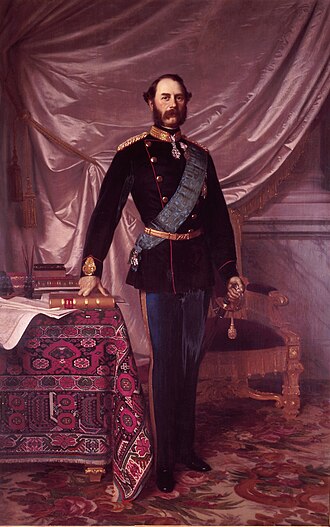
Today is the anniversary of King Christian IX of Denmark signing a constitution on November 18, 1863 that got him into The Second Schleswig War with the German Confederation. Which maybe seems like a nasty thing for Germany to do. Or, once I add that this Constitution effectively annexed Schleswig, which the King of Prussia regarded as a violation of the London Protocol, this “Schleswig-Holstein crisis” starts to sound like a Monty Python sketch about European dynastic politics. Except looking back it’s an ominous precursor to both World Wars.

It is extremely convoluted. There’s a famous remark (well, famous among people who like such things) attributed to British statesman Lord Palmerston that “Only three people have ever really understood the Schleswig-Holstein business—the Prince Consort, who is dead—a German professor, who has gone mad—and I, who have forgotten all about it.” So I’m not going to try to give you all the details lest I go mad or perish. And I’m not really in a position to forget them due to never having known them. But here’s an ominous summary.

Both the First Schleswig War (1848–51) and the Second (1864) were fought over two duchies, Holstein and Lauenburg, driven by secessionist movements by ethnic Germans. And it is worth emphasizing that Denmark had since the 1848 wave of liberal revolutions in Europe been a constitutional monarchy, while Prussia was nothing of the sort and neither was its Austrian ally.

Now you may think it a no-brainer that Prussia and Austria walloped Denmark without undue difficulty and forced it to cede Schleswig, Holstein, and Saxe-Lauenburg. (Yes, another duchy heard from.) And the new King of Denmark did know he was in a tight spot when forced to choose between signing the November Constitution or defying the will of his people. But looking back we are more aware of the looming menace of a unifying German Empire than people might have been in 1864.

Including the Austrians who, um, got into a war with Prussia two years later that lasted only seven weeks and ended in an upset victory for Prussia which thus came to dominate Germany and, after another unexpected victory over France in 1870, to unify most of it under what would not unreasonably be called “Prussian militarism”.

Most. But not all. The ethnic map of Europe is complex even by the normal standards of humanity in which the Wilsonian dream of universal peace due to rigorous avoiding of multiculturalism is impractical. And as Germany continued to swell geographically and in ambition, it used the need to assemble all Germans under a single flag and the alleged mistreatment of German minorities as a pretext to war on one state after another in an fairly unbroken stream from 1864 through 1945. (Also, Prussia/Germany could not build the Kiel Canal to get its battleships back and forth between the Baltic to defeat Russia and the North Atlantic to defeat Britain until it controlled Holstein.)

It looked like Pythonesque rubbish back in 1864. But it would have been better for major powers to stand up to German nastiness back then when it would have been easier to stop.

It happened todayJohn Robson
Wish I'd said that - November 18, 2016

“The problem [for the Devil, regarding Adam and Eve] was to rid these two of their fantasies, to convince them that the world does exist; that life is not a game but a very serious, even difficult and troublesome thing, and that notions of good and evil are ultimately only relative and impermanent.” Peter Demianovich Ouspensky, Talks With A Devil: Two tales by P.D. Ouspensky

Famous quotesJohn Robson