Posts in It happened today
It happened today - June 16, 2015

railway Anyone up for some excitement? Well, fasten your safety restraints and hold on to your hats because on June 16, back in 1884, the first roller coaster in North America opened at Coney Island. Then quaintly known as a “switchback railway”, it was a monster, accelerating to a breathtaking 6 miles per hour. And even though it cost a full nickel to ride, it created a trend; by 1900 there were hundreds of them around the United States.

It’s easy to make fun of the excitement people derived from what now seems so sedate. It’s hard to believe Ferris Wheels were once exciting, though to a farmer who had never seen the world from above it must have been amazing when the fair came to town and they could suddenly see the familiar landscape of their life all laid out below them like a model. And obviously if you suffer acrophobia then no matter how solid, safe and slow it is, you suffer paroxysms of terror.

Likewise it is impossible to read today with a straight face the account New York governor Martin Van Buren sent to president Andrew Jackson (whose VP and successor he would later become): “The canal system of this country is being threatened by the spread of a new form of transportation known as ‘railroads.’... As you may well know, railroad carriages are pulled at the enormous speed of 15 miles an hour by engines, which, in addition to endangering life and limb of passengers, roar and snort their way through the countryside. The Almighty certainly never intended that people should travel at such breakneck speed.”

Jackson wasn’t persuaded; four years later he became the first president to ride on a train. And nor were the rest of us. Modern roller coasters are far more dramatic, even terrifying, than that original “switchback”. Canada’s Wonderland alone has over a dozen high-intensity roller coasters and other thrill rides that go well over 90 mph, 80 degree descents, drops of hundreds of feet and so on. Now to be fair by 1927 Coney Island had the Cyclone, which reached 60 mph and had a vertical drop of 85 feet. So obviously the roller coaster arms race got started early. And yet it is impossible to argue that people back in 1884 only thought they were having fun and mistook junk for cool technology, or that no one could enjoy a black and white movie or a song on a lute.

The fact is that both excitement and enjoyment have far more to do with what is inside us than what is outside. Modern people are jaded; we eat far more, travel further, drop faster and take ludicrous quantities of antidepressants.

I’m not saying I’d get much out of the Coney Island original myself. I’m not immune. But when you reflect on the passionate excitement it generated, it should enable you to believe that people in the past were not miserable because they didn’t have iPhones, gas-powered lawn mowers and Velcro.

It happened today - June 15, 2015

Kickstarter-image-new Well, today is the big day. Eight hundred years ago exactly Magna Carta was sealed at Runnymede, giving effective constitutional protection to our liberties.

There is so much to say about Magna Carta… and we are in the process of saying much of it in our documentary. But there is one thing that stands out for me, with increasing clarity, as I study the story and retell it. And that is courage.

Without courage we would never have had Magna Carta and even once we had it we would never have kept it. The courage of men like Stephen Langton and Edward Coke, Alfred the Great and George Washington (who, by the way, was assigned to lead the Continental Army on this date). But also the courage of countless thousands of men, and women, who determined to stand up for liberty at great personal cost.

If you defied King John and lost, your family as well as you personally risked humiliation, ruin, torture and death. The same was true when the enemy was Danish raiders, and on through history. Of course meek surrender was no guarantee of personal safety either. But it’s easy to say in a comfortable, well-heated, well-lit study facing no worse issue than the size of the display screen on your word processor.

Aristotle called courage first among virtues because without it we only practice the others when convenient. So much as the story of Magna Carta is one of principles, of mental clarity, of stubborn determination, it is first and foremost the story of the courage that gave us liberty under law and all the blessings from prosperity to cultural dynamism that flow from it.

Courage may of course be misused. It baffles me to hear suicide bombers denounced as “cowards”. It takes enormous misplaced courage to strap on explosives and blow oneself up. But courage properly applied is a great virtue. It is a terrible thing when the best lack all conviction, while the worst are full of passionate intensity.

So remember, as you count your blessings, that courage is a renewable resource. We not only can, but must, find the courage in our own time to uphold those good things given to us by those whose courage did not fail them. Including the rights enshrined in Magna Carta.

It happened today - June 14, 2015

UNIVAC June 14 is the anniversary of the 1951 “dedication” of the world’s first commercial electronic digital computer, UNIVAC, manufactured by Remington Rand and bought by the Census Bureau. It’s amazing to reflect on how far we’ve come since this eight-ton behemoth began cranking at roughly one kilohertz using 5,000 vacuum tubes. But I want to reflect instead on how little distance we’ve come since the U.S. went through its first nationwide civil defence drill three years later.

There’s an unbearably cheesy feel to anything associated with nuclear fears in the 1950s, and never more I think than with those brisk hide-under-your-school-desk videos like 1951’s “Duck and Cover” with Bert the Alert Turtle offering a grimly surreal upbeat look at mass death and the end of civilization.

The 1954 exercise involved 54 cities, including some in Canada, responding to an imagined aerial and submarine nuclear attack targeting most major urban areas. At 10:00 alarms were sounded and people headed for shelters including President Eisenhower.

The result was an estimated 12 million deaths, a number so large as to be both unimaginable and intolerable. Of course it was far smaller than the number that would have died by the 1960s, when the Soviets had missiles (the shock of Sputnik in 1957 was about half that the no-good Reds had gotten into space first and half that they’d done it with technology that could deliver a hydrogen bomb with minimal warning and no effective defence).

So it became fashionable to assert that nuclear war was too horrible to think about. The problem of course is that mighty few major problems are effectively solved by ignoring them in a state of resigned panic.

Nuclear war is especially bad because an unwillingness to face its consequences dramatically increases the likelihood of having to. One could of course simply decide to surrender unconditionally to the first credible nuclear threat. But that means it will definitely occur soon and your way of life will vanish. Or you can refuse to calculate what proportion of civilians will die under various scenarios and refuse to prepare for them, which will tempt an adversary to strike.

The alternative, very well captured by Herman Kahn’s 1962 book title Thinking About the Unthinkable, is to contemplate what would happen given various numbers and types of nuclear weapons being launched in various sequences and try to figure out, and communicate, the consequences to an attacker. It is easier if the adversary is atheist communists who believe death is the end than with religious fanatics who believe nuclear Armageddon is the ticket to a heaven strangely reminiscent of a brothel.

You simply cannot deter a nuclear attack except by being willing to retaliate or perhaps pre-empt according to which seems to save the most lives in the short and long run. And that requires you to estimate the outcome of various horrifying scenarios and choose the best one or the best set with all the probabilities you can estimate taken into account.

I would still skip the upbeat part with the cartoon characters, mind you.

It happened today - June 13, 2015

Robert McNamara One curious aspect of growing older is that you increasingly find yourself holding strong opinions, even obsessions in some cases, on public policy controversies few people even remember let alone care about, like the New York Times publishing the “Pentagon Papers” starting on June 13, 1971. If you study history, you even get to be militant about controversies that “ended” decades or centuries before you were born like the Tudor usurpation of the crown of England from Good King Richard III.

In case you’re not old or weird enough to remain fixated on the divisive Vietnam War, the “Pentagon papers” were a top-secret internal study by the U.S. Department of Defence of that war’s history, commissioned by LBJ’s increasingly disillusioned Secretary of Defence Robert McNamara in 1967. It portrayed U.S. involvement in a highly unflattering light, with considerable justification. And it was kept secret until a disillusioned Defence Department employee named Daniel Ellsberg smuggled portions out.

Publication of these excerpts stoked anti-war sentiment as the Times clearly intended that they should. It was by then editorially strongly against the war and against Republican President Richard Nixon, who tried in vain to get the Supreme Court to block publication of further installments.

There is no question that the study was legitimately news. But it did dovetail with the Times’ policy preferences. And the Times became increasingly irresponsible as time went by and Nixon acted both irresponsibly and lawlessly himself. I still have not forgiven the Times for its April 13 headline “Indochina Without Americans: For Most a Better Life” datelined the Cambodian capital of Phnom Penh, where the Khmer Rouge genocide was about to erupt.

As a matter of fact the New York Times has been editorially wrong, and often irresponsible, on foreign policy for much of the last century. I’m still angry about their stand on both Nazism and Bolshevism in the 1930s, for instance (Google “Duranty” and “Pulitzer” for a taste of the latter; for the post-war period you might look at Russ Braley’s Bad News: The Foreign Policy of the New York Times), and on Reagan in the 1980s. Still, publication of the Pentagon Papers was, I concede through clenched teeth, a service to American democracy and national security.

Some things must be kept secret for reasons of state. But not nearly as many things as people in government think. And they cannot be kept so secret within government that the legislative branch does not know what the executive is doing. National security is the first duty of government. Liberty under law must be protected. But to say so is not to excuse doing national security wrong, or sacrificing liberty under law to its supposed defence. Besides, as president John Quincy Adams told Congress, “liberty is power” and the capacity of democracies to examine their mistakes frankly makes them far stronger, not weaker, over the long run.

The short run can be a different story. Within two years of publication of the Pentagon Papers, American disillusionment with the war, and Nixon’s self-immolation in Watergate, led to a “peace” agreement that was in fact a fraudulent cover for North Vietnamese conquest of the South over the next two years while the U.S. stood feebly by. (Le Duc Tho, North Vietnam’s chief negotiator, refused to share the Nobel Peace Prize with Henry Kissinger for the peace agreement; Kissinger later returned his when it became clear how brutally cynical the North Vietnamese and their Soviet backers had been.)

I’m still mad about that treacherous conquest of South Vietnam too, by the way. And about how the Times and much of what was then the mainstream media covered national security in the mid-1970s. The Pentagon Papers were not wrong about the deceit and folly that led the U.S. into Vietnam. But Nixon for all his faults was not wrong about the consequences of making such a commitment and then “bugging out”. There is a reason Carter’s single term in office was followed by Reagan winning twice to the Times’ unconcealed and contemptuous dismay. That’s why I clench my teeth while admitting the Times was right to publish the Pentagon Papers. But the fact is they were.

Richard III, on the other hand, should not have been deposed, mutilated and buried in an unmarked grave that wound up under a parking lot. But that’s a subject for another day.

It happened today - June 12, 2015

Ronald Reagan at the WallOn June 12, 1987, Ronald Reagan challenged Soviet leader Mikhail Gorbachev to tear down the Berlin Wall. Two years later, it fell, and Communism crumbled, a marvelous demonstration of the power of stating the obvious.

Reagan had that talent to a truly remarkable degree. To his enemies he was simplistic, indeed a simpleton. To his admirers he was clear. In fairness he did sometimes oscillate between them. But the more the Gipper moves from the heat of partisan confrontation to the light of historical perspective the more we see that the clarity prevailed.

Reagan himself was infuriatingly unconcerned with criticism; Florence King once described him as “contemptuous of contempt” which I think is a useful political attribute for resisting conventional wisdom. But he was not arrogant. He could laugh at himself, a useful quality that enhances one’s common sense. And common sense is something Reagan had in abundance. He didn’t believe in people working themselves into exhaustion (as he once characteristically joked “It's true hard work never killed anybody, but I figure, why take the chance?”) and he was not led by sophistry into overlooking the obvious. Including when it came to communism.

Reagan never forgot that central planning didn’t work. He wasn’t buffaloed by econometrics into believing the Soviet economy was a success. He knew it wasn’t, and he was proved right where others were contemptuously and contemptibly wrong. As George Orwell once said, “To see what is in front of one’s nose requires a constant struggle.” It was a task Reagan managed and his sophisticated critics did not.

In a June 1982 speech to the British Parliament, “sounding a bit delusional” as his Ottawa Citizen obituary would later put it, he said “the march of freedom and democracy” would “leave Marxist-Leninism on the ash heap of history.” Now it is characteristic of Reagan that he was mischievously paraphrasing Trotsky who had memorably consigned his Menshevik opponents (and former colleagues) to the garbage dump of history. Reagan’s critics, who didn’t think he had ever read a book, typically missed this pointed thrust.

Those critics were even more shocked when in 1983 Reagan called the Soviet Union an evil empire. New York Times columnist Anthony Lewis declared the speech ‘simplistic,’ ‘sectarian,’ ‘dangerous,’ ‘outrageous’ and “primitive” while distinguished historian Henry Steele Commager called it “the worst presidential speech in American history.” And yet it was the plain truth. And it worked.

In 1987, again in characteristic Reagan style, he stood before the Brandenberg Gate and challenged the much-admired “reformer” Mikhail Gorbachev, saying “Secretary General Gorbachev, if you seek peace–if you seek prosperity for the Soviet Union and Eastern Europe–if you seek liberalization: come here, to this gate. Mr. Gorbachev, open this gate. Mr. Gorbachev, tear down this wall.”

Again, puckishly, Reagan was invoking Pink Floyd’s wildly successful 1979 album The Wall, subtly mocking critics who considered him out of touch. But he was also articulating a basic truth in a clear and compelling way.
As he knew perfectly well, tearing down the wall would doom communism. The Berlin Wall was built on a lie, a transparent lie, that it was intended to keep spies and infiltrators out, to stop the movement of bad people east. In fact it was intended to keep the enslaved population of Eastern Europe trapped, to stop the movement of good people west. And for years, especially given the wave of self-doubt that engulfed the West from the 1960s on, it became fashionable to see a moral and geopolitical equivalence between East and West, to ignore or downplay this basic truth.

There were always some who saw it including within the Soviet Union. During debates over the “Jackson-Vanik Amendment” in the Nixon years which basically insisted on free emigration from the U.S.S.R. in return for trade liberalization (don’t ask for details unless you want a drink from a fire hydrant as I wrote my PhD on it), there was a Soviet joke about premier Aleksei Kosygin asking Communist Party chairman Leonid Brezhnev why they didn’t allow free emigration. Brezhnev says “Well, I would, Aleksei, but I’m afraid we’d be the only two left.” Kosygin looks at him in puzzlement and says “You and who else?”

Reagan understood that. And he understood the power of simple truths plainly spoken. And once he challenged Gorbachev and the scoffing stopped, everyone including liberalizers within the Soviet empire asked well, why don’t you? And when they did, in 1989, communism collapsed into an ignominious heap of polluted rust.

Now to be sure the Soviet system was far weaker by 1987 than it had been in, say, 1967. Its “internal contradictions,” as Marx liked to call such things, had caught up with it. Reagan was in the right place at the right time. But he knew it because of the clarity of his vision, and he knew what to say and do.

As he told Richard Allen in 1977, “My theory of the Cold War is that we win and they lose.” It was appallingly simplistic and reactionary. And it worked. Maybe it’s worth trying again.

It happened today - June 11, 2015

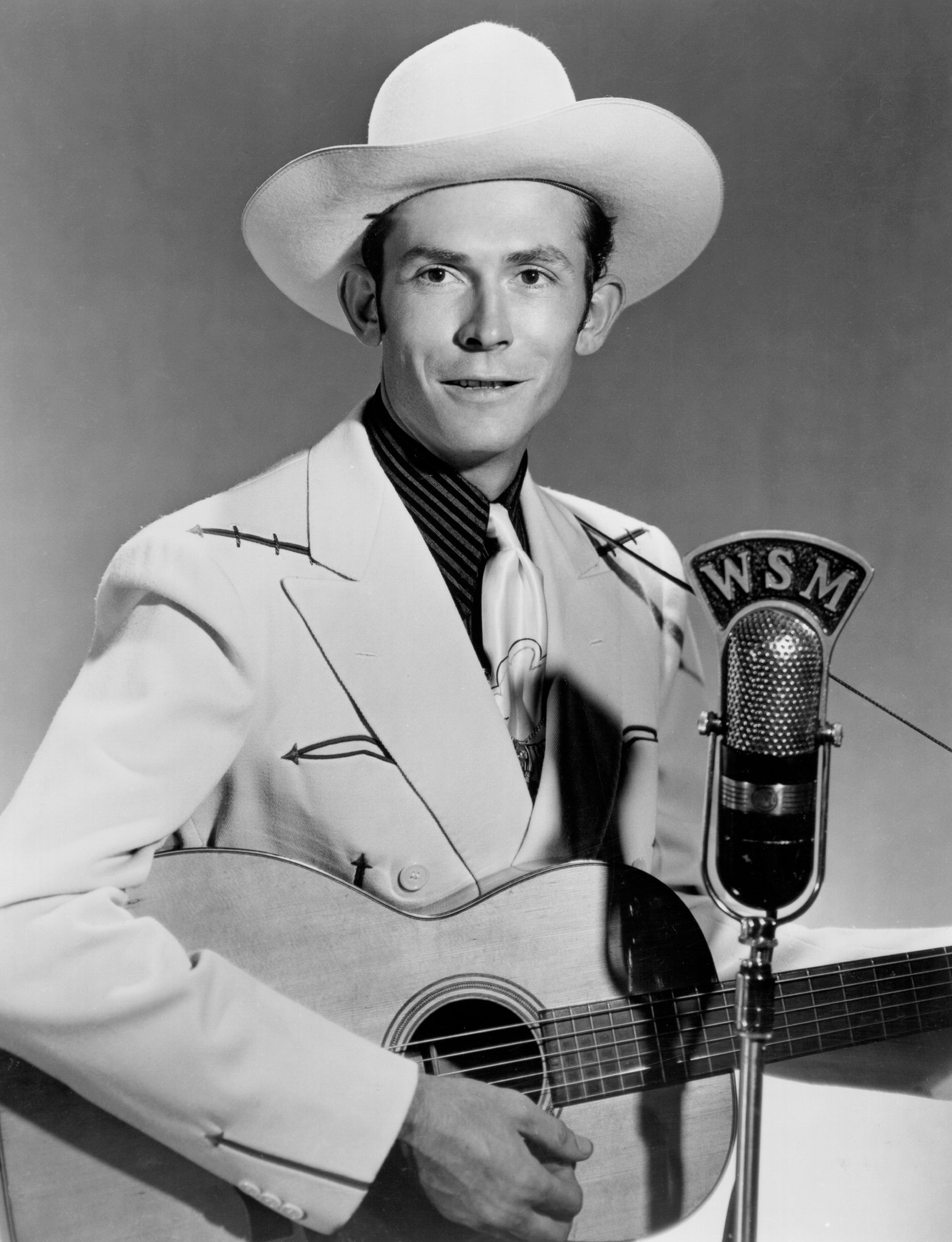
Hank Williams SrOn June 11 back in 1949, country legend Hank Williams Sr. had his debut at the Grand Old Opry, so wildly successful that the crowd called him back for six encores of the same song, “Lovesick Blues,” before organizers asked them to stop so the rest of the show could go on. Now you may not cherish real old-tyme country music enough even to know the Opry was the premiere live country-music venue, broadcast weekly from 1925. If not you should. But even if you don’t the story is remarkable… and not in a good way.

Williams’ debut was so successful that he became a regular on the Opry for the next three years, at which point they fired him for drinking so heavily he was entirely unreliable. As early as 1942 he had been fired from an earlier radio gig for “habitual drunkenness”. By 1952 he lost his marriage for the same reason, and less than six months after the Opry fired him he died of alcohol-induced heart failure at 29 on Jan. 1 1953, a truly remarkable accomplishment in a very bad way.

He left behind a slim legacy in one sense. There just aren’t that many songs. But in another sense his legacy is enormous. The songs he produced and recorded in just four years are powerful musically and emotionally and they profoundly influenced music. Indeed I once heard an interview with his grandson Hank Williams III (who looks disconcertingly like his grandfather) in which he argued that the “first” rock song, Rock Around the Clock, is in fact simply Hank Williams Sr.’s “Move it on over” with different lyrics. And rock music, the fusion of white country with black R&B (which profoundly influenced Williams; he learned guitar from a black street performer in Georgiana, Alabama), was enormously important to American and world culture from the 1950s on including in the field of race relations.

In a third sense, on a human level, his legacy is moving and problematic. The music is wonderful, the lyrics frequently compelling, including the revealing self-portrait in “Lost Highway” (remember Franklin’s observation that he who’s aground knows where the shoal lies) and sometimes funny. And his life story, beginning with the poor kid who made good despite being essentially unable to read or write music, was a terrible tragedy. Indeed, the Opry had initially refused to have him on, even after his breakthrough with “Move It On Over” in 1947 and his first recording contract. But competition with The Louisiana Hayride show forced them to relent.

Now as Williams himself said in “Move It On Over,” warnings had no effect on him because “I don’t take no one’s advice.” Winston Churchill once said he got more out of alcohol than it got out of him, and indeed he died at 90 a famous statesman and author. Williams sacrificed everything to alcohol. Including all the music he might have given us had he lived a normal life extending, say, to 1978 if he’d reached 75.

The weird thing is that, except when absolutely inebriated, he was a magnificent musician the whole way to his sordid demise. There are some “high function” alcoholics who exhibit remarkable talent and energy throughout a long life marred by disastrous personal relationships. Others succumb to the bottle and squander their talents as well as the love in their lives and perish forgotten. But Williams is in this to me odd third category of someone whose life was falling apart, from his family to his health, in catastrophic fashion, and yet whose talent seems to have been unimpaired until the moment he died. His last hit, the enduring classic “Your Cheatin’ Heart,” was recorded so late, in September 1952, that it wasn’t released until after he died; that same final recording session also produced the hilarious yet strangely compelling “Kaw-Liga” about a wooden cigar-store Indian who never spoke his love for the carved maiden across the way and now “wishes he was still an old pine tree”. How can the man have been such a ruin and his talent still so intact?

Finally and most importantly Williams is, if you’ll pardon the expression, a sobering reminder that worldly success and personal success are entirely different categories. Many achieve great things on the world stage yet are miserable human beings, both inside and to their family and friends, while others whose lives appear unremarkable are great successes in what really matters.

Williams, briefly and tragically, was in the first category as he rolled too fast down the Lost Highway. It may make for great art. But if you know anyone on it, do what you can to get them off.

It happened today - June 10, 2015

Benito MussoliniOn June 10, 1940, Mussolini led Italy into war with the Allies. Winston Churchill’s snide response to Italy’s participation in the Axis was, roughly, “It’s only fair. We had them the last time.” Hitler sneered that “First they were too cowardly to take part. Now they are in a hurry so that they can share in the spoils.” It takes some doing to get those too deadly foes ridiculing you at the same moment. But Italy’s declaration of war was indeed a move as squalid as it was futile and an object lesson in deluded belligerent sleaze.

Somewhere I read a line attributed to Kipling, though I’ve never been able to confirm it, that if you go into the jungle you must know what size beast you are. (If anyone knows the source, or can definitively debunk it, please let me know.) But whoever said it, clearly Mussolini did not take heed. Indeed it’s curious to reflect, in retrospect, on how fascist Italy was seen as a great power in the 1930s on a par with Germany, perhaps more dangerous, and Mussolini a totalitarian theorist at least as important as Hitler.

Certainly Mussolini took the lead in testing the democracies’ resolve, attacking Ethiopia in 1935 and taking a major role in the Spanish Civil War, and helped show Hitler that it was wanting. He looms surprisingly large in Churchill’s The Gathering Storm. But it didn’t take a long time for Hitler to push his hapless Italian colleague into second place and indeed, after Italy’s 1940 collapse in North Africa and bungled invasions of Greece and Yugoslavia in 1941, to see him and his military correctly as more of a liability than an asset. It isn’t even obvious that Italian participation in the fall 1939 and spring 1940 campaigns against France would have been any help, while in June 1940 their failure to break through French defences was risible without being significant.

On the other hand, it brought swift condemnation from American president Franklin Delano Roosevelt, whose commencement address to the University of Virginia (including his son Franklin Jr., from the University’s law school) declared indignantly that “On this tenth day of June, 1940, the hand that held the dagger has struck it into the back of its neighbor” and pledged all possible material support for Britain and France, pretty much declaring an end to American neutrality. In that sense, by having no clue what size beast he was, Mussolini did the Axis cause far more harm than good by joining, convincing FDR and many Americans that the gathering storm was more ominous and threatening to them than they had realized.

Later, when informed that Romania had declared war on the United States shortly after Pearl Harbor, Roosevelt would ask “Did you ever hear an ant fart in a windstorm?” But at least Romania had the feeble excuse of having no real choice. Had Mussolini kept Italy out of the war, successfully continuing to pose as a statesman, he wouldn’t have wound up hanging from a meathook in 1945. Like Franco, he might have enjoyed an unsavory reputation and a long reign.

As for Italians, well, their country’s sound defeat by the Allies followed by a decision to blame the regime not the people, aided by enthusiastic Italian efforts on the Allied side from September 1943 on, worked out pretty well. Today Italy is solidly democratic if not exactly a model of public efficiency, with the third largest economy in the Eurozone. Italians’ decision to allow Mussolini to take power and throw Italy’s lack of weight around could have gone far worse for them, perhaps ironically had he managed to do more harm. But it is amazing how everyone misjudged Italy’s geopolitical importance under the rule of an archetypal dictator, most dramatically that dictator himself.