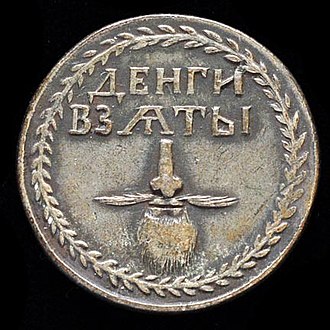
Not even a close shave

A Russian beard token from 1705, carried to indicate that the owner had paid the beard tax imposed by Peter the Great (Wikipedia)

If you want to know how not to do it, sadly, you can very often ask the Russian government. Like that business with the beard tax.

Huh? Beard tax? Wouldn’t they just shave? And the funny thing is that’s what the government, also known as Peter the Great, was hoping for when he brought it in on September 5, 1698.

You don’t often get a situation where a government introduces a tax hoping it won’t bring in money. But cynics, or perhaps realists, will not be surprised to hear that even then it failed.

Perhaps, as classic radio PI Brad “the Fat Man” Runyon once said, that could stand a little clarification. So here goes.

Peter the Great was a determined “modernizer.” He understood that to rival the West in military might to avoid being overwhelmed by it, Russia or any other what we would now call “underdeveloped” nation had to become prosperous and dynamic. And to do so it would have to adopt many Western cultural habits.

As I’ve written elsewhere, there’s a fatal paradox in any such attempt. Since the fundamental impulse here is to resist Western military power in order to resist its cultural sway, the necessity of adopting its culture to fend off its culture necessarily negates itself. But it also cannot work because the key element in western dynamic spontaneity is its spontaneity. It comes from within, from below, organically. If you have to force it, you just break it.

Which brings us to Peter. He understood full well the power of the West, especially its apparently chaotic, bafflingly successful approach of questioning everything and letting people work things out for themselves in the economy, in government, increasingly at that point even in religion. And he hated it. But he needed it. So he decided, as a singlehanded autocrat, to force it on his people.

Provided, of course, that instead of questioning everything they didn’t question anything, and didn’t think of working anything out for themselves in any important area. He created a new capital, further west and westward-looking, St. Petersburg. With slave labour.

He created a new social hierarchy with bureaucrats in place of aristocrats. The only way you could make it worse, one is tempted to say. But of course if merit had displaced birth spontaneously it would be good. It’s only bad when the whole thing is forced on a sullen populace, not just the serfs but everyone.

Likewise, Peter ordered his courtiers and officials to wear western clothing instead of traditional oriental robes, a legacy of the Mongols. And to shave off their old-tyme beards. The aristocrats balked. God wanted them to have beards. And so Peter placed a heavy tax on beards and in some cases forcibly shaved people himself.

Not only an absolute monarch, Peter was also a scary giant, 6’ 8”. When he shaved you, you stayed shaved. But evidently some of his victims actually carried their severed beards around with them so on the Second Coming they could fish them from their pockets and say see, I would have kept it if I’d dared or something equally unimpressive.

If people had decided in a decentralized, genuinely voluntary way to adopt new habits it would have been a desperately needed breath, nay gust, of invigorating fresh air in a stale and closed Russia. Instead it was a fiery blast that withered society further. Like all such violent modernizers, Peter squeezed more performance out of his government and his people in the short run. But he further weakened their capacity for genuine dynamism.

The result, ironically, was to make Russia even less Western while seeming more so. But in exactly the opposite way to his intention. In that sense, the beard tax was triply counter-productive. Designed to fail to raise money, it raised money, while worsening the problem it was meant to help solve.

Even by the standards of government, it’s an impressive failure.

It happened todayJohn Robson
Fire? Fire!

Here’s a curious-sounding item. On September 4 of 1812, the siege of Fort Harrison began when the place was set on fire. Normally you’d think the fort being set on fire would be the end of the siege.

Not this time. Fort Harrison was held by a tiny American garrison, 15 soldiers and five or so able-bodied civilians along with about three dozen sick soldiers, all commanded by Captain (later President) Zachary Taylor. A very large Indian war band approached, asked for a truce and parley on September 3, and then during the night one of them set the fort on fire and the others attacked.

Unsuccessfully. Things looked pretty grim, with the fire out of control partly because the whiskey went up (there was often strange stuff in frontier whiskey including kerosene and gunpowder – “firewater” wasn’t just an expression). A couple of defenders with working legs made use of them to flee. But Taylor shouted “Taylor never surrenders” and got his men organized to fight the fire.

Did I say men? I should say people. A certain Julia Lambert even got herself lowered into the well to fill buckets faster. And the flames even helped illuminate the attackers as targets.

Well, the long and short of it is that the fort held out successfully for 11 days before being relieved, after somehow patching a 20-foot fire-burned gap in the outer wall and despite having most of their food as well as their hooch consumed in the flames and two attempted relief expeditions ambushed and destroyed.

There is much to be said about the clashes between aboriginals and Europeans in the Americas, and a lot of it is to the discredit of the Europeans. But as I have repeatedly mentioned including in this series, the whole situation cannot be understood without grasping the enormous differences in culture and technology, and indeed the appalling vulnerability of the original Americans to diseases that were carried over the Atlantic from Europe’s farms and cities.

Among these is the degree of organization that let 20 able-bodied Europeans hold off 600 determined aboriginal warriors for a week and a half. And the fact that the attackers asked for a truce then struck during it hoping for the advantage of surprise. Such conduct was neither to their credit nor isolated, and if Europeans said natives’ promises were not to be relied on it wasn’t entirely an invention.

Call it a cultural clash or a misunderstanding if you like. But don’t pretend such things never happened.

It happened todayJohn Robson
Wish I'd said that - September 4, 2016

“It has been often said, very truly, that religion is the thing that makes the ordinary man feel extraordinary; it is an equally important truth that religion is the thing that makes the extraordinary man feel ordinary.” G.K. Chesterton in Charles Dickens

Famous quotesJohn Robson
Why history matters... and how

Here's a wonderful talk by historian David McCullough from 2003, just sent to me by Nick Zahn. I strongly recommend it for such insights as "When the world is storm-driven and the bad that happens and the worse that threatens are so urgent as to shut out everything else from view, then we need to know all the strong fortresses of the spirit which men have built through the ages." Now that's history as it should be done. And as we need it in these characteristically troubled times. McCullough draws together all kinds of things in this talk including the famous 1819 painting Declaration of Independence by John Trumbull which has been on display in the U.S. Capitol since 1826. It's not an accurate depiction of an actual historical event, yet somehow it embodies the meaning of the Declaration in a way that continues to compel and attract attention almost 200 years later.

McCullough also describes George Washington's fascination with architecture and interior design, expressed particularly in his renovation of his Mount Vernon home in the midst of the pressing public concerns that led to the Revolutionary War. "He cared about every detail -- wall paper, paint color, hardware, ceiling ornaments -- and hated to be away from the project even for a day."

Which makes this a good moment to remind people of Brigitte's new C2C Journal piece The Political Power of Art. Such matters are not only a fitting concern for conservatives, they are an indispensable one, because as McCullough says, "it is in their [the American Founders'] ideas about happiness, I believe, that we come close to the heart of their being, and to their large view of the possibilities in their Glorious Cause."

Their ideas about happiness were not narrow and cramped. But nor were these men without flaws. McCullough's talk is the 2003 Jefferson Lecture in the Humanities, a series created by the National Endowment for the Humanities in 1972 and described by the NEH as "the highest honor the federal government confers for distinguished intellectual achievement in the humanities." And of course McCullough is not blind to the various Founders' failings including that Jefferson was "evasive, at times duplicitous" and like many others a "stunning" hypocrite in championing liberty while holding slaves.

These men were human, all too human. As are we. History is our story. For as McCullough also wisely notes, "One might also say that history is not about the past. If you think about it, no one ever lived in the past. Washington, Jefferson, John Adams, and their contemporaries didn't walk about saying, 'Isn't this fascinating living in the past! Aren't we picturesque in our funny clothes!' They lived in the present. The difference is it was their present, not ours. They were caught up in the living moment exactly as we are, and with no more certainty of how things would turn out than we have."

I won't reprint the whole thing here; I hope I have excerpted enough to send you to read it. It is wise and thoughtful and full of fascinating details about these real human beings including Washington's preoccupation with design of which I confess I was not aware. But I will conclude with one more crucial quotation from it: "Daniel Boorstin, the former Librarian of Congress, has wisely said that trying to plan for the future without a sense of the past is like trying to plant cut flowers."

This lecture shows how history should be done. And why it matters.

Up a tree in the name of liberty

Charles II of England was up a tree after the Battle of Worcester. No. Really.

The battle, on September 3 1651, was a decisive defeat for the last intact Royalist army, mostly Scottish, by Cromwell’s New Model Army, mostly Puritans. And the king watched it from the spire of Worcester Cathedral which I suppose is as good a place as any from which to watch your army and hopes be crushed unless, of course, you wanted to be among them and risk sharing their fate. (And no, Charles II in 1651 is not a typo – he claimed the throne as soon as his father was beheaded in 1649, even if he didn’t sit in it until Cromwell had died and his son “Tumbledown Dick” had tumbled off the stage (see the May 25, 2016 It Happened Today.)

As for the tree, he climbed it later, during his flight first north and then to France where he spent nearly a decade. It was a massive oak called the Boscobel Oak or more often The Royal Oak, popular in pictures including on plates and yes, that does explain why so many pubs have that name. But let us return to Worcester, a suitable place for a Royalist last stand because the region had been firmly pro-King since the days of King John and Magna Carta. And we actually were at the site on Fort Royal Hill where the battle ended and seen the spire of the cathedral.

We also saw a plaque that quotes the words future U.S. President John Adams wrote after visiting in 1786 along with another future president, Thomas Jefferson, back when they were friends before they became bitter enemies and then in old age friends again.

“Edgehill and Worcester were curious and interesting to us, as scenes where freemen had fought for their rights. The people in the neighborhood appeared so ignorant and careless at Worcester, that I was provoked, and asked, ‘And do Englishmen so soon forget the ground where liberty was fought for? Tell your neighbors and your children that this is holy ground; much holier than that on which your churches stand. All England should come in pilgrimage to this hill once a year.’ This animated them, and they seemed much pleased with it. Perhaps their awkwardness before might arise from their uncertainty of our sentiments concerning the civil wars.”

I am no fan of Cromwell, who disposed of one tyrant with the aid of an army before making himself another using the same instrument. It was much better that the ancient institutions be restored and refurbished, as they were after 1660 and especially 1689. And I think Adams spoke a bit slightingly of English churches. But he was right that when they have been trampled, the people must recover and restore them. And then remember, as the English then did.

It is from such people that Canada claims its political descent. So we should remember it too. As our Right to Arms documentary (www.arighttoarms.com) will remind people when it is finished later this fall. Complete with footage from Fort Royal Hill.

It happened todayJohn Robson