Saving classical Greece

My latest from the Rebel: The Battle of Salamis on September 22, 480 BC, saved classical Greece before it even got started, before Aristotle, Socrates or Sophocles. https://www.youtube.com/watch?v=-qqB_c1jUgk

The audio-only version is available here: [podcast title="Rebel audio, September 22"]http://www.thejohnrobson.com/podcast/John2016/September/160922Rebel.mp3[/podcast]

History, PodcastJohn Robson
Xerxes takes a soaking

Today we do another battle. But not just any battle, or one with a funny name. One with absolutely profound consequences for our way of life. Salamis, on September 22, 480. No Salamis, no classical Greece, one might say. And no classical Greece means no open society today.

It’s amazing how much of what we regard as the beginnings of our secular heritage, from the philosophy of Plato, Socrates and Aristotle to the drama of Sophocles and Aeschylus to the architecture of the Parthenon took place in this very brief period between, say, the overthrow of Hippias in Athens in 510 BC to the death of Alexander the Great in 323.

Now you may be objecting here that I just threw a lot of marble at you. And it’s true. But here’s the thing. It may be all Greek to us today. But it was all once a staple of education in Western society, not just in school but at home, in conversation, even in church.

Where did it all go? How did we lose interest in our heritage if not by losing interest in its results, becoming so focused on our failings that we lost sight of the fact that the great defect of the West is not living up to its ideals whereas the great defect of so many other societies is the ideals themselves.

Certainly that is true of the Persian Empire that, under the god-emperor Xerxes, sought to conquer the free city states of Greece early in the 5th century BC and very nearly succeeded. In Persia there were no rights for the common person, nor indeed for the rich, whose property was as liable to be seized on an imperial whim or their head cut off as the humblest peasant. There was no dignity for the individual, no spirit of inquiry, no toleration of dissent, let alone admiration for it. And there were, not coincidentally, no citizen-soldiers.

In Greece there were. And it is they who rallied, after a long string of ominous defeats against a numerically far superior foe and after the annihilation of the Spartan rearguard at Thermopylae and of the main Greek armies at Artemisium and the conquest of much of Greece, they nevertheless rallied to Themistocles’ call to confront the mighty Persian fleet.

What’s more, as free people, they bickered and squabbled and argued their way, right up the battle, to a strategy that actually turned the Persians’ superior numbers against them in the narrow straits of Salamis and decisively crushed Xerxes’ navy. (For more on this, as so often, see Victor Davis Hanson’s inspiring Carnage and Culture.)

The mighty Xerxes went home, leaving his general Mardonius to crush these annoying turbulent insolent commoners. Instead the next year at Plataea his army was badly beaten, as was his fleet at Mycale. The Persians left and never again attacked the Greek mainland.

It is a date we should celebrate if we love the right to question authority. It’s not some new radical thing. It’s embedded in our heritage right at the base of those Doric columns. And paradoxically we should today question the radical skeptics who are the new voice of orthodoxy. Because the point of questioning isn’t to undermine everything. It’s to separate truth from error. And sometimes the truth is that tradition had it right.

Chant from on high: “Question authority!” Twerp in crowd: “Why?” Because the messy, rowdy, dynamic Western heritage of individualism is as much worth defending today as it was at Salamis.

It happened todayJohn Robson
Wish I'd said that - September 22, 2016

“And have we now forgotten that powerful Friend? or do we imagine we no longer need its assistance? I have lived, Sir, a long time; and the longer I live, the more convincing proofs I see of this Truth, that God governs in the Affairs of Men. And if a Sparrow cannot fall to the Ground without his Notice, is it probable that an Empire can rise without his Aid? Benjamin Franklin, “Motion for Prayers in the Constitutional Convention” June 28, 1787, in The Patriot Post “Founders’ Quote Daily” April 27, 2007

Famous quotesJohn Robson
I don't think they're applauding you

Monument to Caupo at Krimulda Castle (Wikipedia)

Here’s another one. Nickname, I mean. On St. Matthew’s Day, 1217, which is of course September 21 of that year, Kaupo the Accursed was killed in battle in Estonia. “The Accursed”. Dang. That’s gotta sting.

It might also interfere with recruiting to your cause. You go “Hey, we’ve got a big army, a great leader, a holy cause, who’s game to join in?” Then they go “OK, who’s this great leader person you have? Eh? Did you say ‘the Accursed’? Because maybe it’s just me but when you say that it sounds like it might not go so well.”

Now to be fair to the late Kaupo the Ill-Monickered, he probably picked up the name in the enemy camp, maybe even after the fact. He was apparently a leader of some Livonian group in the early 13th century, and is described in one chronicle as “quasi rex” which again isn’t quite the nickname you might have been fishing for. (It means “almost king” or “like a king” and isn’t nearly as cool or scary as “Tyrannosaurus rex” with no ifs, ands or quasis.)

Kaupo or Caupo (it matters less whether you spell it with a “k” or a “c” than whether you stick “the Akkursed” after it) was the first prominent Livonian to be christened. I know, I know, tallest building in Witchita. (Cue angry letters from Livonia.) Having gone to Rome and met Pope Innocent III, the same guy who sided with King John over Magna Carta boo hiss, he went home clutching the gift of a Bible to face a rebellion which he put down, then crusaded against some pagan Estonians related to his own quasi subjects… and died.

Apparently some people regard him as a fink and a traitor, others as a visionary who helped bring his people into Christian Europe. Personally I lean the second way, given the tragedies that have befallen the Baltic States in those periods when they were separated from the West. But Wikipedia says “Latvian legends, however, are unequivocal: there he is named “’Kaupo the accursed, the scourge of the Livs,... Kaupo who has sold his soul to the foreign bishops.’”

Even Antipope would be a step up. It would also help if your nickname was “guy who won the Battle of St. Matthew’s Day” not “guy who went under in it and good riddance”.

Even better to be called “Saint”, as in “the guy St. Matthew’s Day is named for”.

Kaupo the Accursed, not so much.

It happened todayJohn Robson
Don't ask for a cold cut from this one

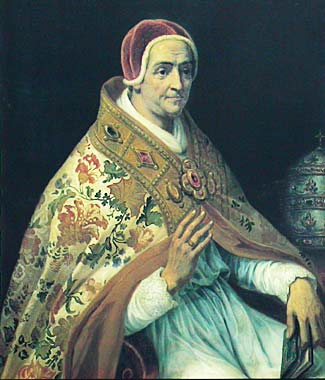
On the subject of nicknames and history, can I get a quick show of hands on appropriate jobs for the “Butcher of Cesena”? No, no, not “he should sell meat in Cesena, Italy”. He wasn’t that sort of guy. He was Robert of Geneva, son of Amadeus III, Count of Geneva, and he earned the nickname for ruthlessness in authorizing a massacre of between three and eight thousand citizens of the Italian town of Cesena in 1377 during the “War of the Eight Saints”. So, who figures he should be Pope?

Well, I see some hands there at the back. And not just from die-hard anti-Catholics in our own time. In fact they belong to, oh dear, a bunch of 14th-century French cardinals, who raised them on September 20, 1378 to make Robert of Never Mind Cesena into Pope Clement VII. Or rather Antipope Clement VII. I’m not sure whether Antipope is a better title than Butcher but I’m pretty sure you don’t want much to do with anyone who acquired both in the space of two years… or ever.

It seems the French cardinals did not like Pope Urban VI very much. I’m not sure why; after all he was forced on the papal conclave by an angry mob and wasn’t a cardinal. On the other hand he was apparently simple, frugal, arbitrary, violent and imprudent. An odd combination. And in this case batting .400 won’t do. Though the French choice wasn’t any better, and triggered the “Western Schism” in which the French crown tried to control the papacy again, having done so with a heavy hand during the “Avignon Papacy” from 1309-1377, a.k.a. the “Babylonian Captivity of the Papacy” which is another nickname you wouldn’t want especially in context of being Pope.

The ruckus over Urban v Clement quickly drew in all sorts of angry secular rulers. And it resulted in a deal, after they both died and their successors proved equally stubborn, whereby a third, compromise pope was also elected, adding to the chaos.

Finally people noticed that the whole thing was rather embarrassing and tended to discredit the faith. So a papal council got two of them to step down and excommunicated the third and elected Martin V who apparently didn’t have a nickname although maybe privately he was called “thank goodness that nonsense is over” or some such.

Obviously an event of this sort has complex roots. But it can’t help to choose a Pope nicknamed “the Butcher” of anything unless it’s “of farm animals for food” which in this case it definitely wasn’t.

BTW, if you’re thinking a war characterized by that sort of brutality would be lucky to muster eight saints among thousands of wretches, it turns out we’re not quite sure who the “Eight Saints” were but there’s no evidence that they were in any way saint-like. They seem to have been either tax collectors or a war council who had unusually good luck with nicknames, unusually good PR or possibly were the victims of pointed sarcasm.

It happened todayJohn Robson