“Well, bucko, that's gonna do us about as much good as a football bat.”
“Reader William White” quoted in the Wall Street Journal OpinionJournal July 12, 2004 [White could not remember who originally said it]
“Well, bucko, that's gonna do us about as much good as a football bat.”
“Reader William White” quoted in the Wall Street Journal OpinionJournal July 12, 2004 [White could not remember who originally said it]
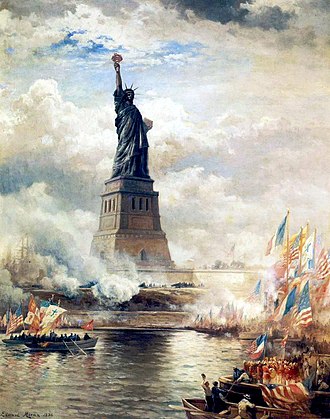 On October 28 back in 1886 President Grover Cleveland dedicated the famous Statue of… Well, you know, of course. The Statue of Liberty. It’s a lot more famous than, say, Grover Cleveland, except to nerds who relish his being the only man to serve non-consecutive presidential terms. (And don’t give Bill Clinton any ideas.)
It is easy to despair over, or despise, the United States. People have been doing it since before the Revolution. And Donald Trump isn’t making it harder. Nor is Hillary Clinton. Nor is the fact that the American government today is so large, aggressive, arrogant and inept that it’s hard to remember that it is a nation founded in liberty and long faithful to that founding. But those symbols do keep trying to remind us, and them.
Of course virtually every nation imagines itself to love “liberty”. But too often in bombastic patriotic odes, anthems and speeches the word means political independence of our tribe, which then denies freedom to its own members and the very humanity of everyone else. In America it meant something so different that the whole world knows the Statue of Liberty and she shows up at protests on the other side of the world.
No Chinese symbol could resonate in American politics in anything like the same way the “Goddess of Liberty” did in Tienanmen Square in 1989. Not even in the negative way that, say, Mao Zedong once did including in the Beatles song “Revolution”. And that gives some grounds for hope. Freedom is so deep in the political DNA of the United States that in a crisis citizens might yet turn to it both instinctively and passionately.
For that matter, some of us nerds also cherish Grover Cleveland because, as a Democratic president, he once vetoed a bill to relieve drought-stricken Texas farmers on the grounds that the Constitution did not empower the federal government to appropriate money from the people generally for the benefit of some particular group.
The sum was just $10,000, perhaps equivalent to a quarter of a million dollars today (and today it is hard to imagine Congress giving so little to anyone). But in vetoing it, one of 584 vetoes he cast in defence of limited government, Cleveland said “I can find no warrant for such an appropriation in the Constitution, and I do not believe that the power and duty of the general government ought to be extended to the relief of individual suffering which is in no manner properly related to the public service or benefit. A prevalent tendency to disregard the limited mission of this power and duty should, I think, be steadfastly resisted, to the end that the lesson should be constantly enforced that, though the people support the government, the government should not support the people.”
He also challenged the people calling on the government to act, especially those working for newspapers, to campaign instead for private donations. And the result was some $100,000 from citizens’ own pockets. Truly a response worthy of a free nation.
The United States, to say nothing of the Democratic Party, has moved an enormous distance away from such politics and from its foundations. But the statue still stands proudly off the southern tip of Manhattan, reminding Americans that if they are not free they are not American. It is not true of the most famous symbols of any other nation, not even Britain. And perhaps the Star Spangled Banner does still wave over the land of the free.
“I don’t mind being ugly, but I have a strong objection to being sad.”
G.K. Chesterton in Daily News February 11, 1911, quoted in Gilbert Magazine Vol. 12 #5 (March 2009)
My latest for The Rebel: https://www.youtube.com/watch?v=pN5VcHv21qs
The audio-only version is available here: [podcast title="Rebel, Oct. 27, 2016"]http://www.thejohnrobson.com/podcast/John2016/October/161027Rebel.mp3[/podcast]
The idea for our latest project, our True, Strong and Free documentary on how to fix the Constitution, originally came from an article I wrote for C2C Journal two years ago. You can read the original article here.
https://youtu.be/pqdsNY9_AfU The audio-only version is available here: [podcast title="Ask the Professor, October 27"]http://www.thejohnrobson.com/podcast/John2016/October/Ask_Professor_60.mp3[/podcast]
 On this date in history, or possibly legend, October 27 312 AD, the Emperor Constantine had a vision of the Cross and the words "Εν Τούτῳ Νίκα" which, being hard to pronounce or understand, we now render as “in hoc signo vinces” which alas is also today hard to pronounce or understand. But it means “Through this sign you shall conquer” and as the Emperor did win the subsequent battle of the Milvian Bridge. And convert to Christianity along with the Empire of which he became sole ruler partly due to this battle.
Nowadays such stories are dismissed as the sort of silly superstition typical of the dumb people who populated the past. If you’re very lucky someone will try to discern a “genuine” scientific event, like a solar halo, that might have misled the Emperor into thinking he’d seen a cross, or perhaps think he’d been blessed by some solar deity and later muddled himself into believing it had been Christ. More likely they will argue that he wasn’t really a Christian because the sun god appeared on his monuments or coins.
It’s odd to think how rapidly the idea that he might have had a genuine vision has been banished. I don’t say disproved. It’s not even obvious to me how you would disprove it. Not that one should accept every claim to have seen a vision. And certainly nobody in the 4th century AD did so. Not even the deeply credulous. Definitely not the sophisticated, educated, intelligent and tough-minded sorts who fought and won battles for control of the greatest empire the world had ever known.
On the other hand, Constantine went from being not officially Christian to being officially Christian because, as far as we can tell, he himself recounted the story of the omen to Eusebius, who in his Life of Constantine says he heard it from the Emperor personally. Certainly something happened. And the odd thing about all the debunking of things that were widely believed for many centuries is that they tend to explain why history didn’t happen the way it did.
I don’t know if Constantine saw a vision or just found the story good propaganda. I don’t know whether he was long secretly a Christian due to his mother’s influence or whether he convinced her to convert. But I do know he decreed official toleration for Christians and when he knew he was dying urgently sought baptism, trying to reach the river Jordan but not making it.
So obviously he thought it was very important for some reason scholarship strives mightily to prove was not merely wrong but preposterous and probably insincere. Just as an enormous number of people from the early Apostles onward became Christians despite the manifest dangers of doing so and surface absurdity of the whole story. But apparently all of them were ignorant, deluded or weird.
Unlike we moderns, with our calm, rational, well-informed approach to everything.
“The greater part of the world has, properly speaking, no history, because the despotism of custom is complete.”
John Stuart Mill On Liberty