We wish to inform our readers

Times of India Buildings, ca. 1898 (Wikipedia) Speaking of places everybody’s watching, this is the anniversary of the 1st edition of the Times of India on November 3, 1838. And no, I don’t mean everybody was or is watching India. Back then it was Britain. And if Britain had quality newspapers, the inevitable question was why you didn’t.

You could answer that newspapers were Western and imperialist and you didn’t want one. Before sneaking off to read a British one in private even if it was months old and tattered. Or you could say yours was as good. Or that you were planning one. Or that the government should do something. But you just couldn’t ignore the question.

Now the Times of India, which began life as The Bombay Times and Journal of Commerce, has generally aspired to give the second answer and done very well. It is the third-largest newspaper in India by circulation and the largest-selling English-language daily in the world. (And no, practically nobody cares what the largest-selling paper is in any other language; you see how this works.) And while it too may succumb to this dang Internet thing, it has consistently had a high reputation for quality.

It is an important Indian institution. And yet it is, of course, utterly foreign in origin and conception. Its original publisher was Raobahadur Narayan Dinanath Velkar, who you don’t get points for guessing was Indian. But its first editor was one J.E. Brennan and it published news from Britain as well as India and the world.

As of course it would because the “newspaper” is an entirely western idea, and moreover Anglosphere journalism has a tone not found even elsewhere in the West. And the “World Revolution of Westernization” so brilliantly discussed by Theodore von Laue in his book of the same name has swept over the world to the point that the only places that don’t have newspapers are either total backwaters or places that used to have them before the smartphone came along.

It’s now the United States. But for a long time, including the 19th century, it was Britain (and what could be a more British name than The Bombay Times and Journal of Commerce?). And you can curse imperialism until your teeth ache, and write endless stinging editorials against it. But you’ll still be writing them in a newspaper that you would not begin to have without imperialism, any more than you’d have editorials.
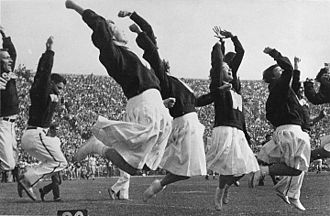
Gimmee an I, gimmee a T

Cheerleaders at the University of Wisconsin–Madison in 1948 (Wikipedia) The world is a big place. And yet in most eras including our own, all eyes are on one particular spot much of the time. There is one country to which people in all others compare themselves, and their own nation, with varying degrees of admiration, complacency, bitterness or other emotions. Which is my segue to the invention of cheerleading.

Yes, cheerleading. On Nov. 2 1898. And it could only be in… you know it. The United States. Specifically the University of Minnesota.

The latter was not a foregone conclusion. And the “sport” or activity or excrescence or whatever you consider it has of course historical roots, from British sports crowds chanting various things in unison, some more edifying than others, to the U.S. college scene. Including a “Princeton Cheer” documented from the late 1870s on that went “Hurrah! Hurrah! Hurrah! Tiger! S-s-s-t! Boom! A-h-h-h!” and more or less still does and accounts for the otherwise baffling “Sis Boom Bah” I first encountered in Pogo. If you care.

The point here isn’t the comics I read as a kid and still consider brilliant. Nor is it people in the stands yelling even with “cheer leaders” designated to trigger these arguably inane outbursts at key moments. It’s the point at which a “cheerleading squad” appeared to help focus the crowd’s enthusiasm, followed by a cheerleading fraternity in 1903 and then the invention of girls in revealing clothing.

Well, not exactly. But just as World War II opened up a great many other jobs for women as men went overseas, so it let them into cheerleading. From which they have never been dislodged, making up over 95% of all participants though in a nod to political correctness American colleges keep the ratio pretty even. And you just know this sort of thing would arise in the United States and everyone else would know about it.

Nowadays the United States apparently has around 1.5 million cheerleaders at all levels, against perhaps 100,000 in the whole rest of the world. And of course being American they have continually made it bigger, glitzier and more dramatic, from the aforementioned clothing to increasingly amazing athletics, organized competitions and so on.

Meanwhile the rest of the world gapes in amusement, delight or horror. But gape they do. Whereas what anyone does at sporting events in 98% of the world’s countries is known only there.

The United States does give some alarming signs of being in decline. And perhaps it is no longer inventing such iconically weird things the way it did in the late 19th and early 20th centuries. But I wouldn’t count on it.

Not even as part of a crowd being directed by preppie guys wit megaphones while girls in spangles form a pyramid.

And Michelangelo said, Let there be God

Is Boris Karloff funny as Frankenstein’s monster? Almost unwatchably corny? If so, it’s because he’s such an exact, stereotypical imitation of… of… himself. Which naturally brings me to Michelangelo.

Well, it could be worse. It could bring me to Karloff’s interactive ad for Butter-Nut coffee which trades on his exceptional, campy resemblance to Boris Karloff. (And if you haven’t seen it, I urge you to Google it and drink deeply.) But in a desperate lunge for high culture cred, I’m going with Michelangelo instead because it was on Nov. 1, 1512, that his fresco on the roof of the Sistine Chapel was first shown to the public.

Yes, that one. With God with flowing white beard reaching out to touch Adam. The one you’ve seen parodied so often, from the Simpsons to the Muppets to bank card ads to the Pastafarians, that the original itself seems like a parody. Including that business of God as an old man with a big beard. Which is, of course, proof of its transcendent genius.

I’m sure there were one or two people who saw it on that Nov. 1 and went “Oh, I don’t like that.” But the majority must have known at once, like the audience for the 1st performance of Beethoven’s 9th, that the world was somehow changed, that something had been created that was as original as art can be, and technically brilliant, yet as natural that the reaction was half “It can’t be” and half “Of course.”

There’s a lot more up there, of course. Just as there’s a lot more to Karloff including, dare I mention it in this context, his iconic “mummy” on which every subsequent mummy movie is in some sense a commentary. Indeed, to have created two characters so worth parodying is a mark of the man’s genius. As is the fact that the only major award of his long acting career was a Grammy for the LP of… I presume you know that too. How the Grinch Stole Christmas. (And the name, a stage name adopted while doing theatre in Canada; his actual name was the deeply not spooky “William Henry Pratt.”) And the fact that he parodied himself superbly, including in the original stage production of Arsenic and Old Lace where he played a gangster infuriated at being continually mistaken for Boris Karloff.

Oh, by the way, Michelangelo also did sculptures including the much-parodied David. (A Google search for “Michelangelo David parody” returned “About 7,510,000 results (0.88 seconds)”.

Not bad.

UncategorizedJohn Robson
Wish I'd said that - November 1, 2016

“If you can’t tie your shoelaces under pressure but play like a world-beater as soon as it’s too late, that’s worse in the dugout than being a no-talent klutz. That is called taking the apple.”

Thomas Boswell How Life Imitates the World Series

Famous quotesJohn Robson
Hot enough for ya, mate?

Marble Bar, way back when This is a hot one. On October 31 the town of Marble Bar, Australia started a record streak never surpassed, of 160 straight days of temperatures of 100 degrees Fahrenheit or higher. (I know we’re supposed to use metric and say 37.8 degrees Centigrade but it doesn’t sound as significant or scary and this is Halloween.) That people could have withstood it, even a fairly small number, is a tribute to the odd ruggedness of mankind in general and Australiankind in particular especially as it was before residential air conditioning.

Eh? Before air conditioning? The streak lasted from October 31 1923 to April 7 1924? How can this be? Isn’t global warming the ominous everybody-knows-but-idiots crisis of our times, in which every year is hotter than the hottest year in recorded history and mankind are great sinners needing salvation from government?

Well, no. Not really. Especially as “recorded history” when it comes to temperature dates back only to the mid-19th-century end stages of the “Little Ice Age” that began around 1300 and was not, surely, caused by man. I stress that point because if we did not cause it to start, it is a bit presumptuous, and contrary to sound scientific method, to insist that we caused it to end. (One of the fundamental laws of science, as opposed to politics, is that the nature of causation does not change over time; if it did, there would be no fundamental laws.)

I’m no fan of pollution or of arrogance. It is arrogant to think we can do whatever we like to the planet and nothing bad will happen. But it is also arrogant to think the entire universe including the climate revolves around us.

If it did, Marble Bar would have set that record recently.