“The greatest mistake you can make in life is to be continually fearing you will make one.”
Elbert Hubbard
“The greatest mistake you can make in life is to be continually fearing you will make one.”
Elbert Hubbard
https://www.youtube.com/watch?v=Xs0K4ApWl4g On October 30, 1938, Martians did not invade Earth. As they often don’t. Perhaps because they’re happy where they are, perhaps because we’re not as great as we think, or perhaps because they’re extinct microbes or never existed at all.
If it’s the latter, they have lots of company. Including all the people who panicked over the famous, or infamous, CBS “Mercury Theatre on the Air” broadcast starring Orson Welles.
It’s a story we’ve all heard and, in many cases including mine, believed. The show was in grittily realistic format and crucially didn’t have a lot of commercial breaks (for young people I should explain that before the Internet we used to endure periodic interruptions in whatever loud inane thing we were watching or listening to for some generally loud inane pitch for a product we didn’t need; now of course they pop up during it which is called “progress”).
So even though the legal department insisted on changing the names of a lot of actual institutions and buildings to thinly veiled substitutes, an idiot could have believed Martians were invading and panicked without checking first. And the urban legend is that many idiots did. But it’s not true.
It’s curious, therefore, that so many people believed and still believe they did. Now the obvious explanation is that we like to believe many of our fellows are such fools they will run screaming from a radio broadcast. But why would that be a comforting thought, especially given that they might run straight into a voting booth? Perhaps it is because, knowing humanity is prone to folly and that includes us, we can feel smug that at least we’re not quite as stupid as those people streaming screaming through the streets.
Until we look out our own window, or on the Internet, and find that they aren’t there and never were. Then we realize the fool is, as so often, in the mirror.
Especially as in the aftermath of this nonexistent panic, a real one did happen, with people denouncing CBS and calling for heavy regulation. And Orson Welles became more famous than I’ve ever been able to understand.
So maybe the Martians haven’t invaded because they don’t want the management of such a pack of fools. Or maybe they’re as bad as we are, and panicked at false rumours of panic at false rumors of an invasion from the Earth.
“There are many religions, but there is only one morality.”
John Ruskin
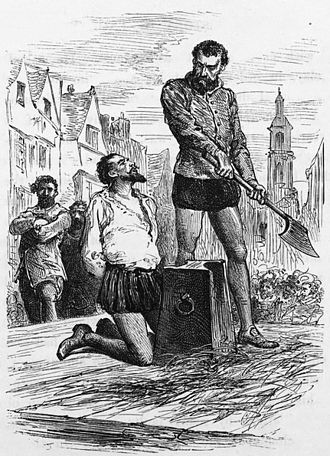 On October 29 back in 1618 Sir Walter Raleigh was beheaded on largely trumped-up charges (as noted in this series this Oct. 10). I’ve never been quite sure what to make of Raleigh.
He is larger than life in a very Renaissance kind of way, a writer, adventurer and courtier who I expect was also more annoying than life and not just for the daunting example he set. Today I suppose he’s a villain for having made tobacco popular in England, one of many things for which James I hated him and for once not without reason. (If you wonder why James regarded himself as a highly intelligent man and a skilled controversialist, you should read his “Counterblaste to Tobacco” which shows him at his best; a man who could write “A custome lothsome to the eye, hatefull to the Nose, harmefull to the braine, dangerous to the Lungs, and in the blacke stinking fume thereof, neerest resembling the horrible Stigian smoke of the pit that is bottomelesse” cannot have been entirely without virtues.)
As for Raleigh, he was brave, gallant and dashing. But also I think somewhat slippery, not a man on whose word it might be safe to rely. His career had many ups and downs and not everything bad that happened to him was undeserved. But on balance there are two things for which I cherish his memory, along with a throwaway line in a book I read in my teens saying when Raleigh was sent with troops to Ireland to deal with a revolt there were already British soldiers stationed there to tell the newcomers there was “no bread, no beer, no money and the butter was hairy”.
One was his insistence during his treason trial on the right to summon witnesses, not then a feature of English law. It failed, but his words still ring: “[Let] my accuser come face to face, and be deposed. Were the case but for a small copyhold, you would have witnesses or good proof to lead the jury to a verdict; and I am here for my life!" The other was his principled stand in debate on a harsh bill aimed at Protestant dissenters, informed perhaps in part by his own experience of persecution under the Catholic Bloody Mary. As Catherine Drinker Bowen describes it in her wonderful biography of Edward Coke, The Lion and the Throne, “Laws that punished the fact, he [Raleigh] could approve. But laws which punished a man’s intention he considered hard. Were juries henceforth to be ‘judges of men’s intentions, judges of what another means?’ And on such judgement, were they to take life and send into banishment?”
His own career ended badly and I’ll bet being one-upped by him at court was as much fun as Edward Blackadder made it sound (see the second series episode “The Potato”). But he was a true Englishman and never more than in his spirited defence of liberty sheltered by just law.
“Well, bucko, that's gonna do us about as much good as a football bat.”
“Reader William White” quoted in the Wall Street Journal OpinionJournal July 12, 2004 [White could not remember who originally said it]
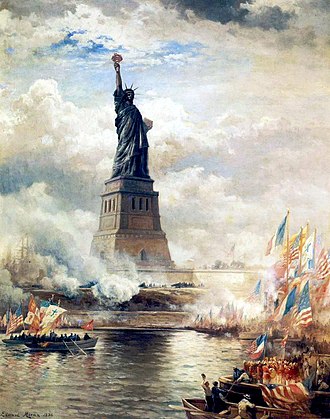 On October 28 back in 1886 President Grover Cleveland dedicated the famous Statue of… Well, you know, of course. The Statue of Liberty. It’s a lot more famous than, say, Grover Cleveland, except to nerds who relish his being the only man to serve non-consecutive presidential terms. (And don’t give Bill Clinton any ideas.)
It is easy to despair over, or despise, the United States. People have been doing it since before the Revolution. And Donald Trump isn’t making it harder. Nor is Hillary Clinton. Nor is the fact that the American government today is so large, aggressive, arrogant and inept that it’s hard to remember that it is a nation founded in liberty and long faithful to that founding. But those symbols do keep trying to remind us, and them.
Of course virtually every nation imagines itself to love “liberty”. But too often in bombastic patriotic odes, anthems and speeches the word means political independence of our tribe, which then denies freedom to its own members and the very humanity of everyone else. In America it meant something so different that the whole world knows the Statue of Liberty and she shows up at protests on the other side of the world.
No Chinese symbol could resonate in American politics in anything like the same way the “Goddess of Liberty” did in Tienanmen Square in 1989. Not even in the negative way that, say, Mao Zedong once did including in the Beatles song “Revolution”. And that gives some grounds for hope. Freedom is so deep in the political DNA of the United States that in a crisis citizens might yet turn to it both instinctively and passionately.
For that matter, some of us nerds also cherish Grover Cleveland because, as a Democratic president, he once vetoed a bill to relieve drought-stricken Texas farmers on the grounds that the Constitution did not empower the federal government to appropriate money from the people generally for the benefit of some particular group.
The sum was just $10,000, perhaps equivalent to a quarter of a million dollars today (and today it is hard to imagine Congress giving so little to anyone). But in vetoing it, one of 584 vetoes he cast in defence of limited government, Cleveland said “I can find no warrant for such an appropriation in the Constitution, and I do not believe that the power and duty of the general government ought to be extended to the relief of individual suffering which is in no manner properly related to the public service or benefit. A prevalent tendency to disregard the limited mission of this power and duty should, I think, be steadfastly resisted, to the end that the lesson should be constantly enforced that, though the people support the government, the government should not support the people.”
He also challenged the people calling on the government to act, especially those working for newspapers, to campaign instead for private donations. And the result was some $100,000 from citizens’ own pockets. Truly a response worthy of a free nation.
The United States, to say nothing of the Democratic Party, has moved an enormous distance away from such politics and from its foundations. But the statue still stands proudly off the southern tip of Manhattan, reminding Americans that if they are not free they are not American. It is not true of the most famous symbols of any other nation, not even Britain. And perhaps the Star Spangled Banner does still wave over the land of the free.
“I don’t mind being ugly, but I have a strong objection to being sad.”
G.K. Chesterton in Daily News February 11, 1911, quoted in Gilbert Magazine Vol. 12 #5 (March 2009)
My latest for The Rebel: https://www.youtube.com/watch?v=pN5VcHv21qs
The audio-only version is available here: [podcast title="Rebel, Oct. 27, 2016"]http://www.thejohnrobson.com/podcast/John2016/October/161027Rebel.mp3[/podcast]