In my latest National Post column I lament the latest New Brunswick budget continuing down the boringly disastrous path of deficits today for affordable free money the day after tomorrow... or after the next election... or never.
 In what seems truly a bygone era, Fidel Castro seized power in Cuba on February 16 of 1959. Yes, 58 years ago. And a Castro is still in power in this ghastly real-life Autumn of the Patriarch.
I could say a lot of things about Fidel Castro without getting to anything nice. Like how revealing it is that he would have switched jobs repeatedly while still being the guy you got shot for disobeying. And how typical it is of a regime that for all its yapping about true democracy had no legitimacy that it became dynastic like North Korea. (Mind you his own daughter, from one of his many infidelities, fled the island prison in disguise in 1993 and his own sister opposed him from American exile.) But never mind him.
What I want to do on this dismal anniversary is insult all the leftists who placed such high hopes on him to begin with and then somehow insisted despite everything that he really was a good man and a liberator. Anybody can make a mistake. Even the New York Times in originally hailing him as "the Robin Hood of the Caribbean". But to persist in one, to speak of democracy and human rights and peace in a sanctimonious tone while siding with this seedy brutal villain and denying repeatedly that he was a Communist, or in case he was denying that it mattered if he was one, surely indicates grave defects in judgement.
Especially as it is a habit of the left, from Stalin through Castro to Mugabe and beyond; as Jay Nordlinger memorably put it in National Review back in 1994, "Like an adolescent girl on holiday, the radical Left is always falling in love with some unsuitable foreigner..."
To do it and learn nothing is to double down on nasty folly. Why have so many done it, and not just on the radical left, including our own Prime Minister Justin Trudeau?
For that matter, why are there still Che T-shirts?
"Unless we can make daybreak and daily bread and the creative secrets of labour interesting in themselves, there will fall on all our civilisation a fatigue which is the one disease from which civilisations do not recover." G. K. Chesterton in The Listener Jan. 21 1934, quoted in Gilbert Magazine Vol. 10 #6 (April-May 2007)
"To corrupt family relations is to poison fountains; for the sources of the Commonwealth are within the households, and errors there are irretrievable." Edmund Burke, quoted by Andrea Mrozek in Cardus Comment Summer 2016
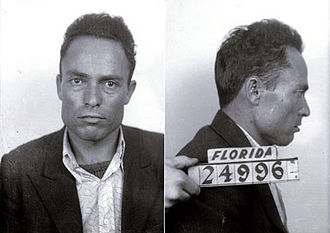 There are a lot of ways to get into the history books. But here’s one you wouldn’t want. On February 15 of 1933, Giuseppe Zangara tried to assassinate president-elect Franklin Roosevelt. Had he succeeded, it would have been the first time anyone was elected president and then died before taking office.
It didn’t happen then, and it hasn’t happened since, something I refrain from mentioning between any election and inauguration lest I should be suspected of trying to jinx the president-elect. As a matter of fact, no one has ever died between being nominated by a major party and the election either. Leaving aside violence, you’d think simply by the odds it would have happened to somebody. (Democratic lion Stephen A. Douglas, one of Lincoln’s opponents in the 4-way 1860 election, did die suddenly less than three months after his victorious rival was inaugurated.)
As for getting into the history books anyway, a dismal footnote to Zangara’s failed attempt is that in the process, standing on a wobbly folding chair and fighting a crowd trying to subdue him, he managed to shoot four other people including Chicago mayor Anton Cermak, who died of his wounds on March 6, two days after Roosevelt’s inauguration. So Cermak becomes "Who was that guy shot by mistake next to FDR?"
Meanwhile Zangara was executed in "Old Sparky," the Florida State Prison’s electric chair, on March 20, justice being swifter in those days. (For what it’s worth, the judge who sentenced him to death called for a complete handgun ban.) And in the process Zangara did make a sort of history.
You see, the rules said prisoners could not share a cell prior to execution but as someone else was awaiting capital punishment he obliged them to expand the "death cell" into the now proverbial "Death Row". It’s not exactly what you put down as your ambition in your high school yearbook. But it beats being the guy assassinated by mistake while the real target wasn’t becoming the first ever president-elect not to make it to Inauguration Day.
The audio-only version is available here: [podcast title="Ask the Professor, February 14, 2017"]http://www.thejohnrobson.com/podcast/John2017/February/Ask_Professor_79.mp3[/podcast]
"There is only one thing which is generally secure from plagiarism – self-denial." G. K. Chesterton in Illustrated London News September 2, 1911, quoted in Gilbert Magazine Vol. 9 #2 (Oct.-Nov. 2005)
 Ah, the wonders of the steam age. Including that on February 14 back in 1849, James Knox Polk became the first sitting president of the United States to have his photograph taken.
If you’re wondering why he was in office on that date, it’s because prior to the New Deal with its air of constant crisis there was a four-month period between an election and the swearing in of the new president.
Oh, you didn’t mean it that way? You were wondering why somebody called James Polk was ever President? And in his defence I should note first that Polk was elected in 1844 in something of an upset, both as Democratic nominee and then as president, on the pledge to serve only a single term. So he did not run in 1848. (He then enjoyed the shortest retirement of any president, dying of cholera on June 15, 1849.)
Can I say anything else nice about him? Well, he was also elected in part on his pledge to annex Texas which he did, and the United States has generally been better for it. And historians generally credit him with having been a very successful president for having managed to garner support for and pass virtually everything on his agenda. On the other hand, like every other president between roughly John Tyler and James Buchanan, he stands indicted of having failed to halt the drift into bloody civil war.
As for his photo, it’s a somewhat grim affair. But in addition to the expectation that statesmen would look vaguely statesmanlike back then, there was the need to sit very still while primitive film gradually absorbed your image.
It’s a long way from the modern selfie. But in some sense the journey began with Polk.
As I said, the wonders of the steam age.