"[H.G. Wells] seems to believe that men who have begun anyhow, and come from anywhere, and believe or disbelieve anything, will by some process of pooling impressions arrive at an agreement at the end... I cannot see how this is really consistent with any rational process of thought at all... people who differ at the beginning still differ at the end…’" G.K Chesterton in G.K.’s Weekly June 22, 1928, quoted by Dale Ahlquist in Gilbert Magazine Vol. 20 #2 (Nov.-Dec. 2016)
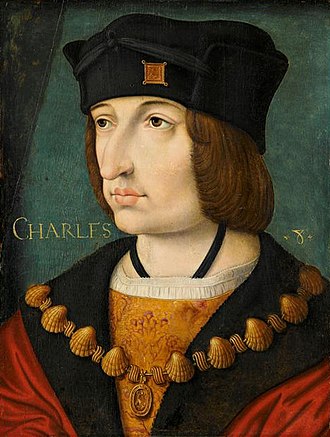 In a sign of a more cosmopolitan era, on February 22 Charles VIII "the Affable" of France marched into Naples to claim its throne. It didn’t work, as the grand schemes of Kings of France often did not. But it’s interesting to reflect on a period in which neither the French nor the Italians would regard it as in principle offensive to have a French king on an Italian throne, whatever they thought of the actual claimant.
In fairness, Charles did rather better in boldly marrying Anne of Brittany in 1491. It was bold because technically she had already married Habsburg Holy Roman Emperor Maximilian I, by proxy and possibly not properly. By bagging Brittany instead of the Hapsburgs getting it he did help France avoid Hapsburg encirclement and emerge as a great power. The same is not true of his Italian venture.
Having somehow inherited a legally, morally and practically dubious claim to the throne of Naples, reinforced by a somewhat cynical Pope Innocent VIII, he made various deals with other important monarchs and then conquered Italy without much apparent difficulty in late 1494 and early 1495, to the joy of Savonarola but the concern of many other players including a new Pope, Alexander VI. His enemies created the League of Venice against him and he was more or less driven out of Italy in 1495, a great deal poorer but apparently no wiser. And wars would continue over Italy for 50 years, convulsing Western European geopolitics to no good purpose at much cost especially to Italians.
As for Charles, who if he was affable was so largely on the surface, he banged his head on a doorframe in 1498 and fell down dead. (OK, he fell into a coma and died nine hours later but as banging your head on a door and perishing at age 27 goes it was pretty quick.) He left France, his dynasty and Italy in a right mess. So on the whole not a good king.
Still, I do find it odd that we pride ourselves on our cosmopolitan, tolerant and multicultural attitudes. Yet we retain a kind of Wilsonian fascination with ethnic states to the point that it seems strange, even perverse, to have a French King seeking the throne of Naples, an Austrian Hapsburg seeking to rule Brittany and so on.
There were good reasons why they should not have done so, primarily that this particular French King should also not have ruled France, nor the profligate Habsburg Maximilian I of Austria, who stuck the Holy Roman Empire with a debt it took a century to pay off. But ethnicity seems to me to have nothing to do with it.
On March 17 and 18 I'll be helping host the Economic Education Association of Alberta annual conference on "Meeting the Climate Change Challenge." We'll be gathering in Calgary to talk about the science, the policy choices and the rhetoric surrounding the alarmist vision of disastrous man-made global warming, not because the environment isn't important but because thinking sensibly is. We've got a great lineup of speakers and panelists, which you can see here, including my talk on "The Environment: A True Story".
So register now and join us in March for a compelling discussion that dispels myths and cuts through shrill rhetoric to make sense of this crucial issue.
In my latest National Post column I explore Bruce Schneier's warning that the Internet of Things is desperately insecure, and suggest that it's strange to run so much risk for so little genuine benefit.
"If we don’t discipline ourselves the world will do it for us." William Feather
 "A spectre is haunting Europe – the spectre of communism." It is, I must admit, a brilliant opening line. With that line the Communist Manifesto opened on February 21 of 1848. And the world was never the same again. In, most people must surely now admit, mostly bad or even horrible ways.
Radicalism is, I suppose, inevitable, an intellectual or even psychological disposition that has always been with us and always will be. And it will always be impatient, convinced that good will is all you really need, and therefore also convinced that its opponents must be evil, an attitude which rapidly passes through insolence into abuse. But Marxism seems to have been a singularly poisonous and attractive form of radicalism, a perilous combination.
Marx himself long enjoyed a reputation as a deep thinker that sometimes attaches to the voluminously impenetrable. Marx was not, in fact, a great analytic economist, although his theories had a certain plausibility when conventional economics believed in the labour theory of value that they could not retain to the educated mind after the marginalist revolution of the early 20th century. But he was also attractive to the usual suspects, especially of the more dangerous sort, because his supposed erudition was basically just the lead weight in the glove of his rhetoric.
Marx always was a fine rhetorician even if Kapital is all but impenetrable. I’ve always cherished Joseph Schumpeter’s phrase that "the cold metal of economic theory is in Marx’s pages immersed in such a wealth of steaming phrases as to acquire a temperature not naturally its own."
Especially in the Communist Manifesto, full of ringing phrases like "The history of all hitherto existing society is the history of class struggles" that are exceptionally clear as well as polemical.
Among these is one that I consider highly perceptive, partly because Marshall Berman used it as the title of an unsettling book about modernity. It is that under what Marx called capitalism but might better be dubbed "modernization," a disorienting process of constant change occurs in which "All that is solid melts into air". Including your formerly brilliant cutting edge smartphone, which three years later is an embarrassing brick. But a few insights do not make a philosopher or an economist.
Nor do a few good phrases make a good man. Including his castigation of "the idiocy of rural life". Oddly the famous "Religion is the opium of the masses" is not from the Communist Manifesto but from the posthumously published "A Contribution to the Critique of Hegel's Philosophy of Right" whose title gives a fair idea of Marx’s general prose style despite his gift for turning a phrase when he wanted. And that quotation, in full, is not as rude as Marx often is: "Religion is the sigh of the oppressed creature, the heart of a heartless world, and the soul of soulless conditions. It is the opium of the people". But Marx was, as a rule, abusive, in debate and in his personal life and I do not think it can be disregarded in considering his theories and their appeal.
Space precludes getting into all the details here but he was a mean, selfish, thuggish hypocrite, and his doctrines not accidentally often appealed to thoroughly unpleasant people. Moreover they were materialist, which necessarily denies human dignity (whether it is true or not is of course not determined by its attractiveness). And Marx and Engels’ theory of class struggle, in ways that to borrow a Bolshevik phrase are no accident, absolutely denied the possibility of rational debate, declaring all opposition to Communism to be at once viciously self-interested and impenetrably obtuse, thus leaving a speedy resort to violence the only course. In that sense, for all its elaborate theoretical framework, Marxism was at bottom radically relativist and nihilistic regarding the very possibility of objective truth.
Despite its failings, or perhaps because of them, far too many adolescent revolutionaries of all ages adhered to it for far too long for the thrill of giving reputable society, and staid socialists, a poke in the eye, without looking carefully at the implications of its doctrines. And perhaps that, too, is an enduring characteristic of radicalism. But if so, it is another reason to avoid it.
A spectre did indeed haunt Europe for more than a century after the Communist Manifesto first appeared. And it turned out to be even worse under Stalin, Mao and Pol Pot among others, than its most vociferous critics warned, in part because its most vocal and determined adherents were so careless about what they advocated. It remains hugely popular on the intellectual left, even trendy.
Do such people never learn?
"'When the cart stops,' said Huai-Jang, the Master of Ma-Tsu, 'do you whip the cart or whip the ox?'" Thomas Merton Zen and the Birds of Appetite