And Michelangelo said, Let there be God

Is Boris Karloff funny as Frankenstein’s monster? Almost unwatchably corny? If so, it’s because he’s such an exact, stereotypical imitation of… of… himself. Which naturally brings me to Michelangelo.

Well, it could be worse. It could bring me to Karloff’s interactive ad for Butter-Nut coffee which trades on his exceptional, campy resemblance to Boris Karloff. (And if you haven’t seen it, I urge you to Google it and drink deeply.) But in a desperate lunge for high culture cred, I’m going with Michelangelo instead because it was on Nov. 1, 1512, that his fresco on the roof of the Sistine Chapel was first shown to the public.

Yes, that one. With God with flowing white beard reaching out to touch Adam. The one you’ve seen parodied so often, from the Simpsons to the Muppets to bank card ads to the Pastafarians, that the original itself seems like a parody. Including that business of God as an old man with a big beard. Which is, of course, proof of its transcendent genius.

I’m sure there were one or two people who saw it on that Nov. 1 and went “Oh, I don’t like that.” But the majority must have known at once, like the audience for the 1st performance of Beethoven’s 9th, that the world was somehow changed, that something had been created that was as original as art can be, and technically brilliant, yet as natural that the reaction was half “It can’t be” and half “Of course.”

There’s a lot more up there, of course. Just as there’s a lot more to Karloff including, dare I mention it in this context, his iconic “mummy” on which every subsequent mummy movie is in some sense a commentary. Indeed, to have created two characters so worth parodying is a mark of the man’s genius. As is the fact that the only major award of his long acting career was a Grammy for the LP of… I presume you know that too. How the Grinch Stole Christmas. (And the name, a stage name adopted while doing theatre in Canada; his actual name was the deeply not spooky “William Henry Pratt.”) And the fact that he parodied himself superbly, including in the original stage production of Arsenic and Old Lace where he played a gangster infuriated at being continually mistaken for Boris Karloff.

Oh, by the way, Michelangelo also did sculptures including the much-parodied David. (A Google search for “Michelangelo David parody” returned “About 7,510,000 results (0.88 seconds)”.

Not bad.

UncategorizedJohn Robson
Wish I'd said that - November 1, 2016

“If you can’t tie your shoelaces under pressure but play like a world-beater as soon as it’s too late, that’s worse in the dugout than being a no-talent klutz. That is called taking the apple.”

Thomas Boswell How Life Imitates the World Series

Famous quotesJohn Robson
Hot enough for ya, mate?

Marble Bar, way back when This is a hot one. On October 31 the town of Marble Bar, Australia started a record streak never surpassed, of 160 straight days of temperatures of 100 degrees Fahrenheit or higher. (I know we’re supposed to use metric and say 37.8 degrees Centigrade but it doesn’t sound as significant or scary and this is Halloween.) That people could have withstood it, even a fairly small number, is a tribute to the odd ruggedness of mankind in general and Australiankind in particular especially as it was before residential air conditioning.

Eh? Before air conditioning? The streak lasted from October 31 1923 to April 7 1924? How can this be? Isn’t global warming the ominous everybody-knows-but-idiots crisis of our times, in which every year is hotter than the hottest year in recorded history and mankind are great sinners needing salvation from government?

Well, no. Not really. Especially as “recorded history” when it comes to temperature dates back only to the mid-19th-century end stages of the “Little Ice Age” that began around 1300 and was not, surely, caused by man. I stress that point because if we did not cause it to start, it is a bit presumptuous, and contrary to sound scientific method, to insist that we caused it to end. (One of the fundamental laws of science, as opposed to politics, is that the nature of causation does not change over time; if it did, there would be no fundamental laws.)

I’m no fan of pollution or of arrogance. It is arrogant to think we can do whatever we like to the planet and nothing bad will happen. But it is also arrogant to think the entire universe including the climate revolves around us.

If it did, Marble Bar would have set that record recently.

Little green folly

https://www.youtube.com/watch?v=Xs0K4ApWl4g On October 30, 1938, Martians did not invade Earth. As they often don’t. Perhaps because they’re happy where they are, perhaps because we’re not as great as we think, or perhaps because they’re extinct microbes or never existed at all.

If it’s the latter, they have lots of company. Including all the people who panicked over the famous, or infamous, CBS “Mercury Theatre on the Air” broadcast starring Orson Welles.

It’s a story we’ve all heard and, in many cases including mine, believed. The show was in grittily realistic format and crucially didn’t have a lot of commercial breaks (for young people I should explain that before the Internet we used to endure periodic interruptions in whatever loud inane thing we were watching or listening to for some generally loud inane pitch for a product we didn’t need; now of course they pop up during it which is called “progress”).

So even though the legal department insisted on changing the names of a lot of actual institutions and buildings to thinly veiled substitutes, an idiot could have believed Martians were invading and panicked without checking first. And the urban legend is that many idiots did. But it’s not true.

It’s curious, therefore, that so many people believed and still believe they did. Now the obvious explanation is that we like to believe many of our fellows are such fools they will run screaming from a radio broadcast. But why would that be a comforting thought, especially given that they might run straight into a voting booth? Perhaps it is because, knowing humanity is prone to folly and that includes us, we can feel smug that at least we’re not quite as stupid as those people streaming screaming through the streets.

Until we look out our own window, or on the Internet, and find that they aren’t there and never were. Then we realize the fool is, as so often, in the mirror.

Especially as in the aftermath of this nonexistent panic, a real one did happen, with people denouncing CBS and calling for heavy regulation. And Orson Welles became more famous than I’ve ever been able to understand.

So maybe the Martians haven’t invaded because they don’t want the management of such a pack of fools. Or maybe they’re as bad as we are, and panicked at false rumours of panic at false rumors of an invasion from the Earth.

UncategorizedJohn Robson
A Swashbuckling Friend of Freedom

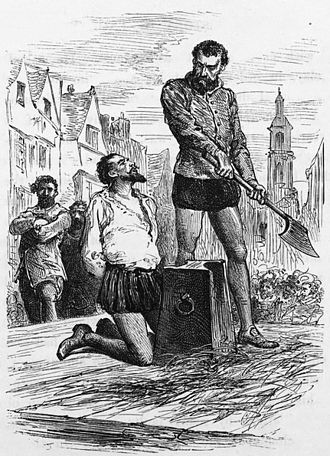
On October 29 back in 1618 Sir Walter Raleigh was beheaded on largely trumped-up charges (as noted in this series this Oct. 10). I’ve never been quite sure what to make of Raleigh.

He is larger than life in a very Renaissance kind of way, a writer, adventurer and courtier who I expect was also more annoying than life and not just for the daunting example he set. Today I suppose he’s a villain for having made tobacco popular in England, one of many things for which James I hated him and for once not without reason. (If you wonder why James regarded himself as a highly intelligent man and a skilled controversialist, you should read his “Counterblaste to Tobacco” which shows him at his best; a man who could write “A custome lothsome to the eye, hatefull to the Nose, harmefull to the braine, dangerous to the Lungs, and in the blacke stinking fume thereof, neerest resembling the horrible Stigian smoke of the pit that is bottomelesse” cannot have been entirely without virtues.)

As for Raleigh, he was brave, gallant and dashing. But also I think somewhat slippery, not a man on whose word it might be safe to rely. His career had many ups and downs and not everything bad that happened to him was undeserved. But on balance there are two things for which I cherish his memory, along with a throwaway line in a book I read in my teens saying when Raleigh was sent with troops to Ireland to deal with a revolt there were already British soldiers stationed there to tell the newcomers there was “no bread, no beer, no money and the butter was hairy”.

One was his insistence during his treason trial on the right to summon witnesses, not then a feature of English law. It failed, but his words still ring: “[Let] my accuser come face to face, and be deposed. Were the case but for a small copyhold, you would have witnesses or good proof to lead the jury to a verdict; and I am here for my life!" The other was his principled stand in debate on a harsh bill aimed at Protestant dissenters, informed perhaps in part by his own experience of persecution under the Catholic Bloody Mary. As Catherine Drinker Bowen describes it in her wonderful biography of Edward Coke, The Lion and the Throne, “Laws that punished the fact, he [Raleigh] could approve. But laws which punished a man’s intention he considered hard. Were juries henceforth to be ‘judges of men’s intentions, judges of what another means?’ And on such judgement, were they to take life and send into banishment?”

His own career ended badly and I’ll bet being one-upped by him at court was as much fun as Edward Blackadder made it sound (see the second series episode “The Potato”). But he was a true Englishman and never more than in his spirited defence of liberty sheltered by just law.