Posts in International
Washington Watches a Balloon – It Happened Today, January 9, 2017

Regular readers of this feature will know that I have a soft spot for the incorrigible enthusiasts for hot air balloons, dirigibles and all those lighter-than-air craft that preceded the airplane, were rudely shoved aside by it, and yet whose backers continue to dream. You just can’t keep a hot air balloon down.

It is also remarkable that for some reason the French were especially keen enthusiasts. I won’t make any hot air jokes here. But I will note that French pioneers included Jean-Pierre Blanchard, who in 1785 boldly demonstrated the value of a parachute in escaping a troubled hot-air balloon by … um… throwing his dog out wearing one. (See "It Happened Today" for October 22, 2016.) Dogs being what they are, the pooch was probably enthusiastic about it. But I do not suggest you try it with a cat or it may well sharpen its claws on your balloon before your next flight. Or on you as you seek to ease it out of the contraption or into the parachute.)

Blanchard's interest in the subject of escaping alive from a balloon gone bad was doubtless stimulated by his own very nearly lethal trip from Dover to Calais on January 7 of 1785 in which (see "It Happened Today" for January 7, 2016) he and his co-lunatic only escaped a plunge into the Channel en route by jettisoning all the ballast they could think of including Blanchard’s pants. And the danger was very real; an effort by another Frenchman, Pilâtre de Rozier, to cross the Channel the other way later that year ended in a fatal crash.

Well, on January 9, 1793, Blanchard was at it again. No, I don’t mean the animal cruelty stuff or the mid-air striptease. I mean a historic balloon flight. The first in the Americas, taking off from the yard of Walnut Street Jail in Philadelphia and reaching Deptford in New Jersey. Which may not sound like the acme of glamour. But in fact the flight was witnessed by America’s first, incumbent President George Washington along with her future 2nd president John Adams, 3rd president Thomas Jefferson, 4th president James Madison and 5th president James Monroe.

Sadly, Blanchard suffered a heart attack and fell from a balloon in the Hague in 1808 and died about a year later from his injuries. And his widow continued ballooning demonstrations until she too died in an accident. And it’s also sad to see how France, which was somehow still a world leader in many ways at the turn of the 19th century despite a long tradition of bad government that was about to get worse, has gradually faded as excessive if no longer vicious government seems gradually to have stifled much of the French genius for bold innovation.

Obviously ballooning continues to have adherents, and I cannot look up on a beautiful day and watch balloons cruising over Ottawa without wishing I were in one. But given all the passionate commitment, interest and courage that went into their early development I do hope that one day that somehow the first and most graceful form of manned flight will become more important relative to the dominant, convenient but loud and increasingly tawdry airplane travel that dominates today.

Who knows? Maybe they'll even serve good food. Especially if the French are involved.

A Load of Bull on Slavery – It Happened Today, January 8, 2017

Nicholas V January 8 was not a good day for the Papacy, Portugal or Africa. At least not if you mean January 8 of 1454. For on that date Nicholas V confirmed that Portugal owned all of Africa south of Cape Bojador and could enslave the inhabitants.

OK, perhaps "confirmed" isn’t quite the right word, since Portugal did not actually own that part of the world and nobody has the right to enslave anyone. And while you might expect an assertion to the contrary from some cackling old reprobate hunched over his ill-gotten gains, there’s this general idea out there that the Pope’s job when it comes to worldly matters is to be so unworldly that, in upholding high ideals, he sometimes gives advice that is almost wilfully useless. That trap at least Nicholas avoided.

Instead he issued this bull from concern that without it, other European nations would start horning in on Portugal’s "right" to grab large tracts of land because its inhabitants were not Christian, and demonstrate the virtues of the true faith by brutally mistreating them and denying their humanity. I can think of better plans.

I bring this up because I entirely reject ludicrous PC versions of history in which only Europeans were bad, basically the white serpents invading various gardens of Eden around the world. The inhabitants of Africa before the coming of European domination were up to the usual human tricks, sometimes in remarkably horrible ways. As were the inhabitants of the Americas. And I believe that on balance, the spreading particularly of the ideals and practices of the Anglosphere has brought great benefit to mankind. But it will not do, in rejecting one fairy tale, to substitute another.

At times, European conduct was so loathsome as to invite despair at humanity’s fallen condition. Especially when the worst practices were endorsed by those entrusted with recalling us to our moral senses when we went wrong. And so it is also important to note here that opposition to slavery and mistreatment of colonized people generally arose soonest and most strongly among professed Christians including Catholic clergy in the Spanish empire.

Still, we should pause on January 8 and reflect on the casual manner in which the papacy put its seal of approval on all that was worst about European colonization.

Andalusia! – It Happened Today, January 6, 2017

St James the Great, depicted as Santiago Matamoros (Santiago the Moor-slayer) (Wikipedia) If you’d lived in Spain in 1492 you would have considered January 6 a very big deal indeed. For on this date Ferdinand and Isabella of Aragon and Castile respectively, who ruled a semi-unified Spain, entered Grenada and completed the “Reconquista” of Spain from Muslim invaders after a mere seven and three quarters centuries.

You would have been much less likely to get excited at the sailing on August 3 of that same year of three modest ships from Palos de la Frontera under the command of a deluded Genoan explorer who thought Eurasia was way bigger, the Earth considerably smaller and Japan a lot further east than any of them actually were. Yet that’s the date we still remember: "In fourteen hundred and ninety-two, Columbus sailed the ocean blue." Or maybe they don’t do that bit in schools or homes any more because Yes, it’s Christopher Columbus, once much celebrated, now much reviled, who never even admitted he’d found a new continent but did.

Looking back, which matters more? To be sure, the Reconquista was part of the recovery of European confidence and integrity without which the dynamic outward turn from the late 15th century on might not have been possible. But the Turks had only battered down the walls of Constantinople 39 years earlier and would go on trying to conquer Europe for several centuries before taking a break. And they didn’t prevent Spain, Portugal, France and most happily England from embarking on an age of colonization that transformed the world, not always in happy ways, but ultimately surely in very positive ones.

We are so reluctant to talk that way nowadays that, I am informed, some significant scholars and intellectuals including apparently Ortega y Gasset actually deny the Reconquista happened. And soon no doubt Columbus’s voyages will be so thoroughly deconstructed as not to have happened either. But in fact there is a kind of closing of one era and opening of another when by superficial coincidence the Reconquista is completed in the same year that Columbus sailed the ocean blue.

Manz Drowned in Zurich – It Happened Today, January 5, 2017

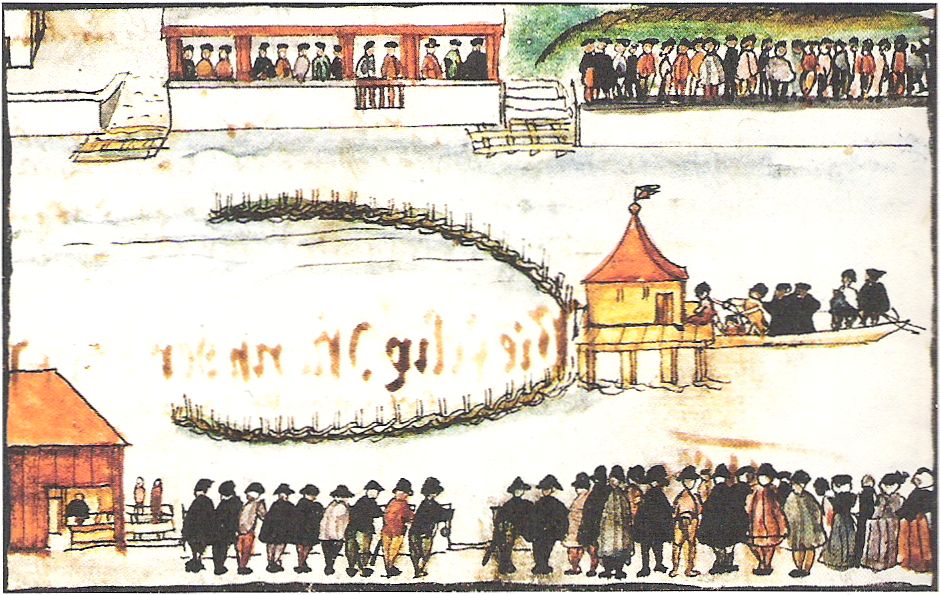
On January 5 Felix Manz was drowned. Which might seem like bad luck and maybe the occasion for a safety campaign. But I’m afraid it’s considerably more unpleasant than that. You see, he was drowned on purpose, in Zurich, on January 5 of 1527, as what I can only assume is a grimly ironic punishment for advocating and practising adult baptism.

Manz was an Anabaptist, part of an extreme wing of the Protestant Reformation, theologically speaking. Among other things they argued that infant baptism was just wetting a baby and that the ceremony could only have spiritual effect if performed on someone who understood it and did it willingly.

I grant that they could be annoying in a mild way, because they also tended to refuse to take oaths, defend the state or go along with civil authorities. They based this conduct on a very literal reading of the Sermon on the Mount and what strikes me as a wilful disregard of the injunction to render unto Caesar that which is rightly Caesar’s in this troubled and sinful world.

However that may be, Manz was not drowned for refusing to take an oath. He was drowned by the state because on March 7, 1526 the very Protestant Zurich council, whose members included the leading theologian Huldrych Zwingli whose ideas had a major influence on John Calvin, had declared adult rebaptism punishable by drowning. Which ought at least to dispel any notion that Protestants were better than Catholics on the topic of freedom of conscience and on separating Church and state. In fact Zwingli himself was killed in battle trying to force Protestantism on Catholic parts of Switzerland.

I’m not very sympathetic to Anabaptist doctrine or behavior in a lot of areas. I And I can see legitimate grounds for jailing people who will not pay a parking ticket because Jesus told them not to. But it’s the behaviour, not the belief, that matters, and it’s the behaviour of refusing to do something necessary to public order.

I don’t have freedom of conscience to run a red light or refuse to testify truthfully in court about seeing someone else do it. But holding a man under water until he dies for wanting to be held under water until God is happy is surely so grotesque that it’s hard to believe anyone would do it, let alone do it proudly.

Wish I'd said that - January 5, 2017

"There are few words which are used more loosely than the word 'Civilization.' What does it mean? It means a society based upon the opinion of civilians. It means that violence, the rule of warriors and despotic chiefs, the conditions of camps and warfare, of riot and tyranny, give place to parliaments where laws are made, and independent courts of justice in which over long periods those laws are maintained. That is Civilization— and in its soil grow continually freedom, comfort, and culture. When Civilization reigns, in any country, a wider and less harassed life is afforded to the masses of the people. The traditions of the past are cherished, and the inheritance bequeathed to us by former wise or valiant men becomes a rich estate to be enjoyed and used by all." Winston Churchill in 1938, quoted in Daniel Hannan Inventing Freedom: How the English-Speaking Peoples Made the Modern World

Never Darken My Altar Again – It Happened Today, January 3, 2017

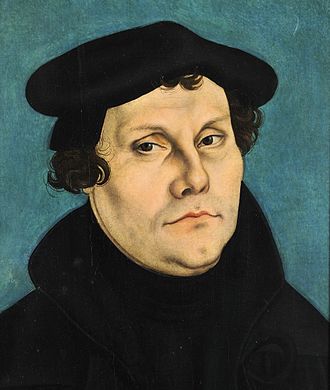
On this date in 1521, January 3, Martin Luther was excommunicated. And frankly it served him right.

Now perhaps this view might trigger controversy. In the modern world it might even "trigger" people, whatever that means. Many of them seem to be sprinklers or something. But the simple fact is that Luther’s teachings were, by 1521, incompatible with Roman Catholic doctrine.

The odd thing about many criticisms of Luther’s excommunication is that they seem to come from people whose ideas are also incompatible with Catholic doctrine. Which being the case, I don’t see why you’d want to be in communion with that particular church or to feel resentment that a person who rejected its views should be told in no uncertain terms not to darken the altar again.

To be sure, there was a major issue at the time to do with the entanglement of God and Caesar. The Roman Catholic Church was not "that particular church" in those days. It was "the church" and had a nasty habit of seeking to exert secular power very directly, grasping the wrist of the hand that held the sword. And I can find much to criticize in the secular and political consequences of being cast out of communion with it in 1521 in Germany. But to say so is not to say that the church ought not to have told people then, or that it ought not to tell them now, that there are certain core doctrines on which it is necessary to accept the official Vatican position if one wishes to take the communion wafer and wine in a Roman Catholic mass. The modern world being what it is, this point is often strangely obscured. For instance National Geographic asserts that "Months earlier, Luther had written a pamphlet criticizing many aspects of the church, including nepotism, corruption, and the sale of indulgences. Indulgences were grants that could be bought to allow the buyer to escape spiritual punishment for misdeeds. Luther had been warned that his views may lead to his excommunication, and refused to recant them." And it goes on to say that "In spite of his excommunication, Luther remained very popular. His outspoken belief in reform inspired the Reformation."

To some extent this canned version of Luther the brave dissenter is correct. And there was much to dislike about the manner in which the Catholic church conducted its affairs in those days, and in others. Indulgences in return for money were especially crass, and Luther took rightful aim at the alleged slogan "As soon as a coin in the coffer rings, a soul from purgatory springs." But these were corrupt practices not dogmas, which many Catholics strove mightily to reform within their own church, and with considerable success, in the wake of the "Reformation".

Luther went much further. In addition to rejecting many of the Catholic sacraments, he actually denounced to the whole notion of salvation through good works. And while the relationship between free will and grace is a very complicated doctrine on which many Protestants and Catholics are beginning to suspect they do not differ as greatly as they once thought, I consider pure predestination a loathsome doctrine that simply cannot be true as it reduces life to a cruel puppet show. Whether you agree or not, there is no room for argument that Catholicism insists on the efficacy of good works under some circumstances. In rejecting that idea, Luther rejected the church and not the other way around.

It should also be noted that while his views on the subject of church and state are complex to the point of apparent inconsistency, Luther’s theology led in practice and during his lifetime not to a separation of the two but to the establishment of Lutheran and other Protestant churches in those parts of German where the ruler was of such persuasion, and the enforcement of theological orthodoxy in a manner at least as ruthless as in areas that remained Roman Catholic. So on the main point on which he might receive interdenominational praise, for resisting the rendering unto Caesar of that which is God’s, he is by no means clearly or entirely innocent. He was also a gruesome anti-Semite although in that respect, alas, he again resembled the 16th-century Catholic church to the great discredit of both.

However that may be, the basic point remains. By 1521 Luther was not an orthodox Roman Catholic and he openly challenged the church not only on its unsavory practices but on its core doctrines. For that he was shown the cathedral door on Jan. 3, 1521, and rightly so.

They Crossed the Frozen Rhine – It Happened Today, January 2, 2017

Area settled by the Alemanni, and sites of Roman-Alemannic battles, 3rd to 6th centuries (Wikipedia) January 2nd was not a great day for the Roman Empire back in 366 AD. For on that date a Germanic tribe called the Alemanni crossed the frozen Rhine river. It wasn’t the first time they invaded the Empire nor the last. But it was part of an ominous movement of barbarians from east to west that overwhelmed the overstretched defences and led to the sack and "fall" of Rome.

In fact the Alemanni had been trouble for the Romans for centuries, manageable much of the time as barbarian ferment on the borders generally was. And to be fair the Romans had behaved badly toward the Alemanni on occasion as well as the reverse. But what strikes me as interesting here is the way this tribe rocketed across the stage of history and fell into the orchestra pit but somehow kept their name on the program.

You see, the Alemanni were given a pretty bad beating by the Franks under Clovis I in 496 AD in the squabbling over the ruins of Rome. And after exactly 250 years of Frankish rule they launched an uprising that didn’t work out well at all, with all their nobles executed. Which was pretty much the end of them except to linguists, who still talk about Alemanic dialects of High German in, for instance, Baden-Württemberg (which unless you’re German you had to Google it too). And, speaking of language, in the French word Allemagne which means, of course, Germany.

Now it is no secret that relations between the French and the Germans have not always been smooth. Indeed the common nickname "Boche" is a French word for "rascal" or perhaps something a bit stronger (and semi-literally means "cabbage head"). And then there’s "Hun" and so on. But the French to this day use the moniker of a violent and disruptive tribe for the entire nation of Germany.

Odd, really, given that "France" and "French" come from the Franks who were, uh, this Germanic tribe who came west and… Oh well. There was a lot of that going on at the time. And in fact the Franks were on the side of the Romans more often than not and in a very real sense could and did claim to be the heirs of the Roman Empire rather than its conquerors, including founding the Holy Roman Empire under Charlemagne.

So the Franks did better overall than the Alemanni even if the European country they named got rather the worse of recent contests with the latter despite getting Alsace back after World War I which includes part of by now very historic Alemannia. But I suppose the Alemanni might be happy to know that although crushed and dispersed, they are not entirely forgotten and their name is still spoken with a mixture of apprehension and grudging respect almost 1,300 years after that unfortunate uprising and nearly 750 years since even the duchy of Alemannia went away.