"There was no good in telling everybody he met that he was a prince, for he felt that a prince ought to be able to get on like other people, else his rank only made a fool of him. He had read of princes setting out upon adventure; and here he was out in similar case, only without having had a choice in the matter. He would go on, and see what would come of it." George MacDonald, At the Back of the North Wind
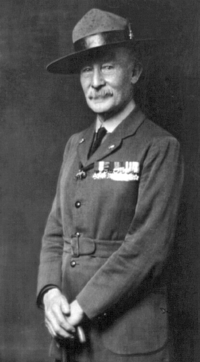 On January 24 of 1908, in what does seem a vanished era of tranquility and earnestness, Robert Baden-Powell organized the first Boy Scout troop. But those days were not as tranquil as they seem, the Boy Scouts and Girl Scouts are still enormously popular, and the mission of forming character is not as obsolete as some might suppose.
To begin with, Baden-Powell formed the Scouts in the wake of the (Second) Boer War, which had proved far more challenging for the British army than anticipated and which concluded less than a decade and a half before the outbreak of World War One. During the conflict then-Colonel Baden-Powell became a hero for his successful conduct of the defence of Mafeking, aided by the Mafeking Cadet Corps formed by Lord Edward Cecil.
Deeply impressed by the Corps, Baden-Powell wrote Scouting for Boys, based on his earlier Aids to Scouting, a brief guide to military scouting and wilderness survival that, he noticed, was exceptionally popular with boys. A huge success, currently the fourth best-selling book of all time, its tone might seem outdated. But the spirit of self-reliance, duty and cheerfulness it inculcated clearly helped Britain and Canada win World War I.
The scouts have changed enormously since 1908, mostly in good ways. Baden-Powell’s sister Agnes created the Girl Guides just two years later (after a group of girls showed up at the first Scout Rally in 1909 in uniform and informed Baden-Powell they were the "Girl Scouts," a commendable exhibition of initiative that evidently struck "B-P" as he is sometimes known as favourably as it does me. Agnes also created the Brownies (originally Rosebuds) for younger girls while Baden-Powell’s wife took over as president of the Girl Guides in 1920.
Among other changes, the uniform has been adapted over many decades for greater practicality as well as a not necessarily beneficial greater casualness. And at least some branches have dropped God from their pledge. But while one must I suppose move with the world, not too far or too fast. And sometimes one must stand against the world.
So it is worth reading the words of Baden-Powell, then nearly 80, at the Scouts’ 1937 World Jamboree, in the shadow of Hitler in a world in which racial prejudice was taken to be so normal one faced ostracism for not sharing it. The Scout uniform, B-P declared proudly, "hides all differences of social standing in a country and makes for equality; but, more important still, it covers differences of country and race and creed, and makes all feel that they are members with one another of the one great brotherhood".
Surely that surprisingly modern sentiment casts a different and more favourable light on the supposedly stuffy, naïve, chauvinistic and even jingoistic "stiff upper lip" tally ho chaps ambiance of Edwardian England. Just as the scouts’ methods for promoting self-reliance and cooperation simultaneously is strikingly up-to-date for something from that vanished era.
So here’s a confession. I have never read Scouting for Boys. But I think I’m the worse for it, and intend to track down a copy.
"Human nature demands ritual everywhere. Abolish your ritual, and you get an inferior ritual. Destroy your impressive ceremony, and all you get in return is an unimpressive ceremony." G.K. Chesterton in Illustrated London News March 17, 1906, quoted in Gilbert! Vol. 6 #3 (December 2002)
"The hatchet was buried, but the handle was still visible." A news story about George W. Bush meeting with Bill Clinton in the Ottawa Citizen December 20, 2000
"I never said it was always wrong to enter fairyland. I only said it was always dangerous." Father Brown in G.K. Chesterton "The Sins of Prince Sardine"
"He can be compelled, who does not know how to die." Seneca
"There are two kinds of people in politics: those who want to be somebody, and those who want to do something." An adage often cited by European Community founder Jean Monnet among others
"Take away the supernatural and what remains is the unnatural." G.K. Chesterton in Heretics