"The form of government based on representation, which now gives the political life of the whole civilized world its peculiar character, goes back in its historic origin to the medieval Estates-system of government." Otto Hintze in Bertie Wilkinson The Creation of Mediaeval Parliaments
 On this date in history, Feb. 1 Taiwan was conquered by China. Which is worth noting because the current regime in Beijing dreams of a replay.
It’s also therefore worth noting that it happened as recently, historically speaking, as 1662. And that it required a nine-month siege and was followed by a far from smooth process of filling the island with mainlanders and driving the original inhabitants into the hills or assimilating them.
Some Chinese might nevertheless take pride in the successful 1662 invasion since it took Taiwan back from the Dutch East India Company which could hardly claim to be indigenous and which was unpopular in part at least for suppressing local traditions like head-hunting. But it does not establish as an incontrovertible tenet of international law or morality that China and Taiwan must always be one country.
Now it is also true that since the Chinese conquest, the island was essentially taken over by mainlanders, the aboriginals now being about 2% of the population. But the key point is that the claim that Taiwan has always been part of China is untrue.
It was not part of China before 1662, nor after 1895 when Japan took it. Which I’m not excusing, especially given the aggressive intolerance of Imperial Japan. But I am pointing out that only for 333 years from the 17th to the 19th centuries, and a further four between the defeat of Japan in the Second World War and the ousting of the Chinese Nationalists from the mainland in 1949, was Taiwan part of China.
If you take the semi-Wilsonian view that nations must be ethnically pure to avoid war, and that all members of a given ethnicity ought to be members of a single nation, then it makes sense that Taiwan and China should be reunited. Ideally, I would say, under the democratic free enterprise government of the former rather than the Communist tyrants in Beijing. And they might legitimately be unified it if is the will of the inhabitants of both established in successful referendums. But otherwise the desire of one big country to swallow another smaller one is aggression even if the people of the bigger country are generally for it. And if you do not subscribe to the ethnic purity theory of nationhood, there is no real logic to the argument that Taiwan and China must be one country so it’s OK to do it by force.
That Communists falsify history to justify military adventurism does not qualify as such logic should go without saying. These days apparently it has to be said anyway.
 On January 31 of 1801, lame-duck U.S. President John Adams appointed John Marshall Chief Justice of the Supreme Court. Such appointments often backfire; Eisenhower would later bitterly regret elevating Earl Warren to Marshall’s old job. And at the time it was largely seen through the partisan lens of Adams’ effort to stack the judiciary against his hated rival Thomas Jefferson. But it turned out to be one of the greatest appointments in American history.
Adams had originally offered the job to another leading member of what was fast becoming the Federalist party, John Jay. But Jay turned it down partly on the grounds that the Supreme Court had insufficient "energy, weight, and dignity." Which might sound like a weird thing to say given the importance of the judiciary in the American system of checks and balances. But it was in fact not clear in 1801 that the Court was an equal branch or that it could, in fact, invalidate statutes as unconstitutional.
It was Marshall himself, whose skilful and congenial guidance included changing the practice of each judge issuing his own opinion to the presentation of a majority or even unanimous consensus, who made the Court what it has been since. And the critical turning point was Marbury v Madison in 1803 in which a unanimous Court struck down portions of the Judiciary Act of 1789 as unconstitutional.
It was, interestingly, the only time in his 35 years as Chief Justice that the Marshall Court declared an Act of Congress unconstitutional. And it was one whose practical impact pleased the incumbent President and Congress even though they were Jeffersonian Republican foes of the Federalist Party, which probably helped it avoid becoming a focus for partisan wrangling. But however that may be, it was a crucial step in the evolution of the American system to the point that one prominent constitutional scholar declared that only when Marshall finished reading the court’s opinion in Marbury v Madison was the Grand Convention that wrote the Constitutional entirely adjourned.
As for John Adams, who spent a long and productive life in service of his country, he later said "My gift of John Marshall to the people of the United States was the proudest act of my life." It may also have been his most effective.
"Despotism may be able to do without faith, but freedom cannot." Alexis de Tocqueville, Democracy in America
A story in The B.C. Catholic describes my Jan. 14 speech to POGG Canada upholding freedom, including freedom of speech, as a founding Canadian principle. P.S. If you're interested in booking me for a speaking engagement contact Robert Abrams at Big Idea Speakers Bureau or email me at jr- at – johnrobson – dot – ca.
 With the 100th anniversary of Canada's great victory at Vimy Ridge fast approaching, I'm delighted to announce that the book version of my documentary The Great War Remembered is now available for purchase.
The First World War was the defining event of the 20th century, shaping the modern world in ways we still feel very strongly today. Modern technology and logistics created unprecedented slaughter, and partly as a result the long, bitter, bloody conflict undermined faith in Western civilization. But it was a necessary war and the Allies did win it, with pivotal contributions from Canada, which "found itself" in the war and especially at Vimy, not just as a nation, but as a free nation determined to defend liberty under law.
It is appropriate that we remember the costs of the war and lament the loss and the missed opportunities. But we should also remember, and celebrate, the determined spirit that stood up to aggression on behalf of a way of life well worth defending even at this terrible cost.
Order your copy today and take a timely, fresh look at an often misunderstood conflict central to the modern world.
p.s. American and international shoppers should purchase directly through Amazon.
p.p.s. We also have the Kindle version available, here.
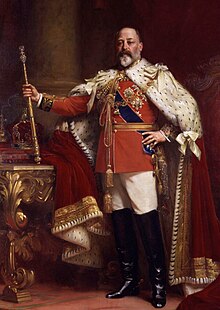 On this date in 1901, Edward VII was proclaimed king after about a million years as Prince of Wales. OK, not a million. But 60. Then he became king because Victoria died which left almost everybody heartbroken. And in 1910 he died after eight years on a throne he waited decades for.
His reign was not entirely uneventful. Nor indeed was his Princeship of Wales. Evidently "Bertie", as his family always called him, had a very good time indeed as heir to the throne, with actresses, noblewomen and professionals including at a Paris establishment with custom furniture now on display in a museum, which definitely did not amuse his mother, including the bit where he was almost named as respondent in a divorce suit by an MP and did have to testify in the case.
Victoria blamed her husband Albert’s rising from his sickbed in 1861 to visit and reprimand his son over a singularly indiscreet indiscretion with an actress for causing Albert’s death from typhoid just two weeks later, and once wrote to Edward’s older sister that "I never can, or shall, look at him without a shudder." But Edward also pioneered royal appearances doing things like opening the Thames Embankment and the Tower Bridge.
As King he not only presided over a widening of the social circle around the royals and a refurbishing of public ceremonies, and a needed modernization of the army and navy following the Boer War. He also supported and promoted a far-sighted rapprochement with France while distrusting his cousin Kaiser Wilhelm II, and gave his name to a languid but elegant era in which Britain’s decline from its once-unchallenged world dominance military, economic and cultural seemed only a gentle hint borne on a breeze rippling the leaves on stately oaks and beeches lining manor drives.
Then he died fairly young at 68, more than slightly unthin, and is remembered today as who was that guy after Victoria that wasn’t still king when the Great War started? To which the answer, surprisingly, is also that he was the guy saved from then generally fatal appendicitis right before his coronation by a pioneering and surprisingly modern-sounding surgical procedure of draining pus through a small incision.
 As a result of the "Affair of the Placards," six Protestants were burned at the stake in front of Notre Dame Cathedral in Paris on January 21, 1535. And while it’s fashionable to mock those WWJD bracelets as cloyingly sentimental, there are worse questions you could ask yourself. Especially if you’re, you know, a Christian cleric or would-be governmental defender of the faith.
When I say this grisly execution happened "as a result of" the Affair of the Placards, it might be more precise to say it happened afterward and on the ostensible basis of it. The Affair itself was the scandalous posting of a series of aggressive protestant posters in Paris and other French cities denouncing the Catholic mass. They were intended to be offensive, and it worked. But the total number of people killed during their production and display was zero. Not even the King of France.
Here I say "not even" because one of the placards was actually put on his bedroom door in Ambois. It was not merely an affront but a pointed demonstration that had they chosen to they could have gone in and killed him. But they did not, nor did they try to. So he responded with a big public show of affirming his Catholic faith, reversed his earlier policy of trying to protect French Protestants from their more aggressive Catholic countrymen.
Bear in mind that France was dangerously riven by religious sentiment at this point, and a very great distance indeed from any real conception of separation of Church and State. Indeed they still have issues with it, being militantly secular. (I know it has been said that atheism is a religion in the same sense that not collecting stamps is a hobby. But I disagree. Atheism offers equally firm answers to the same full range of metaphysical questions, and to enforce it through the state is not religious neutrality.) So I have to ask two key questions.
First, did either side gain anything by being deliberately obnoxious? I grant the Protestant grievance at being silenced on theological questions and living in perpetual fear of extreme mob violence. (In the wake of the Placards a number of leading Protestants pre-emptively fled France including John Calvin.) But to have posted reasonable comments on the advantages of free discussion of religion would have been a better move, surely, than to put up something highly likely to provoke Catholics into measures that further inflamed feelings in ways that reduced the likelihood of their acting with genuine charity.
As for the Catholics, to respond with extra-legal violence and state murder could not have been better calculated to reinforce their non-co-religionists’ worst suspicions about their motives and the need to arm against them. So everybody lost, and France spiraled into religious wars, intolerance and intellectual stagnation.
Among those who lost most, surely, are the self-proclaimedly Catholic king and the clergy who said there’s probably nothing Jesus would like better, nothing he’d be more likely to do if he were here, than to destroy some fellow human beings as horribly, painfully and messily as possible right at our best church. Oh yeah. I’m sure that’s in the Sermon on the Mount somewhere.