Posts in Constitution
New York Inc. – It Happened Today, February 2, 2017

On February 2, 1653, New Amsterdam was incorporated. What a great story.

Huh? Does it lack the steamy drama we have come to demand? Even if we know, from the song Istanbul or elsewhere, that New Amsterdam was later renamed New York City which, if you like big cities, remains one of civilization’s jewels? Well, let me try to defend this admittedly un-bodice-ripper-like choice of theme.

I have commented before on the stunning military, economic and cultural imbalance between Western Europe and the rest of the world by 1500 that led a speck of land like the Netherlands become a global empire. (No offense to the Dutch; I actually mean it as a compliment. But nobody looking at the Netherlands and India in 1450 would have thought the former would start picking off bits of the latter within two centuries including fighting Portugal for them.) But there’s more, or rather, there’s a side to the story that helps explain why the imbalance was so enormous. And it’s precisely the incorporation of municipalities with genuine legal rights and "liberties" in places like England and the Netherlands.

New Amsterdam itself was founded as a political entity, unsurprisingly, in 1625. It was the seat of the colonial government of New Netherland. But the "factorij" outside the fort, though protected by and closely associated with it, was a private venture. As were earlier Dutch ventures including in what would later be Albany and, not coincidentally, the various early English colonies from Massachusetts Bay to Jamestown. Indeed, New Netherland itself was originally a private venture of a sort Emperors and Tsars would not tolerate or keep their plundering hands off if they prospered.

By the way, you’ve all heard of the infamous purchase of Manhattan for 60 guilders or 24 Spanish dollars from a Lenape Indian chief who supposedly did not know what the cunning Europeans were up to. It casts a rather different light on that hackneyed tale of naivety and perfidy to learn that at the time the island was apparently mostly in the hands of a rival band. So chief Seyseys shrewdly swindled the Dutch by selling them someone else’s land.)

It was still a small settlement, under 300 people in the 1640s. Life was hard and survival uncertain. But people do things the way they think proper even in adversity, and hence in 1653 New Amsterdam became a city with, crucially, municipal rights. Not just duties. Not paper promises. Real genuine legal guarantees of their right to make decisions and live with the consequences without sudden arbitrary deprivation. (Not entirely coincidentally, the first Jews seem to have arrived in 1654.) Two years later, on September 15, 1655, a massive Indian attack destroyed farms and killed around 100 people while carrying off another 150. But the colony rebounded.

After a bunch of rhubarb New Amsterdam of course wound up in the hands of the English and later the Americans. But in the big picture there is far more similarity than difference in how the Dutch and English treated their citizens and their political and economic rights, namely with respect. And it gave their nations, and their settlements, a dynamism not found elsewhere.

Had New Amsterdam been New Moscow, New Teheran or New Beijing we would not be having this discussion. Which is a major reason it wasn’t.

China and Taiwan Become One Briefly – It Happened Today, February 1 2017

On this date in history, Feb. 1 Taiwan was conquered by China. Which is worth noting because the current regime in Beijing dreams of a replay.

It’s also therefore worth noting that it happened as recently, historically speaking, as 1662. And that it required a nine-month siege and was followed by a far from smooth process of filling the island with mainlanders and driving the original inhabitants into the hills or assimilating them.

Some Chinese might nevertheless take pride in the successful 1662 invasion since it took Taiwan back from the Dutch East India Company which could hardly claim to be indigenous and which was unpopular in part at least for suppressing local traditions like head-hunting. But it does not establish as an incontrovertible tenet of international law or morality that China and Taiwan must always be one country.

Now it is also true that since the Chinese conquest, the island was essentially taken over by mainlanders, the aboriginals now being about 2% of the population. But the key point is that the claim that Taiwan has always been part of China is untrue.

It was not part of China before 1662, nor after 1895 when Japan took it. Which I’m not excusing, especially given the aggressive intolerance of Imperial Japan. But I am pointing out that only for 333 years from the 17th to the 19th centuries, and a further four between the defeat of Japan in the Second World War and the ousting of the Chinese Nationalists from the mainland in 1949, was Taiwan part of China.

If you take the semi-Wilsonian view that nations must be ethnically pure to avoid war, and that all members of a given ethnicity ought to be members of a single nation, then it makes sense that Taiwan and China should be reunited. Ideally, I would say, under the democratic free enterprise government of the former rather than the Communist tyrants in Beijing. And they might legitimately be unified it if is the will of the inhabitants of both established in successful referendums. But otherwise the desire of one big country to swallow another smaller one is aggression even if the people of the bigger country are generally for it. And if you do not subscribe to the ethnic purity theory of nationhood, there is no real logic to the argument that Taiwan and China must be one country so it’s OK to do it by force.

That Communists falsify history to justify military adventurism does not qualify as such logic should go without saying. These days apparently it has to be said anyway.

Here Come the Judge – It Happened Today, January 31, 2017

On January 31 of 1801, lame-duck U.S. President John Adams appointed John Marshall Chief Justice of the Supreme Court. Such appointments often backfire; Eisenhower would later bitterly regret elevating Earl Warren to Marshall’s old job. And at the time it was largely seen through the partisan lens of Adams’ effort to stack the judiciary against his hated rival Thomas Jefferson. But it turned out to be one of the greatest appointments in American history.

Adams had originally offered the job to another leading member of what was fast becoming the Federalist party, John Jay. But Jay turned it down partly on the grounds that the Supreme Court had insufficient "energy, weight, and dignity." Which might sound like a weird thing to say given the importance of the judiciary in the American system of checks and balances. But it was in fact not clear in 1801 that the Court was an equal branch or that it could, in fact, invalidate statutes as unconstitutional.

It was Marshall himself, whose skilful and congenial guidance included changing the practice of each judge issuing his own opinion to the presentation of a majority or even unanimous consensus, who made the Court what it has been since. And the critical turning point was Marbury v Madison in 1803 in which a unanimous Court struck down portions of the Judiciary Act of 1789 as unconstitutional.

It was, interestingly, the only time in his 35 years as Chief Justice that the Marshall Court declared an Act of Congress unconstitutional. And it was one whose practical impact pleased the incumbent President and Congress even though they were Jeffersonian Republican foes of the Federalist Party, which probably helped it avoid becoming a focus for partisan wrangling. But however that may be, it was a crucial step in the evolution of the American system to the point that one prominent constitutional scholar declared that only when Marshall finished reading the court’s opinion in Marbury v Madison was the Grand Convention that wrote the Constitutional entirely adjourned.

As for John Adams, who spent a long and productive life in service of his country, he later said "My gift of John Marshall to the people of the United States was the proudest act of my life." It may also have been his most effective.

The Great War Remembered - and printed

With the 100th anniversary of Canada's great victory at Vimy Ridge fast approaching, I'm delighted to announce that the book version of my documentary The Great War Remembered is now available for purchase.

The First World War was the defining event of the 20th century, shaping the modern world in ways we still feel very strongly today. Modern technology and logistics created unprecedented slaughter, and partly as a result the long, bitter, bloody conflict undermined faith in Western civilization. But it was a necessary war and the Allies did win it, with pivotal contributions from Canada, which "found itself" in the war and especially at Vimy, not just as a nation, but as a free nation determined to defend liberty under law.

It is appropriate that we remember the costs of the war and lament the loss and the missed opportunities. But we should also remember, and celebrate, the determined spirit that stood up to aggression on behalf of a way of life well worth defending even at this terrible cost.

Order your copy today and take a timely, fresh look at an often misunderstood conflict central to the modern world.

p.s. American and international shoppers should purchase directly through Amazon.

p.p.s. We also have the Kindle version available, here.

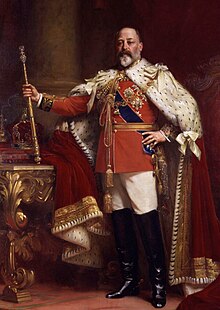
King Edward the Old – It Finally Happened Today, January 22, 2017

On this date in 1901, Edward VII was proclaimed king after about a million years as Prince of Wales. OK, not a million. But 60. Then he became king because Victoria died which left almost everybody heartbroken. And in 1910 he died after eight years on a throne he waited decades for.

His reign was not entirely uneventful. Nor indeed was his Princeship of Wales. Evidently "Bertie", as his family always called him, had a very good time indeed as heir to the throne, with actresses, noblewomen and professionals including at a Paris establishment with custom furniture now on display in a museum, which definitely did not amuse his mother, including the bit where he was almost named as respondent in a divorce suit by an MP and did have to testify in the case.

Victoria blamed her husband Albert’s rising from his sickbed in 1861 to visit and reprimand his son over a singularly indiscreet indiscretion with an actress for causing Albert’s death from typhoid just two weeks later, and once wrote to Edward’s older sister that "I never can, or shall, look at him without a shudder." But Edward also pioneered royal appearances doing things like opening the Thames Embankment and the Tower Bridge.

As King he not only presided over a widening of the social circle around the royals and a refurbishing of public ceremonies, and a needed modernization of the army and navy following the Boer War. He also supported and promoted a far-sighted rapprochement with France while distrusting his cousin Kaiser Wilhelm II, and gave his name to a languid but elegant era in which Britain’s decline from its once-unchallenged world dominance military, economic and cultural seemed only a gentle hint borne on a breeze rippling the leaves on stately oaks and beeches lining manor drives.

Then he died fairly young at 68, more than slightly unthin, and is remembered today as who was that guy after Victoria that wasn’t still king when the Great War started? To which the answer, surprisingly, is also that he was the guy saved from then generally fatal appendicitis right before his coronation by a pioneering and surprisingly modern-sounding surgical procedure of draining pus through a small incision.