In my new video for Canadians for Energy East, a project of the Economic Education Association of Alberta, I explain why Energy East is the right practical answer to the actual choices we face in energy policy in Canada.
"There are few words which are used more loosely than the word 'Civilization.' What does it mean? It means a society based upon the opinion of civilians. It means that violence, the rule of warriors and despotic chiefs, the conditions of camps and warfare, of riot and tyranny, give place to parliaments where laws are made, and independent courts of justice in which over long periods those laws are maintained. That is Civilization— and in its soil grow continually freedom, comfort, and culture. When Civilization reigns, in any country, a wider and less harassed life is afforded to the masses of the people. The traditions of the past are cherished, and the inheritance bequeathed to us by former wise or valiant men becomes a rich estate to be enjoyed and used by all." Winston Churchill in 1938, quoted in Daniel Hannan Inventing Freedom: How the English-Speaking Peoples Made the Modern World
 Yes, it’s Aethelred time again. But I’m not going to heap scorn on him this time, just anxiety. Because I have a different Aethelred in mind than my usual target, the weakly villainous Aethelred II "the Unready" who ruled England unsteadily and even intermittently for the disastrously long period from 978-1013 and again from 1014-16.
Today it’s Aethelred I "of Wessex" who ruled frantically from 865 to 871 and is chiefly remembered today for… nothing, because he isn’t remembered at all. But if he were, it would be for being the brother of Alfred the Great. This Aethelred was the fourth son of king Aethelwulf of Wessex and the third son of Aethelwulf to rule Wessex (following Aethelbald and Aethelbert and yes, these are pretty cool names once you get past the strangeness and the opening diphthong) in this desperate period during which the Danes seemed to be overwhelming English civilization.
Indeed, a great Viking army had hit England the same year Aethelred took the throne and it had destroyed the major kingdoms of Northumbria and East Anglia before turning their sights and swords on Mercia and then in 870 Wessex. And Aethelred himself was badly beaten by the Danes in the Battle of Reading on January 4, 871, regrouped to win at Ashdown but got walloped again at Basing and Meretun in the spring before dying shortly after Easter.
The logical sequel would be Alfred’s own defeat and the perishing of the Anglo-Saxon-Jute order in England, barbaric in its origins but thoroughly Christian and surprisingly civilized by the 9th century. It would be like the gradual disintegration of Arnor and the crumbling of the successor fragments of Rhudaur, Cardolan and Arthedain in the backstory to The Lord of the Rings (and for better or worse, I didn’t have to Google them before writing that sentence; I even spelled them correctly from memory) as the virtue and power of the Numenorians waned in Middle Earth. And not surprisingly, given Tolkien’s scholarly background in Anglo-Saxon history.
Instead a miracle happened hardly less improbable than the victory of the good guys in Tolkien’s epic. Which again is not surprising given Tolkien’s metaphysics. But as we celebrate the great heroes like Alfred and the great villains like the other Aethelred boo hiss, we should also remember those valiant figures like the first Aethelred or, fictionally, Theodred, who fight a valiant losing battle that helps, in however small a way, to buy time and space for the unlikely great victories to follow.
They are no less noble for having been less fortunate, and nobody can know when they dare draw sword against a mighty foe whether they will be Alfred the Great or Aethelred the Forgotten. Nor should they weigh the matter long when duty calls.
"You cannot legislate the poor into freedom by legislating the industrious out of it. You don’t multiply wealth by dividing it. Government cannot give anything to anybody that it doesn’t first take from somebody else. Whenever somebody receives something without working for it, somebody else has to work for it without receiving. The worst thing that can happen to a nation is for half of the people to get the idea they don’t have to work because somebody else will work for them, and the other half to get the idea that it does no good to work because they don’t get to enjoy the fruit of their labor." Adrian Pierce Rogers in his 1996 Ten Secrets for a Successful Family (frequently misattributed online, incidentally)
In my latest National Post column I express shock at people's wish to be shocked, and at where they do and don't go to satisfy this weird desire.
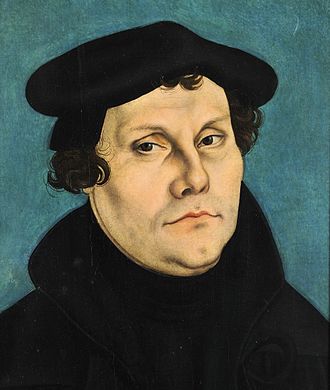 On this date in 1521, January 3, Martin Luther was excommunicated. And frankly it served him right.
Now perhaps this view might trigger controversy. In the modern world it might even "trigger" people, whatever that means. Many of them seem to be sprinklers or something. But the simple fact is that Luther’s teachings were, by 1521, incompatible with Roman Catholic doctrine.
The odd thing about many criticisms of Luther’s excommunication is that they seem to come from people whose ideas are also incompatible with Catholic doctrine. Which being the case, I don’t see why you’d want to be in communion with that particular church or to feel resentment that a person who rejected its views should be told in no uncertain terms not to darken the altar again.
To be sure, there was a major issue at the time to do with the entanglement of God and Caesar. The Roman Catholic Church was not "that particular church" in those days. It was "the church" and had a nasty habit of seeking to exert secular power very directly, grasping the wrist of the hand that held the sword. And I can find much to criticize in the secular and political consequences of being cast out of communion with it in 1521 in Germany. But to say so is not to say that the church ought not to have told people then, or that it ought not to tell them now, that there are certain core doctrines on which it is necessary to accept the official Vatican position if one wishes to take the communion wafer and wine in a Roman Catholic mass. The modern world being what it is, this point is often strangely obscured. For instance National Geographic asserts that "Months earlier, Luther had written a pamphlet criticizing many aspects of the church, including nepotism, corruption, and the sale of indulgences. Indulgences were grants that could be bought to allow the buyer to escape spiritual punishment for misdeeds. Luther had been warned that his views may lead to his excommunication, and refused to recant them." And it goes on to say that "In spite of his excommunication, Luther remained very popular. His outspoken belief in reform inspired the Reformation."
To some extent this canned version of Luther the brave dissenter is correct. And there was much to dislike about the manner in which the Catholic church conducted its affairs in those days, and in others. Indulgences in return for money were especially crass, and Luther took rightful aim at the alleged slogan "As soon as a coin in the coffer rings, a soul from purgatory springs." But these were corrupt practices not dogmas, which many Catholics strove mightily to reform within their own church, and with considerable success, in the wake of the "Reformation".
Luther went much further. In addition to rejecting many of the Catholic sacraments, he actually denounced to the whole notion of salvation through good works. And while the relationship between free will and grace is a very complicated doctrine on which many Protestants and Catholics are beginning to suspect they do not differ as greatly as they once thought, I consider pure predestination a loathsome doctrine that simply cannot be true as it reduces life to a cruel puppet show. Whether you agree or not, there is no room for argument that Catholicism insists on the efficacy of good works under some circumstances. In rejecting that idea, Luther rejected the church and not the other way around.
It should also be noted that while his views on the subject of church and state are complex to the point of apparent inconsistency, Luther’s theology led in practice and during his lifetime not to a separation of the two but to the establishment of Lutheran and other Protestant churches in those parts of German where the ruler was of such persuasion, and the enforcement of theological orthodoxy in a manner at least as ruthless as in areas that remained Roman Catholic. So on the main point on which he might receive interdenominational praise, for resisting the rendering unto Caesar of that which is God’s, he is by no means clearly or entirely innocent. He was also a gruesome anti-Semite although in that respect, alas, he again resembled the 16th-century Catholic church to the great discredit of both.
However that may be, the basic point remains. By 1521 Luther was not an orthodox Roman Catholic and he openly challenged the church not only on its unsavory practices but on its core doctrines. For that he was shown the cathedral door on Jan. 3, 1521, and rightly so.
In my latest National Post column I argue that while history doesn't repeat, its lessons do... especially for those not paying attention. (Due to an editing mishap, at the end of the 3rd paragraph, between the sentence ending "great and small." and the one beginning "Regrettably, as with...", the sentence "But I am sure we’re not going to fight World War One again." was omitted.)
"what Milton Friedman called TANSTAAFL – 'There ain’t no such thing as a free lunch.'" William C. Mitchell and Randy T. Simmons, Beyond Politics: Markets, Welfare, and the Failure of Bureaucracy