 On January 26 of 1924 the Soviet government renamed the former St. Petersburg "Leningrad." It was an ominous move though not as ominous as moving the capital to Moscow on March 12 1918, a dramatic symbol of its rejection of Russia’s always uneasy membership in Western civilization. But it also led to one of those great jokes Soviet oppression engendered.
By way of background, the tsars had already changed the somewhat Germanic-sounding "St. Petersburg” to Petrograd (Петроград) on the outbreak of World War I. So after World War II, the authorities are processing all sorts of displaced persons and the bureaucrats ask this somewhat baffled old guy "Where were you born?" "St. Petersburg." "Where did you live before the Revolution?" "Petrograd." "Where did you live before the Great Patriotic War?" "Leningrad." "Where do you want to live now?" "St. Petersburg."
Sadly, had he been younger and lived a long life he might have got his wish insofar as Leningrad was renamed St. Petersburg in 1991. But the spirit of openness and affiliation with the West that had never been sufficiently embraced before 1914, including by the towering Peter the Great himself, was neither understood nor accepted after the fall of Communism particularly by the Russian political elite. Under Putin in particular it’s still really Leningrad and the capital is still in the inward-looking Moscow not Russia’s window on Europe and the free world beyond.
It’s a great pity, for the Russian people and for us.
In my latest National Post column I argue that Justin Trudeau's recent refusal to answer an English question in English "since we're in Quebec" is neither an innocent mistake nor a harmless reflex.
 To return to the topic of weddings that bring tears to your eyes, and again a royal one, would you cry if the king insisted on marrying you without telling anyone? Or might you just flee instead?
I have a feeling Anne Boleyn did neither on November 14, 1532 when she tied the knot surreptitiously with the dreadful Henry VIII. Anne was clearly in over her head, an ominous phrase in this context. But the young woman (we aren’t sure how young; she may have been born in 1501 or 1507) appears to have been a clever and confident schemer who wrongly thought she knew exactly what she was doing.
They were publicly married on January 25, 1533, leading to a ruckus of which you may have heard. The new Archbishop of Canterbury Thomas Cranmer, formerly the Boleyn family chaplain, declared the marriage null and void on May 23 of that year and, five days later, mysteriously changed his mind. Henry VIII could do that to you.
And to himself; when Anne proved unable to give him male heirs he had her convicted of high treason, as well as adultery and incest and perhaps witchcraft, by a jury that included her own uncle who lived to tell the tale largely, one suspects, because she did not (along with five men framed as her lovers). Cranmer then conveniently realized Anne’s marriage had been invalid after all. Gosh.
Henry had married Anne secretly because the Pope was still trying to figure out whether to annul his marriage to Catherine of Aragon. (And when it became public excommunications flew.) So he wanted to have things both ways. And Anne ought to have realized that when Henry VIII thinks he’s using you and you think you’re using him, he’s right.
So I don’t have a lot of wedding advice to offer women other than don’t make the bridesmaids wear seafoam green. (They don’t have to look awful for you to look nice and nobody will ever wear that outfit again.) But I would urge you to reject any suitor who proposes that you marry him and move into his bed without mentioning it to anybody.
Especially, and I cannot stress this too strongly, if his surname is Tudor and his title is King.
A story in The B.C. Catholic describes my Jan. 14 speech to POGG Canada upholding freedom, including freedom of speech, as a founding Canadian principle. P.S. If you're interested in booking me for a speaking engagement contact Robert Abrams at Big Idea Speakers Bureau or email me at jr- at – johnrobson – dot – ca.
 With the 100th anniversary of Canada's great victory at Vimy Ridge fast approaching, I'm delighted to announce that the book version of my documentary The Great War Remembered is now available for purchase.
The First World War was the defining event of the 20th century, shaping the modern world in ways we still feel very strongly today. Modern technology and logistics created unprecedented slaughter, and partly as a result the long, bitter, bloody conflict undermined faith in Western civilization. But it was a necessary war and the Allies did win it, with pivotal contributions from Canada, which "found itself" in the war and especially at Vimy, not just as a nation, but as a free nation determined to defend liberty under law.
It is appropriate that we remember the costs of the war and lament the loss and the missed opportunities. But we should also remember, and celebrate, the determined spirit that stood up to aggression on behalf of a way of life well worth defending even at this terrible cost.
Order your copy today and take a timely, fresh look at an often misunderstood conflict central to the modern world.
p.s. American and international shoppers should purchase directly through Amazon.
p.p.s. We also have the Kindle version available, here.
In my latest National Post column I argue that the unsettling nature of free enterprise is also the key to its success.
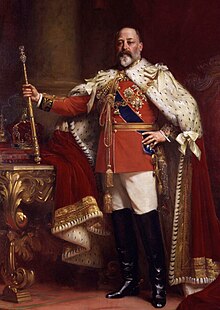 On this date in 1901, Edward VII was proclaimed king after about a million years as Prince of Wales. OK, not a million. But 60. Then he became king because Victoria died which left almost everybody heartbroken. And in 1910 he died after eight years on a throne he waited decades for.
His reign was not entirely uneventful. Nor indeed was his Princeship of Wales. Evidently "Bertie", as his family always called him, had a very good time indeed as heir to the throne, with actresses, noblewomen and professionals including at a Paris establishment with custom furniture now on display in a museum, which definitely did not amuse his mother, including the bit where he was almost named as respondent in a divorce suit by an MP and did have to testify in the case.
Victoria blamed her husband Albert’s rising from his sickbed in 1861 to visit and reprimand his son over a singularly indiscreet indiscretion with an actress for causing Albert’s death from typhoid just two weeks later, and once wrote to Edward’s older sister that "I never can, or shall, look at him without a shudder." But Edward also pioneered royal appearances doing things like opening the Thames Embankment and the Tower Bridge.
As King he not only presided over a widening of the social circle around the royals and a refurbishing of public ceremonies, and a needed modernization of the army and navy following the Boer War. He also supported and promoted a far-sighted rapprochement with France while distrusting his cousin Kaiser Wilhelm II, and gave his name to a languid but elegant era in which Britain’s decline from its once-unchallenged world dominance military, economic and cultural seemed only a gentle hint borne on a breeze rippling the leaves on stately oaks and beeches lining manor drives.
Then he died fairly young at 68, more than slightly unthin, and is remembered today as who was that guy after Victoria that wasn’t still king when the Great War started? To which the answer, surprisingly, is also that he was the guy saved from then generally fatal appendicitis right before his coronation by a pioneering and surprisingly modern-sounding surgical procedure of draining pus through a small incision.