Can you kick in?

MamaKata2 Hi folks,

With 10 days to go, Brigitte and I are asking for your help to get her "Not Just for Kicks" project across the finish line. I know a lot of you have supported our bigger projects, for which we're very grateful. And we'll have another one in the spring that I hope you'll think is worthwhile. And a number of you are supporting us with monthly donations that are also much appreciated.

So now I'm asking people who enjoy our work but haven't yet backed it to put something into Brigitte's project. She's over 2/3 of the way to her $1,500 target to help her make a book and video about her and our daughter's journey to the WKC world karate championships in Dublin, Ireland, about the hard work, the sense of achievement and the victories over fatigue and fear. But we still need $400.

Can 80 people kick in $5 each in the next week and a half and make it happen?

Thanks.

The bad news is, you're on fire anyway

On August 20 of 1308, Jacques de Molay was formally absolved of heresy by Pope Clement V. Which seems kind of nice given the tangled bad feelings between the Grand Master of the Knights Templar and the Roman Pontiff, who had dissolved his order a year earlier partly because Philip IV of France was deeply in debt to the Templars and naturally figured that if he could just, you know, grab all their cash he’d be a much richer if not necessarily a better man. Uh, except for the bit where Philip had de Molay burned for heresy anyway.

Did I mention that Philip’s nickname “the Fair” pertained to the colour of his hair not his moral conduct? (Yes, on July 31.) He was also called “the Iron king” though in this case “the red hot Iron king" might have been more appropriate. He did not have de Molay burned all at once and not instantly, to be sure. He had him tortured in 1307, along with many other Templars, as a result of which they confessed to whatever to make it stop, giving Clement the rationale to dissolve the order and Philip to dissolve their bank accounts.

After that things get a bit obscure as well as bloody. Apparently the Pope and the King agreed to split the court proceedings that resulted from De Molay recanting his forced confession. And during the subsequent investigation into the crucial question whether the Templars denied Christ and Philip could get all their money, the king had 54 of them burnt at the stake in 1310.

De Molay and a few others were kept in a mouldy jail cell, from which they were dragged on March 18, 1314 to be told that as heretics they would spend the rest of their lives in a mouldy jail cell. But to the wonderment of all, de Molay and Geoffroi de Charney, Master of Normandy for the Templars, staggered to their feet and said the only thing they were guilty of was a cowardly confession under torture to save their own hides at the expense of the Order. They said the Order was pure and holy and innocent, which led to the elaborate French legal proceeding of the king ordering them burnt immediately or rather, set on fire immediately and burnt slowly that very day.

They were, rejecting all offers of a pardon in return for retraction and managing to retain their composure within reason, thus earning themselves the status of martyrs and their charred bones were collected as relics.

Philip got the money though. And as for the Pope’s pardon, which you were wondering when I’d get to, regrettably it was discovered by an Italian paleographer named Barbara Frale in September 2001 in the Vatican Archives, at which point it was a bit late for de Molay’s secular prospects to perk up.

As for the other kind, surely the case gives one pause. Obviously it is not a great bargain to spend the rest of your life in a cell at the mercy of Philip the Fair in Name Only, and besides de Molay was 71 so he might have gotten out soon anyway. But for a man to whom torture was not just a word but a hideous personal reality, in the face of which he had once renounced all he believed in, to step forward a second time and risk among other things the humiliation of once again being unable to bear the pain is a very impressive act.

Who today might do such a thing? Not, one fears, those enjoying the loudest applause and most fulsome praise particularly from themselves. I suppose there have always been more willing to act the role of Philip the Fair or support it than Jacques de Molay. But I have little confidence that all the progress we congratulate ourselves on having experienced has improved that situation.

May we burn her?

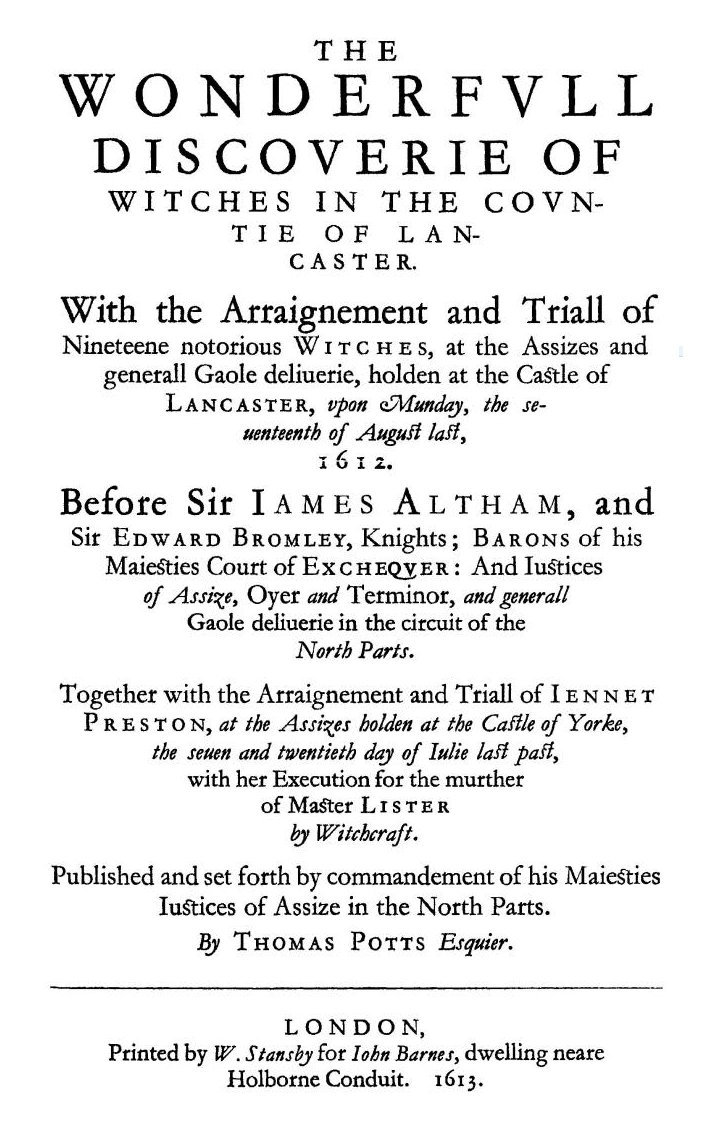
Ugh, witch trials. Gotta hate those Middle Ages, right? Like the one of the “Samlesbury Witches” held on August 19 of 1612 in Lancashire where…

Wait a minute. 1612? That’s not the Middle Ages. They weren’t just this bad period back then somewhere when people weren’t smart and kind like us. They were a very distinct period from either the Fall of Rome if you include the Dark Ages in them, or from around the 10th century if you don’t, down through about 1500 and then we had the “Renaissance” and the “Enlightenment” and after all that dumb superstition the lights came back on and classical knowledge and attitudes were reborn.

Remember?

Now there are a lot of things I could say about this view, like that it’s totally ridiculous. I have often cited Tony Blair’s foreign secretary Robin Cook saying that Slobodan Milosovic’s forces putting Albanians into concentration camps “belongs to the Middle Ages. It does not belong to modern Europe. We are right to fight it.” So you’re saying concentration camps were a feature of Edward I’s England not Stalin’s Soviet Union or Hitler’s Germany. And you learned your history where exactly?

The answer appears to be Aberdeen Grammar School, Royal High School and the University of Edinburgh where, to be fair, he studied English literature. But it sounds as though it could have been Monty Python and the Holy Grail. And since for many people it was, the prevalence of this “Terrible Middle Ages” idea makes it necessary to take it a bit more seriously in order to demolish it in detail.

Like they thought the Earth was flat ha ha ha. Elizabeth May recently ridiculed our “First Past The Post” electoral system by saying it was invented when “people thought the Earth was flat”. Except they didn’t. Indeed, John Sacrobosco’s best-selling Tractatus de Sphaera (he was so dumb he wrote in Latin which we would never do) presented not merely the doctrine that the Earth was round but several simple compelling proofs. I’d like to hear a typical modern student do that. (Since you ask, three of them are that stars rise and set sooner in eastern than western places, people in the northern hemisphere can always see some stars including the Pole Star that you can’t in the southern but you can see others and the list changes gradually as you travel south or north, and that as a ship sails away from shore, people on deck lose sight of land before those at the top of the mast. Clever, huh?)

Now let’s consider witches. They burned them in the Middle Ages because they were dirty dumb and religious, right? Uh, wrong again. The first explicitly attested witch trials were in the 14th century, but they really got going in the 16th and went over the top in the 17th. Remember Salem, the famous non-medieval outbreak? Even England, not as bad as France, Germany or Scotland, executed somewhere under 500 witches between the early 15th and the mid-18th century, versus a couple of hundred a year in Scotland in the late 16th century and what seems to have been thousands in Germany.) And evidently the upsurge in concern about witches in 17th-century England was partly the work of James VI/I, as if he needed more blots on his escutcheon; the first Stuart king of England was convinced Scottish witches were conspiring to harm him and in keeping with his not entirely fanciful self-conceit as an intellectual had written a book Daemonologie in 1597 justifying witch-hunting. Thanks, Jim.

Now in fairness I should note that the Samlesbury Witches were actually acquitted. (And that the infamous Spanish Inquisition took a very dim view of accusations of witchcraft.) But eleven other witches tried in the same Assizes were executed. And the last execution of a witch in England was in 1716, involving a woman and her nine-year-old daughter.

Thank goodness they didn’t live in the Middle Ages when the Catholic Church insisted that the faithful … not believe witches could fly. Unlike its Renaissance version which insisted they believe it.

Wish I'd said that - August 19, 2016

After being shipwrecked, Robinson “Crusoe might be driven to make his own trousers on the island. But he was not driven to make his own legs on the island… You may regard the universe as a wreck; but at least you have saved something from the wreck.” G.K. Chesterton in “The Idea of Separation” quoted in Gilbert Magazine Vol. 10 #5 (March 2007)

Famous quotesJohn Robson
The hardest day

My latest for The Rebel: https://www.youtube.com/watch?v=QsVyMvTdPgU

The audio-only version is available here: [podcast title="Rebel audio, August 18"]http://www.thejohnrobson.com/podcast/John2016/August/160818Rebel.mp3[/podcast]

History, PodcastJohn Robson