"Not everything that can be counted counts, and not everything that counts can be counted." Albert Einstein
 To return to the topic of weddings that bring tears to your eyes, and again a royal one, would you cry if the king insisted on marrying you without telling anyone? Or might you just flee instead?
I have a feeling Anne Boleyn did neither on November 14, 1532 when she tied the knot surreptitiously with the dreadful Henry VIII. Anne was clearly in over her head, an ominous phrase in this context. But the young woman (we aren’t sure how young; she may have been born in 1501 or 1507) appears to have been a clever and confident schemer who wrongly thought she knew exactly what she was doing.
They were publicly married on January 25, 1533, leading to a ruckus of which you may have heard. The new Archbishop of Canterbury Thomas Cranmer, formerly the Boleyn family chaplain, declared the marriage null and void on May 23 of that year and, five days later, mysteriously changed his mind. Henry VIII could do that to you.
And to himself; when Anne proved unable to give him male heirs he had her convicted of high treason, as well as adultery and incest and perhaps witchcraft, by a jury that included her own uncle who lived to tell the tale largely, one suspects, because she did not (along with five men framed as her lovers). Cranmer then conveniently realized Anne’s marriage had been invalid after all. Gosh.
Henry had married Anne secretly because the Pope was still trying to figure out whether to annul his marriage to Catherine of Aragon. (And when it became public excommunications flew.) So he wanted to have things both ways. And Anne ought to have realized that when Henry VIII thinks he’s using you and you think you’re using him, he’s right.
So I don’t have a lot of wedding advice to offer women other than don’t make the bridesmaids wear seafoam green. (They don’t have to look awful for you to look nice and nobody will ever wear that outfit again.) But I would urge you to reject any suitor who proposes that you marry him and move into his bed without mentioning it to anybody.
Especially, and I cannot stress this too strongly, if his surname is Tudor and his title is King.
A story in The B.C. Catholic describes my Jan. 14 speech to POGG Canada upholding freedom, including freedom of speech, as a founding Canadian principle. P.S. If you're interested in booking me for a speaking engagement contact Robert Abrams at Big Idea Speakers Bureau or email me at jr- at – johnrobson – dot – ca.
 With the 100th anniversary of Canada's great victory at Vimy Ridge fast approaching, I'm delighted to announce that the book version of my documentary The Great War Remembered is now available for purchase.
The First World War was the defining event of the 20th century, shaping the modern world in ways we still feel very strongly today. Modern technology and logistics created unprecedented slaughter, and partly as a result the long, bitter, bloody conflict undermined faith in Western civilization. But it was a necessary war and the Allies did win it, with pivotal contributions from Canada, which "found itself" in the war and especially at Vimy, not just as a nation, but as a free nation determined to defend liberty under law.
It is appropriate that we remember the costs of the war and lament the loss and the missed opportunities. But we should also remember, and celebrate, the determined spirit that stood up to aggression on behalf of a way of life well worth defending even at this terrible cost.
Order your copy today and take a timely, fresh look at an often misunderstood conflict central to the modern world.
p.s. American and international shoppers should purchase directly through Amazon.
p.p.s. We also have the Kindle version available, here.
"There was no good in telling everybody he met that he was a prince, for he felt that a prince ought to be able to get on like other people, else his rank only made a fool of him. He had read of princes setting out upon adventure; and here he was out in similar case, only without having had a choice in the matter. He would go on, and see what would come of it." George MacDonald, At the Back of the North Wind
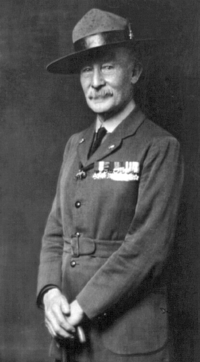 On January 24 of 1908, in what does seem a vanished era of tranquility and earnestness, Robert Baden-Powell organized the first Boy Scout troop. But those days were not as tranquil as they seem, the Boy Scouts and Girl Scouts are still enormously popular, and the mission of forming character is not as obsolete as some might suppose.
To begin with, Baden-Powell formed the Scouts in the wake of the (Second) Boer War, which had proved far more challenging for the British army than anticipated and which concluded less than a decade and a half before the outbreak of World War One. During the conflict then-Colonel Baden-Powell became a hero for his successful conduct of the defence of Mafeking, aided by the Mafeking Cadet Corps formed by Lord Edward Cecil.
Deeply impressed by the Corps, Baden-Powell wrote Scouting for Boys, based on his earlier Aids to Scouting, a brief guide to military scouting and wilderness survival that, he noticed, was exceptionally popular with boys. A huge success, currently the fourth best-selling book of all time, its tone might seem outdated. But the spirit of self-reliance, duty and cheerfulness it inculcated clearly helped Britain and Canada win World War I.
The scouts have changed enormously since 1908, mostly in good ways. Baden-Powell’s sister Agnes created the Girl Guides just two years later (after a group of girls showed up at the first Scout Rally in 1909 in uniform and informed Baden-Powell they were the "Girl Scouts," a commendable exhibition of initiative that evidently struck "B-P" as he is sometimes known as favourably as it does me. Agnes also created the Brownies (originally Rosebuds) for younger girls while Baden-Powell’s wife took over as president of the Girl Guides in 1920.
Among other changes, the uniform has been adapted over many decades for greater practicality as well as a not necessarily beneficial greater casualness. And at least some branches have dropped God from their pledge. But while one must I suppose move with the world, not too far or too fast. And sometimes one must stand against the world.
So it is worth reading the words of Baden-Powell, then nearly 80, at the Scouts’ 1937 World Jamboree, in the shadow of Hitler in a world in which racial prejudice was taken to be so normal one faced ostracism for not sharing it. The Scout uniform, B-P declared proudly, "hides all differences of social standing in a country and makes for equality; but, more important still, it covers differences of country and race and creed, and makes all feel that they are members with one another of the one great brotherhood".
Surely that surprisingly modern sentiment casts a different and more favourable light on the supposedly stuffy, naïve, chauvinistic and even jingoistic "stiff upper lip" tally ho chaps ambiance of Edwardian England. Just as the scouts’ methods for promoting self-reliance and cooperation simultaneously is strikingly up-to-date for something from that vanished era.
So here’s a confession. I have never read Scouting for Boys. But I think I’m the worse for it, and intend to track down a copy.
In my latest National Post column I argue that the unsettling nature of free enterprise is also the key to its success.
"He was ruled by a sense of duty, but one cannot touch tar without getting one’s hands dirty." John Lawrence, A History of Russia (re Felix Dzerzhinsky)